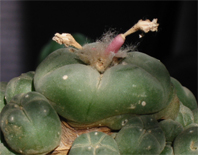
I’m growing my Lophophora plants for aesthetics, but I have to admit that the mescaline content and the traditional ceremonial use by Native Americans are fascinating aspects. Apparently peyote use is ancient; archaeological discoveries in caves and rock shelters in the lower Pecos River region, Texas indicate that peyote use dates thousands of years back.
Peyote buttons recovered from a rock shelter in the lower Pecos River region (photo reproduced from Boyd et al.)
Recently El-Seedi et al. subjected samples from two archaeological specimens of peyote buttons to radiocarbon dating and alkaloid analysis. The specimens were discovered in Shumla Cave No. 5 on the Rio Grande, Texas and now reside in the collection of the Witte Museum in San Antonio, Texas – see photo above. The peyote samples were dated to be in the time interval 3780–3660 BC, and the alkaloid yield was approximately 2% in both samples. The only peyote alkaloid that could be identified was mescaline, i.e. no traces of the other major peyote tetrahydroisoquinoline alkaloids like lophophorine, anhalonine, pellotine, and anhalonidine could be found.
The authors conclude “From a scientific point of view, the now studied ‘mescal buttons’ appears to be the oldest plant drugs which ever yielded a major bioactive compound upon phytochemical analysis. From a cultural perspective, our identification of mescaline strengthens the evidence that native North Americans already recognized and valued the psychotropic properties of the peyote cactus 5700 years ago.”
The ancient use of peyote is also supported by Boyd et al. who argue that Lower Pecos pictographs (found in the same area as the archaeological peyote specimens) can be seen as evidence for early peyotism.
References
Hesham R. El-Seedi, Peter A.G.M. De Smet, Olof Beck, Göran Possnert, Jan G. Bruhn (2005), “Prehistoric peyote use: Alkaloid analysis and radiocarbon dating of archaeological specimens of Lophophora from Texas”, Journal of Ethnopharmacology 101, 238–242
Carolyn E. Boyd, J. Philip Bering (1996), “Medicinal and hallucinogenic plants identified in the sediments and pictographs of the Lower Pecos, Texas Archaic”, Antiquity 70, 256-75
Monday, March 27, 2006
Prehistoric peyote use
Sunday, March 05, 2006
The genus Lophophora – Kaktusy Special 2, 2005: A Review
I just received the new Kaktusy Special monograph on Lophophora. It comprehensively describes the distribution, characteristics and classification of the genus. In an attempt to resolve some of the taxonomic confusion surrounding Lophophora the authors propose a division of the genus into two sections and a change of rank.
Based on factors like chemical composition, habitats, incompatibility of the species, rib numbers and morphology, etc, a division of the genus into the two sections Lophophora and Diffusae is proposed.
Section Lophophora comprises the various forms of the species L. williamsii including the type species (hence the autonym for the section).
Section Diffusae includes the three species related to L. diffusa, i.e. L. diffusa itself, L. fricii, and L. koehresii (aka L. diffusa v. koehresii, aka L. viridescens).
The authors argue convincingly for the taxonomic revision but it would have been interesting if the revision was supported by DNA sequencing results (like Butterworth et al. who confirmed that L. diffusa and L. williamsii are indeed distinct species).
The description for each species includes a detailed distribution map showing the range of the species. The booklet is packed with excellent habitat photos showing the plants natural growth forms (actually some of the very best habitat photos I’ve seen are included in this work – see examples below).
Left – Lophophora williamsii, Sierra de la Paila, Coahuila
Right – Lophophora diffusa, Peña Miller, Queretaro
The booklet is rounded of with a few notes on the cultivation of Lophophora.
The genus Lophophora is a comprehensive and long needed review of the genus. As mentioned it would have been great with DNA sequencing results supporting the change of rank for L. fricii and L. koehresii. Also an index and a list of literature references would have been helpful. That being said, The genus Lophophora must be recommended to anyone interested in these fascinating plants.
The booklet is written by Jaroslav Bohata, Vojtĕch Myšák, and Jaroslav Šnicer; it comprises 48 pages, contains 89 color photos, 3 black and white photos, and 6 drawings. It is available from the Society of Czech and Slovak Cactus and Succulent Growers. Apart from the English edition I believe German and Czech editions are published as well.
Update - March 21, 2006
I have to mention the review of the Genus Lophophora published in the latest edition of CactusWorld (the journal of the British Cactus and Succulent Society). According to the reviewer this work “boldly goes where no taxonomist has gone before” in the attempt at clarifying the systematics of Lophophora ;-)
Tuesday, February 28, 2006
Lophophora williamsii and Obregonia denegrii from seed
Today I sowed this years first batch of seeds - 30 each of:
- Lophophora williamsii (VM 305k; Sierra de la Paila, Coahuila)
- Lophophora williamsii (VM 183k; Hipolito, Coahuila)
- Obregonia denegrii v. prerovskyana nom. prov. (KMR 38; Cinco de Mayo, Tamaulipas)
Lophophora williamsii seedlings (RS 428A; Cuatro Ciénegas, Coahuila)
It's amazing that cactus seedlings can thrive for a year in the humid environment of a sowing bag (notice the green stuff among the seedlings - it's moss!), but it seems to become them well.
Lophophora diffusa seedlings (RS 1193; Peña Miller, Queretaro)
The benefits of growing in bags are many, e.g. you don't need to water often and most pests like red spider mites are avoided (on the other hand you have to be careful not to let in sciarid flies). On the downside, the plants seem slightly leggy - probably because they haven't been fully dormant throughout winter.
Wednesday, February 15, 2006
The power of grafting – VIII
My grafted Lophophora williamsii (SB 854; Starr Co, Tx) is growing its last fruit this season. The fruit looks ripe and fat so I'm hoping for lots of seeds even though the flower was self-pollinated.

Lophophora williamsii - ripe fruit
Yesterday I harvested the dried fruits produced by the plants second and third flower – both of these flowers were also self-pollinated (I didn’t have a whole lot of plants flowering last year ;-)

Lophophora williamsii - harvested fruits
The fruits are approximately 1 cm (~0.4'') long, only the upper half is containing seeds. The yield from these fruits, each contained 6 seeds, is much better than from the first fruit I harvested.

Lophophora williamsii - seeds
If the seeds are viable I hope to come full circle, growing new seedlings in less than two years after the mother plant was sown!
< previous | next >
Thursday, February 09, 2006
Strombocactus Carnage or: How I Opened the Bag and Let in Death by Sciarid Fly
Until lately my Strombocactus disciformis ssp. esperanzae seedlings were thriving and slowly growing in the safe and secluded environment of a plastic bag. Recently I checked the plants and found dried husks and seedlings without roots.
Strombocactus disciformis remains
When I opened the bag a couple of sciarid flies soared out. The soil was sterilized before use so I expect the flies must have entered one of the times I aired the bag.
Sciarid fly (fungus gnat)
Sciarid flies as such are not dangerous to the plant but their larvae will feed on root hairs, enter the roots or even attack the crown or stem of the plant. In the future I’ll take heed when airing my seedling bags and avoid organic material in the soil (the larvae of most species are scavengers, primarily feeding on decaying organic matter).
Today only one seedling is still alive and it is not doing well – the few seedlings surviving the attack also had to cope with the abrupt introduction to the harsh environment outside the bag (the soil had to dry out completely to kill off any remaining larvae).
Tuesday, January 31, 2006
Flowering Ariocarpus fissuratus var. hintonii
None of my Ariocarpi have flowered yet, but this video (1.1MB) of a flowering Ariocarpus fissuratus var. hintonii gives a good impression of what to expect. 
Flowering Ariocarpus fissuratus var. hintonii
More amazing videos of flowering cacti can be found at the Hydrocactus video page.
Wednesday, January 18, 2006
Variegated and cristate Lophophora
Many Thai nurseries are offering large selections of variegated and crested cacti. Unfortunately the Lophophora plants are quickly sold out so I haven’t obtained any yet. The photos below are courtesy of Deaw Cactus.

Lophophora williamsii crest (own root) – 13cm

Variegated Lophophora williamsii – 3.5cm

Variegated Lophophora williamsii v. caespitosa – 6cm
Tuesday, December 27, 2005
Lophophora williamsii v. caespitosa
I’m impressed. I found this photo of a humongous Lophophora williamsii v. caespitosa on the British Cactus and Succulent Society discussion forum.
Lophophora williamsii v. caespitosa
According to the forum this amazing plant was sown back in 1972, and is just one of a batch. Unfortunately it doesn’t say when the picture was taken.
Munching on Lophophora williamsii - II
My cold house grown Lophs have been maimed by some critter eating big, hearty lumps out of them. There are no traces of snails so I expect the culprit to be a grasshopper or bush-cricket trapped in the house.
Maimed Lophophora williamsii (SB 854; Starr Co, Texas)
Lophophora diffusa (JR; Higuerillas, Queretaro) remains
The plants above were sown May 1, 2004 and have grown in the cold house since. Some of this year’s Lophophora seedlings were also taken out by the “unwanted guest”.
I’ve wrapped the pots in horticultural fleece and hope this will keep the culprit out in the future.
Wednesday, December 21, 2005
Winter Solstice
Today is the Winter Solstice for 2005 - the Sun is now at its lowest declination in Northern Hemisphere skies. The Sun is returning; alas, (Northern) winter is just starting.
All Time Most Popular Posts
-
On various occasions I've been asked what growing media I'm using for my cactus plants. I don't have a set soil mix recipe as su...
-
Lophophora williamsii (peyote) populations have diminished in large areas of South Texas where peyoteros harvest the cactus for ceremonial ...
-
Below is a list of retailers/nurseries selling cactus seed and plants. I've only listed vendors I've done business with. If you ar...
-
Most cacti are easily grown from seed - and with a little patience and care they can be grown into beautiful plants. Lophophora williamsi...
-
In last month’s post on the troubled Texan peyoteros I referred to Anderson’s article on the peyote situation in Texas. Given the importanc...
-
Yet another slightly off topic and probably not entirely politically correct post, but I couldn’t help noticing the similarity of my monstr...
-
Flowering stand of San Pedro cacti (Trichocereus pachanoi) To me the main draw of the San Pedro cactus ( Trichocereus pachanoi (syn. Ech...
-
In the June 2008 issue of the Cactus & Co magazine Jaroslav Šnicer, Jaroslav Bohata, and Vojtěch Myšák described a new Lophophora spec...
-
There seems to be an increased focus on the alarming Texas peyote situation. A couple of weeks ago the Houston Press published a mournful, i...
-
I spent two weeks working in Delhi, India during January. I had one weekend off and had planned to spend it in Delhi at my own leisure, but ...