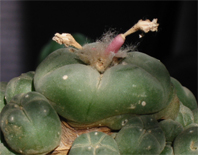
I've had a few Mammillaria meiacantha plants (SB 249; Bernalillo County, New Mexico) growing in my cold house for the last couple of years. The plants thrive and last spring they embarked on a flowering spree.
Mammillaria meiacantha flower
One of the traits Steve Brack mentions for these plants in his seed catalogue are their huge red fruits, so I hope I succeeded in pollinating the flowers and will see some fruits soon.
Flowering Mammillaria meiacantha
I bought these plants for my unheated greenhouse because of their extreme cold tolerance. Steve Brack classifies Mammillaria meiacantha as being safe easily to -10F (-23C). So these plants, if any, ought to be able to survive the cold snap that has engulfed Denmark in snow and almost constant (severe) frost for more than two months now.
Mammillaria meiacantha is also known as Mammillaria heyderi v. meiacantha.
Sunday, February 21, 2010
Flowering Mammillaria meiacantha
Saturday, February 20, 2010
Prickly Pear Cactus Candy
I have to get me a pound of prickly pear cactus candy the next time I’m in the US – if the candy is just half as great as the retro cardboard box, I’ll be in for a treat ;-)

Prickly Pear Cactus Candy
I haven’t been able to find an ingredients list, but one source says the cactus candy is made from the juice of the prickly pear and is an unusual but pleasant taste.
If you are the DIY kind of guy or gal the Opuntia Blog has a recipe for transforming Opuntia cladodes into candy – I would image that a candy based on the prickly pear fruit juice would be more delicious, though, but I have tasted neither.
Monday, February 15, 2010
Flowering Mammillaria grahamii
In the late spring of '09 I bought a handful of Mammillaria grahamii (SB 507; Dona Ana County, New Mexico) from Kakteen-Haage. A few months after receiving the plants they flowered vigorously.
Mammillaria grahamii flower
The all-pink petals and filaments are beautifully contrasted by the bright yellow anthers and the dusty chartreuse stigma. I cross-pollinated several of the flowers and hope for seeds next year.
Flowering Mammillaria grahamii
I bought the plants for my cold house as Mammillaria grahamii is said to be relatively cold hardy. If they survive the current cold snap I guess they can survive anything (in relation to Danish winters, that is ;-) The current freezing conditions have lasted since before Christmas with outdoor temperatures as low as -15 C (5 F) so I hope the plants are not frozen solid.
Hooked Mammillaria grahamii spine
Seeing the Mammillaria grahamii spines up close it is easy to understand why it is also called fish-hook cactus ;-)
Tuesday, February 09, 2010
Gymnocalycium calochlorum with fruit
I have only one Gymnocalycium calochlorum (Mina Clavero, Córdoba, Argentina) plant in my collection and it flowers freely every summer (I’m not sure if this should be put in the past tense as I’m uncertain if the plant survives this winter’s hard frost; the photos in this post are all from the summer of ‘09).
Gymnocalycium calochlorum with ripe, split fruit
The last time the G. calochlorum plant flowered I self-pollinated it and as the pictures show my efforts (as well as the plant ;-) bore fruit. My experience with Gymnocalycium is very limited and I don’t know if these plants in general are self-fertile – anyway, this one bore fruit and the coming spring will show if the seeds are actually any good.
G. calochlorum with ripe fruit and newly pollinated flower
I’m pretty certain that the seeds are the result of selfing – of course I can’t say for absolutely sure but I hand pollinated the flowers and none of the (very few) other gymnos in my collection were flowering at the time. Theoretically the seeds could be the result of some freak hybridization but that doesn’t seem very plausible, as most of the other cacti in my collection are of North American origin and not closely related to Gymnocalycium at all.
Gymnocalycium calochlorum fruit with exposed seeds
I pollinated two flowers that both set fruit. The last fruit is still growing on the plant.
Saturday, February 06, 2010
The stone flowers of the Taj Mahal
I spent two weeks working in Delhi, India during January. I had one weekend off and had planned to spend it in Delhi at my own leisure, but when the guys I worked with offered to take me to Agra and show me the Taj Mahal I off course promptly accepted.

The Taj Mahal
The Taj Mahal is one of the most famous buildings in the world. The magnificent white marble mausoleum is the tomb of Mughal empress Mumtaz Mahal, the favorite wife of Mughal emperor Shah Jahan. Mumtaz Mahal died in 1631 while giving birth to their 14th child and Shah Jahan commissioned the Taj Mahal as a monument and tomb for his beloved wife (and later of Jahan himself). So it’s understandable that the Taj is told in most tourist guides as a true monument to love, or “a teardrop on the face of time” as the British historian Michael Wood poetically phrases it.

South facade of the Taj Mahal
The Taj Mahal rises up on a marble platform that makes it seem to almost float in mid-air when observed from the entrance gateway of the complex. The precise proportions and strict symmetry of the structure are incredible to watch and permeate everything from the minarets and facades on the large scale to the floral motifs inlaid with stone on the small scale.

Floral motifs inlaid with stone above the south portal
The four facades of the tomb are identical and each has a grand portal, known as an iwan or pishtaq. Each portal is bordered by a rectangular frame decorated with inscriptions of verses from the Qur’an inlaid with black marble. The triangular spaces on either side of the point of the arch are decorated with carved arabesque and floral designs inlaid with semiprecious stones.

Decorated marble plinths inside the south portal
In Islamic culture flowers are often seen as symbols of Paradise; the kingdom of God. And stone flowers are everywhere at the Taj Mahal - flowers depicted with realism, yet with a soft lyricism that almost makes you forget they are carved in marble or inlaid with stone. And again the perfect symmetry is everywhere.
One can only admire the artisans who crafted these exquisite marble carvings; marble is a very hard stone to cut and they worked with large slabs of marble – in the above photo there goes 3 “plants” to one slab of marble. In case the craftsmen made just the smallest mistake they would have to ditch the whole slab and start from scratch.

Flower cut in marble, south portal

Floral designs inlaid with stone, south portal
As you enter the burial chamber of Mumtaz Mahal the floral motifs become even more pronounced and eminently detailed. Flowers – both cut and inlaid with stone – are absolutely everywhere. Photography is not allowed within the tomb, but I managed to “sneak in” a couple of (no flash) pictures while the guards were otherwise occupied (I hope taking pictures inside the tomb is not considered rude or bad taste – to my defense I’ll say that the Indian visitors also let loose and took lots of pictures while the guards were gone ;-)

Detailed floral pattern inlaid with stone, burial chamber
It has been said that the only discordant note in the Taj is, ironically enough, the tomb of Shah Jahan placed next to that of Mumtaz. The building was designed so that Mumtaz’s tomb would be its single centerpiece directly below the central dome in the octagonal burial chamber – Shah Jahan’s tomb breaks the symmetry that otherwise permeates the whole construction.

Inscriptions from the Qur’an inlaid with black marble

The main tomb building of the Taj Mahal
Four minarets sit at the corners of the square, raised marble platform that houses the main tomb building. Each slender, round tower is made of white marble, outlined in inlaid black stone, and includes a winding internal staircase leading up to its gallery (which is no longer used to call the faithful to prayer, though)

Minaret at the Taj Mahal
If you have the chance, seeing the Taj Mahal is a must – its ethereal, sad beauty will silence even the most cynical of world travelers.
As a foreigner visiting the Taj Mahal be prepared for a massive difference in entrance fees, though – I paid 750 INR while my Indian friend had to pay only 20 INR. I understand why this is done but I don’t like the signal it’s sending. Maybe I’m just grumpy but after many visits to India I’m growing weary of the ubiquitous (and often professional) beggars and hustlers that seem to think that westerners are walking ATMs that will dispense cash on demand, and it makes me sad to see that even the official India, in this case represented by the Archaeological Survey of India, condones this view.

Tickets to the Taj Mahal
I just watched Michael Wood’s The Story of India and new discoveries apparently suggest that the design of the Taj Mahal might go back to Sufi saints – that the key to the Taj may be a mystic map of a Sufi’s dream, a map where different parts of the Taj Mahal complex represents different elements of the judgment day.

Monkeys at Agra Fort
It has absolutely nothing to do with the Taj Mahal, but I couldn’t resist posting this photo of a couple of monkeys living at the nearby Agra Fort. The monkeys seem to be seriously contemplating if they really need to adhere to the directives on the sign – or if they instead should be frolicking on the lawn, tearing off leaves and eating flowers.
Tuesday, January 05, 2010
Cactus art: Double Cactus / Doppelkaktus
I recently got in contact with the German artist Klaus Weber who works with cacti (among other things) in an artistic context.

Double Cactus by Klaus Weber
Klaus would like to exhibit a Double Cactus in New York, i.e. a piece consisting of two San Pedro (Trichocereus pachanoi) plants grafted together to form one, mirrored plant similar to the ones pictured in this post. Unfortunately Klaus has encountered problems with bringing the plant(s) into the US from Germany and consequently he is looking for a US resident who can help him recreate the grafted cactus piece “in situ”. If you (or anybody you know) are a skilled grafter with the inclination to collaborate with Klaus on creating a Double Cactus in the states, please get in touch with me.

Another Double Cactus
I'm especially infatuated with the last picture – the cacti that sort of grow into each other, reflected in the mirror they sit on, go perfectly with the pillar that transcends smoothly from the “actual” world into the reality behind the looking glass.
The pictures are used with the kind permission of Klaus Weber.
Saturday, January 02, 2010
The Lophophora blog turns 5
Five years ago today, this blog started out with a humble test post. 
The blog was started in frustration over the limited amount of meaningful information about Lophophora online. It was originally conceived as a Lophophora/peyote only blog, but early on (beginning with the first post, one could argue ;-) the blog segued into a more general cactus blog, covering especially smaller Mexican species. Lately a few pieces of non-cactus related flotsam and jetsam have also drifted onto the blog, but the main focus will not swerve from cacti in general and the Lophophora genus specifically.
I hope the blog has met its objectives and provided the reader with (at least a few bits of ;-) relevant information on the Lophophora genus.
Seeing the initial test post again reminds me that I have loads of pictures from my visit to the Joshua Tree National Park that I would like to share – maybe in a future post ;-)
Tuesday, December 29, 2009
The killing frost
The fact that the last many winters have been mild in Denmark has made me act with presumption, ignoring several basic rules for growing cacti in freezing conditions. The week before Christmas Denmark was hit by an early cold spell, bringing hard frost that made many of my coldhouse grown plants suffer the consequences of my folly.
Frozen Lophophora williamsii (SB 854; Starr Co, Texas)
The family spent the Christmas holidays in the summerhouse arriving late December 21, the day of the winter solstice. Of course I had to check up on my plants in the coldhouse first thing, but was met by a disheartening sight: The beautiful turgid, dark jade green Lophophora williamsii plants pictured above are frozen solid.
Lophophora williamsii draped in horticultural fleece
The greenhouse walls are covered with curtains and the plants are draped in horticultural fleece to protect them from the cold, still the temperature was measured to slightly less than -7 C (~ 19 F) just next to the plants. The temperature alone shouldn't be a problem as these plants have endured conditions in the coldhouse since 2004 (actually these very plants started my experiments in Lophophora cold hardiness so I'm double sad to loose them), but freezing conditions combined with plants that haven't had the time to go flaccid before subjected to the frost is a deadly cocktail. I'm sad to admit that I watered the above Lophophora williamsii plants along with a couple of Gymnocalyciums and two large pots of 3 year old L. williamsii seedlings very late in the season (late September). To make things worse October and November came with a perpetual overcast sky and constant, high humidity levels, leaving the plants no chance to dry out thoroughly. Finally, to top things off, December brought very early and double digit freezing temperatures (measured in celsius) killing off the plants still bloated with water. I have learned my lesson and will never water any of my coldhouse plants later than the end of August (the exception being very young seedlings that might otherwise succumb to drought).
Thawed Lophophora williamsii (SB 854; Starr Co, Texas)
Come Boxing Day the frost went away, leaving me with thawing plants and the possibility to asses the damage – unfortunately I had to leave for home the day after, so the exact casualty figures will follow in a later post.
The thawed Lophophora williamsii plants pictured above felt soft and slightly mushy to the touch but I didn't have the heart to squish them to see if they were fluid inside.
Thawed Lophophora williamsii seedlings
The two large pots of 3 year old Lophophora williamsii seedlings are gone for sure. Upon thawing the seedlings first felt like small bags of slush ice before the interior turned completely fluid. Subjected to a light pressure the epidermis broke and liquid oozed out, indicating that the cell walls are lacerated by the frost.
Frost killed Lophophora diffusa
Another mistake I made was to move new plants into the coldhouse without leaving them sufficient time to acclimatize properly for the winter – the plants were moved to the coldhouse in late September/early October. On that account I lost 3 large Lophophora diffusa like the one pictured above.
As is evident from the flaccid (and very much alive) L. diffusa pictured below, these plants are able to survive the cold conditions if treated properly. The two plants are from the same batch, are growing under the same conditions (and the pictures were taken the same day). The only difference being that the survivor was given proper time to adjust to its harsh environment.
Alive Lophophora diffusa
I also recently introduced a handful of new Ariocarpus plants to the coldhouse – they had me somewhat worried but seem to cope. 
Frost damaged Penis Cactus
My last mistake was to leave a collection of columnar cacti out on the terrace until mid October, exposing them to precipitation and moisture for much longer than what's healthy for plants that must winter in freezing conditions. This has taken its toll on my formerly so erect Penis Cactus - I'm not sure if the plant is completely killed off by the frost but it is certainly damaged. I'm worried for the rest of my Trichocereus collection also; many of the plants felt completely frozen to the touch but are not showing any evident signs of damage yet – time will tell, though.
The lesson I have learned from this experience is to always expect the worst from the weather and prepare accordingly (which should have been evident in the first place!). Even if the last many winters have been mild, I should have known that frost can set in suddenly and quite early in Denmark – instead of being lulled into the assumption that most of the winter would be mild with hard frost arriving late, as the situation has been the last few years. I won't be that careless in the future.
After a couple of mild days the weather reports again predict a period of hard, day- and nighttime, frost extending into the new year.
Update, April 11, 2010
Read more about the casualties and survivors of the frost.
Tuesday, December 15, 2009
Flowering Ariocarpus kotschoubeyanus var. macdowellii

Flowering Ariocarpus kotschoubeyanus var. macdowellii
As mentioned in an earlier post I'm fairly inexperienced when it comes to growing Ariocarpus and still in the process of building a collection of these fascinating plants. A few months ago I bought a handful of plants from Mesa Garden including three Ariocarpus kotschoubeyanus var. macdowellii plants (SB 100; El Pilar, Coahuila).
I didn't really expect the plants to bloom this season but mid-September one of them greeted me with a beautiful, pale purple flower, so large that it completely covered the plant.
Ariocarpus kotschoubeyanus var. macdowellii flower, top view
I'm growing the plants in an unheated greenhouse in Denmark and specifically selected this variety of Ariocarpus kotschoubeyanus as it comes from the northern extreme of the species' range. The Living Rocks website has the following to say on A. kotschoubeyanus var. macdowellii:
The northern populations are characterized by a form, which has become known as A. kotschoubeyanus var. macdowellii, this is found to the west and east of Parras with a range of over 100km from Viesca to Estatcion Marte in Coahuila. A. kotschoubeyanus var. macdowellii is a smaller plant than the type, with small beak-like tubercles and pale mauve flowers, often with a high white content in the outer petals.
If the macdowellii plants survive the winter in the cold house I'm probably also going to test the larger, magenta flowered, southern form of the species, Ariocarpus kotschoubeyanus var. elephantidens.

Ariocarpus kotschoubeyanus var. macdowellii flower bud
I'm growing the plants in a greenhouse at my summerhouse and can't check in on them on a regular basis, so it felt like a stroke of luck when I was met by a budding A. kotschoubeyanus var. macdowellii one late Friday evening in the middle of September. The next day the plant was in full bloom as illustrated by the pictures above. In early October one of the other macdowellii plants also developed a bud, but unfortunately I didn't see it flower.
Regarding cold hardiness, the A. kotschoubeyanus var. macdowellii plants are going to be tested sooner than expected. Denmark has a cold spell coming and the weather report shows temperatures below -10 C (14 F) within the next few days.
Sunday, November 08, 2009
Lophophora williamsii f. cristata (crested / fasciated peyote cactus)

Lophophora williamsii f. cristata, top view
Last Sunday I went on a shopping spree and ordered some Lophophora alberto-vojtechii seeds from Köhres and a Lophophora williamsii f. cristata plant from Cactus Plaza.

Crested Lophophora williamsii, front view
The crested L. williamsii arrived yesterday without a scratch and looks exactly as advertised with a length of 4.2 cm and grafted on a Trichocereus pachanoi stock; the width of the crest is 2.5 cm.

Lophophora williamsii f. cristata, side view
I have never grown fasciated Lophophora before and look forward to follow the plant in the years to come. I'm particularly curious to see if the fasciation also affects the flowers or if they develop normally.

Fasciated Lophophora williamsii, the other front
I'm happy as can be with my new acquisition while “She Who Must Be Obeyed” gently shakes her head in silent disbelief ;-)

Crested Lophophora williamsii grafted on Trichocereus pachanoi stock
All Time Most Popular Posts
-
On various occasions I've been asked what growing media I'm using for my cactus plants. I don't have a set soil mix recipe as su...
-
Lophophora williamsii (peyote) populations have diminished in large areas of South Texas where peyoteros harvest the cactus for ceremonial ...
-
Below is a list of retailers/nurseries selling cactus seed and plants. I've only listed vendors I've done business with. If you ar...
-
Most cacti are easily grown from seed - and with a little patience and care they can be grown into beautiful plants. Lophophora williamsi...
-
In last month’s post on the troubled Texan peyoteros I referred to Anderson’s article on the peyote situation in Texas. Given the importanc...
-
Yet another slightly off topic and probably not entirely politically correct post, but I couldn’t help noticing the similarity of my monstr...
-
Flowering stand of San Pedro cacti (Trichocereus pachanoi) To me the main draw of the San Pedro cactus ( Trichocereus pachanoi (syn. Ech...
-
In the June 2008 issue of the Cactus & Co magazine Jaroslav Šnicer, Jaroslav Bohata, and Vojtěch Myšák described a new Lophophora spec...
-
There seems to be an increased focus on the alarming Texas peyote situation. A couple of weeks ago the Houston Press published a mournful, i...
-
I spent two weeks working in Delhi, India during January. I had one weekend off and had planned to spend it in Delhi at my own leisure, but ...