Wednesday, February 27, 2008

Mescaline on the Mexican Border

There seems to be an increased focus on the alarming Texas peyote situation. A couple of weeks ago the Houston Press published a mournful, in-depth article on the vanishing peyote populations and the implications to the Native American Church.

The inside of a peyote button tastes like a dirty raw potato, with a jalapeño backbite

The article features interviews with two (out of three remaining!) peyoteros, Mauro Morales and Salvador Johnson, describing their increasing problems in finding peyote due to root-plowing, over-collection and fencing of land for hunting.


"There's some medicine, right there," he [Mauro Morales] says. It's a lone peyote button, about an inch in diameter, way too small to harvest. It'll be another five years before this peyote is mature. As he navigates the hostile flora, he points to three more small peyote plants, all of them too young to cut.

"I used to collect as much in a week as I now do in a month," he says. "I don't know what's going to happen to the medicine."

Morales almost never utters the word "peyote." For him, the small green-gray cactus is a sacrament with miraculous healing powers, hence his word for it: ­medicine.

What makes peyote different from just about any other cactus in the world is that it naturally produces mescaline, a psychedelic alkaloid that can induce hallucinations lasting for days.

Cactus stickers and the occasional rattlesnake are all in a day's work for Mauro Morales when he goes hunting for peyote

Salvador Johnson used to be a full-time peyotero, but guiding hunting trips pays better these days

To protect against poachers getting in and deer getting out ranchers are increasingly fencing and patrolling their grounds. The ranchers' hands-off policy represents a dilemma for Martin Terry, the world's leading authority on peyote. On the one hand, protection against peyoteros will conserve the cactus. On the other, it prevents Indians from getting access to their sacred plant.


"From the point of view of the plant, the only threat is overharvesting," he says. "The fences and personnel that protect ranch lands from would-be harvesters are the very opposite of a threat, as the protected populations of peyote inside those fences are the only healthy ones in South Texas."

Still, Terry is sensitive to the peyoteros and their way of life. He considers Mauro Morales a personal friend. He wants to make sure that Indians have access to their cactus, but that's getting harder and harder.

The whole situation seems more and more like a gordian knot in dire need of a bold solution. The available natural peyote populations in Texas are over-harvested and not given time to replenish. At the same time many NAC members are opposed to cultivating the plant. One possible solution could be to import peyote from Mexico where the plants are still plentiful; but that might at the same time export the peyote conservation crises!

You can read more on the Texas peyote situation in these posts: The “Peyote Gardens” of South Texas: a conservation crisis?, Troubled times for Texas peyote harvesters, and In Deep South Texas, peyote harvest dwindling.

The full Houston Press article and related videos are available here: Mescaline on the Mexican Border, Video: Two Peyoteros on the Mexican Border, Video: Peyote, Breakfast of Champions, and Video: Peyote in Real de Catorce

Saturday, January 19, 2008

The “Peyote Gardens” of South Texas: a conservation crisis?

In last month’s post on the troubled Texan peyoteros I referred to Anderson’s article on the peyote situation in Texas. Given the importance of this work, I saw it fit to bring it here in its full length - unfortunately I only have an old scan of the article, so the photos are a bit muddled but here goes...


The "Peyote Gardens" of South Texas: a conservation crisis?

Cactus & Succulent Journal 67(2): 67-73 (1995)

Edward F. Anderson
Desert Botanical Garden,
1201 N. Galvin Parkway,
Phoenix, AZ 85008


More than a quarter of a million Native Americans use the peyote cactus (Lophophora williamsii) (Fig. 1) as a sacrament in a Pan-Native American religion called the Native American Church. This bona fide religion includes Native Americans from throughout the United States and Canada. Almost all of the peyote consumed in their ceremonies comes from the "peyote gardens" on the Mustang Plains in south Texas, which has been carefully documented by Morgan (1976, 1983) and by Morgan and Stewart (1984). Federal and Texas laws permit the collecting and use of peyote by Native Americans in their religious ceremonies.
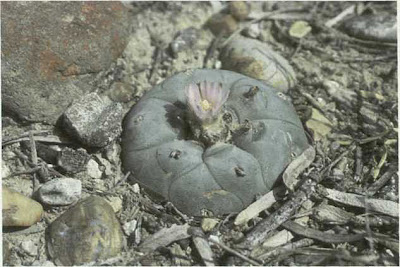
Fig. 1 - Peyote (Lophophora williamsii) in habitat on Las Islas Ranch, Starr County, Texas
Fig. 1 - Peyote (Lophophora williamsii) in habitat on Las Islas Ranch, Starr County, Texas.

The origins of the Native American Church are complex, and the reader can refer to detailed accounts of how the modern peyote religion arose in the late nineteenth century through the influences of traditional Native American ceremonies and Christianity in both Mexico and the United States (Anderson, 1980; Stewart, 1989). This paper describes the long relationship of Hispanic "peyoteros" in south Texas and members of the Native American Church, as well as the impact of many years of collecting peyote tops or "buttons" within the Tamaulipan Thorn Shrub vegetation. Many report that the peyote populations are greatly diminished in size (Morgan and Stewart, 1984; Jerry Patchen, pers. comm.; Salvador Johnson, pers. comm.; Jackie Poole, pers. comm.). Is the continued collecting of the plant for religious purposes leading to a serious conservation problem? Will peyote continue to be available to Native Americans in the foreseeable future?

I recently had the opportunity to return to south Texas, where I had collected and studied peyote populations more than 30 years ago. I met Hispanic peyoteros, visited their drying sites, and talked with leaders of the Native American Church. I also examined a peyote site, where plants had reportedly been harvested about five years earlier.

Peyote has a broad distribution throughout most of northern Mexico and across the Rio Grande into Texas (Anderson, 1980). Though peyote occurs in west Texas near Big Bend National Park, the most extensive area within the U.S. is from the mouth of the Pecos River southward and eastward nearly to Brownsville. The main area in which peyote has been harvested commercially is within Starr, Jim Hogg, Webb, and Zapata counties, primarily along the western Bordas Escarpment, the Aguilares Plain, and the Breaks of the Rio Grande (Morgan and Stewart, 1984). Over 90% of this land is privately owned and well-fenced.
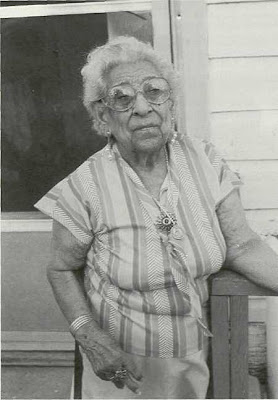
Fig. 2 - Amada Cardenas, an Hispanic peyotero, who has collected peyote for Native Americans since 1933
Fig. 2 - Amada Cardenas, an Hispanic peyotero, who has collected peyote for Native Americans since 1933.

Hispanic peyoteros and some Native Americans have harvested peyote within this region for more than 100 years. Until the 1960's the main area for collecting the plant was in the more northern part, mostly in Webb County in the vicinity of Mirando City. In fact, the first peyoteros worked out of a small community just to the south of Mirando City called Los Ojuelos. Abandoned many years ago, the small town is now being rebuilt. Hispanic peyoteros and Native Americans developed a strong relationship, which has persisted to the present. The home of Amada Cardenas (Fig. 2), who is the oldest living peyotero, is located at the edge of Mirando City. It has become an important religious site for Native Americans who visit the area, with peyote meetings held in either a hogan or tipi. Amada, now 90 years old, was born in Los Ojuelos and became a peyotero in 1933. She is known to most Native Americans as "Mom"; often she provides Road Chiefs (church leaders) with especially fine specimens of peyote (Fig. 3) to serve as "Father Peyote" in the ceremonies they lead. Peyote growing in her garden is also highly revered (Fig. 4). She and the other peyoteros in the northern part of peyote country primarily sell dried peyote. More recently, peyoteros have operated in the more southern area around Rio Grande City; they deal mainly in fresh or "green" peyote, but dry some as well.

Fig. 3 - Especially large, fine peyote tops, which will be used as
Fig. 3 - Especially large, fine peyote tops, which will be used as "Father Peyotes" in religious ceremonies of the Native American Church.

Fig. 4 - Peyote growing in the garden of Amada Cardenas. Note the coins and corn-husk cigarette butts that have been left as 'offerings.'
Fig. 4 - Peyote growing in the garden of Amada Cardenas. Note the coins and corn-husk cigarette butts that have been left as "offerings."

Peyoteros must be licensed by the Texas Department of Public Safety and the Drug Enforcement Administration (DEA) of the federal government, paying annual fees of $5 and $400, respectively (Salvador Johnson pers. comm.; Jerry Patchen, pers. comm.). They must keep accurate records of how many pieces of peyote they harvest and sell each year. Responsible peyoteros lease the rights to collect peyote from the land owners, a typical lease costing $800-1000 for permission to work on a small ranch for 30 days (Salvador Johnson, pers. comm.). Leases for ranches of several thousand acres would cost far more. Unfortunately, a few peyoteros fail to secure permission to collect on private land, thus causing land owners to become angry because of their trespassing. Illegal trespassing was a particularly bad problem in the 1960's and 1970's when non-Native American "hippies" or members of the drug cult came to south Texas to search for peyote. They would often camp illegally and have extended drug parties on private property. Their illegal trespassing, coupled with their association with more serious drugs, caused many ranchers to close their lands to everyone, including peyoteros and members of the Native American Church. These "hippies" have not returned in recent years.

Fig. 5 - Salvador Johnson, who has been a peyotero for more than 30 years, with drying peyote 'buttons.'
Fig. 5 - Salvador Johnson, who has been a peyotero for more than 30 years, with drying peyote "buttons."

There are currently 11 peyoteros working in south Texas. Each harvests and sells about 200,000 tops a year (Salvador Johnson, pers. comm.). However, productivity varies from individual to individual, as well as the season of the year. For example, no one collects during Texas's hunting season, for it is far too dangerous to wander through the brush harvesting plants, with hunters searching through the thick brush for the numerous white-tailed deer. One peyotero, Salvador Johnson of Mirando City (Fig. 5), has been in the business for more than 30 years. He works throughout the northern region of the cactus's distribution in south Texas, an area of 200,000 to 300,000 acres, and collects more than 300,000 buttons or tops a year. He claims that he and four other workers can collect about 30,000 heads on 25 acres of land in about 5 hours — if the plants are abundant. It takes 10 days to dry the buttons (Fig. 6), for which he charges 15-17 cents a piece. The size of the buttons makes no difference with regard to price, for both state and federal laws are concerned only in the number of pieces collected and sold. Thus, Salvador is able to charge $ 150-170 per 1000 dried buttons, plus $5.00 per 1000 for shipping. The price for dried peyote has steadily risen. In 1966 the cost was $15 per 1000 buttons, but it had risen to $80 per 1000 by 1981 (Morgan and Stewart, 1984). Thus, the price has doubled in the last 10 years.
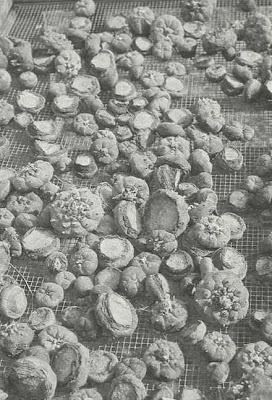
Fig. 6 - Freshly harvested peyote tops that are being dried for sale to Native Americans
Fig. 6 - Freshly harvested peyote tops that are being dried for sale to Native Americans.

Anthony Davis, also known as White Thunder (Fig. 7), is an 83-year-old Pawnee Road Chief and President of The Native American Church of the United States in Texas. Anthony, a longtime member of the Church, says (pers. comm.) that the annual demand by all branches of the Native American Church in the U.S. and Canada for peyote "buttons" is 5-10 million. Unfortunately, the peyoteros of south Texas come far short of reaching this need. If they were to harvest that many tops, what would be the longterm effects on the natural populations? In fact, what is the impact of their present collecting of about two million tops each year?
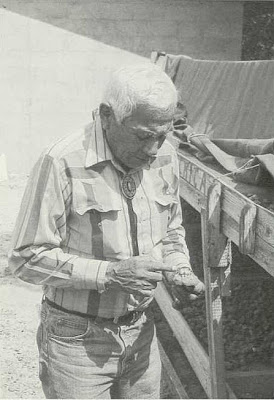
Fig. 7 - Anthony Davis, a Pawnee Road Chief, examining drying peyote 'buttons.'
Fig. 7 - Anthony Davis, a Pawnee Road Chief, examining drying peyote "buttons."

I visited a population of peyote on Las Islas Ranch in northern Starr County. The ranch is presently closed to outsiders, including peyoteros, with numerous high fences and locked gates. The area we visited had never been root-plowed and consisted of natural vegetation (Fig. 8), with heavy stands of mesquite and other native shrubs. No peyoteros have been on the property in more than three years. I examined numerous plants and found about half had been previously harvested. The usual technique for harvesting is to use a flat, short-handled shovel or machete, which is carefully pushed just beneath the soil to sever the top of the plant from the tuberous root system. If the top is removed at ground level, regeneration is rapid, usually with one - or more - heads arising from the original root system (Figs. 9, 10). New tops will sprout in less than two months if the plant is in a state of active growth. The Las Islas site had many peyote plants with one or more small heads, most less than 5 centimeters (2 inches) in diameter. Several large individuals were found growing under large mesquite trees. Peyote seems to be remarkably resilient if proper harvesting techniques are practiced by peyoteros.

Fig. 8 - Natural habitat of peyote on Las Islas Ranch, Starr County, Texas
Fig. 8 - Natural habitat of peyote on Las Islas Ranch, Starr County, Texas.

Fig. 9 - Cluster of small peyote tops
Fig. 9 - Cluster of small peyote tops.

Fig. 10 - Soil removed to show that the tops arise from a large root system from which a top had been removed several years earlier
Fig. 10 - Soil removed to show that the tops arise from a large root system from which a top had been removed several years earlier.

What is the future of peyote harvesting in south Texas? The long-term prognosis, if present conditions continue to exist, is grim. Interestingly, the most serious threat to peyote is not its harvest by peyoteros. They are actually good conservationists and have a responsible approach to their livelihood. They want to carefully nurture the wild populations so that they will have a steady income. Members of the Native American Church, in turn, are dependent upon the peyoteros, for there is no other legal supply of their sacrament. Some will travel to south Texas to collect their own plants, but most cannot afford the time or expense.

The two most serious threats to a continued supply of peyote are root-plowing (Fig. 11) and the locking up of ranches to the peyoteros. These two activities by the land owners are understandable, because they want to make their land economically productive, as well as to protect themselves from lawsuits. The brushland has many snakes and other dangers, and in this time of litigation many owners fear the possibility of lawsuits if anyone is injured or killed on their property. Hunting has become a significant source of income for many ranchers, with groups of hunters paying for permission to be on the land during the winter hunting season. The property has therefore been closed in order to propagate game, prevent poaching, and insure that only those who have paid are on the property. Elaborate, high fences have been built to restrict the movement of deer.

Fig. 11 - Root-plow (note man standing beside it), with Opuntia engelmannii in the foreground and the newly cleared area behind
Fig. 11 - Root-plow (note man standing beside it), with Opuntia engelmannii in the foreground and the newly cleared area behind.

In recent years ever-larger numbers of Native Americans are coming to visit the "peyote gardens," which are almost totally on private land that is fenced and posted. Some Native Americans resent being prohibited from visiting sites where their most important "medicine" grows, thus creating serious tensions between them and the ranchers.

Root-plowing is the only means whereby a land owner can prepare land for cattle grazing, after which various grasses are planted. Of course, native plants are virtually all destroyed, with the
exception of Opuntia engelmannii (Fig. 11). It multiplies rapidly by vegetative means once the ground is disturbed and in many places it forms nearly impenetrable thickets.

As more and more land is subjected to rootplows or is locked up, there is an ever-increasing pressure on those remaining populations of peyote that are legally accessible. An area of peyote should not be recut for at least five years, but often peyoteros cannot wait that long if the demand for buttons is great. Thus, smaller and smaller tops are harvested (Fig. 12) at ever-higher prices.

Fig. 12 - Very small peyote 'buttons,' indicating that peyoteros are being forced to harvest regenerated tops before they have grown to a sufficient size. Photos by author
Fig. 12 - Very small peyote "buttons," indicating that peyoteros are being forced to harvest regenerated tops before they have grown to a sufficient size. Photos by author.

There appear to be three ways to alleviate the probable shortage of peyote within the near future. None is easy, and none may be possible.

First, efforts should be made to persuade ranch owners to allow peyoteros to legally have the right to harvest peyote on their property through leases or permits. Landowners of Texas feel strongly that their lands are private. Negotiations would be difficult, but if some ranchers would allow carefully supervised harvesting, then perhaps others would follow. Unfortunately, the image of peyote as a drug rather than a sacred medicine is hard to dispel. This is an unfortunate consequence of the drug culture and their coming to Texas to collect and consume peyote.

Second, negotiations could be initiated with the Mexican and U.S. governments to allow the importation of dried peyote from Mexico where the supply is still plentiful. This would provide income for Mexican harvesters, with U.S. Hispanics serving as importers and distributors. However, at present Mexico has laws which are even more restrictive regarding possession and use of peyote than in the U.S. Perhaps the new NAFTA treaty and the greater interest of both governments to work cooperatively may at least provide the possibility of discussions about peyote.

Third, salvage operations could be undertaken with the cooperation of ranchers who are rootplowing fields. If they could be pursuaded to allow peyoteros to collect entire peyote plants prior to their destruction by the plow, then those collected could be placed into cultivation. Suitable fields with security would have to be found, but such an activity would provide income to the rancher, to the harvester, and to the grower. The plant grows well in cultivation, though few peyoteros and Native Americans have been inclined to propagate other than small back yard gardens of peyote, thinking that the wild populations will never be depleted. Unfortunately, this is not the case.

Peyote is not a dangerous drug that victimizes Native Americans as alcohol has done. Rather, it is a sacred plant having a history of use of more than 6000 years. It is only used ceremonially and as medicine. It is not addicting, nor does it cause harmful effects. It is one of the most important medicines to Native Americans. Their religion, in which peyote is used as the sacrament, is highly moral and serious. For anyone who has experienced the night-long ceremony of singing, praying, and mediating, there can be only respect and admiration. Serious efforts must be made to assure the continued supply of peyote for members of the Native American Church.

Acknowledgments
Financial support for this investigation was provided by the CSSA Research Fund. It is much appreciated. In addition, I wish to thank Dr. Stacy Schaefer of The University of Texas-Pan American for arranging travel, accommodations, and interviews in south Texas. I also want to thank Jerry Patchen for several valuable suggestions in the writing of this paper.

References
Anderson, E. F. 1980. Peyote: the divine cactus. University of Arizona Press, Tucson.

Morgan, G. R. 1976. Man, plant, and religion: peyote trade on the mustang plains of Texas. Ph.D. dissertation, University of Colorado.

Morgan, G. R. 1983. The biogeography of peyote in south Texas. Bot. Mus. Leafl., Harvard Univ. 29:73-86.

Morgan, G. R., and O. C. Stewart. 1984. Peyote trade in south Texas. Southwest. Hist. Quart. 87:269-296.

Stewart, O. C. 1989. The peyote religion: a history. University of Oklahoma Press, Norman.

Thursday, December 20, 2007

Troubled times for Texas peyote harvesters

Ted Anderson’s article The “Peyote Gardens” of South Texas: a conservation crisis? (1995) documented that the Texan peyote populations have greatly diminished in size, and that a conservation crisis might be imminent as wild populations are depleted by over-harvesting and habitat destruction.

A recent Reuters article sums up the current grim situation for the Texan peyoteros and the “peyote gardens” they harvest. Today only 3 peyoteros are active in Texas, compared to as many as 27 peyote dealers being licensed in the 1970s; the 2006 harvest yielded 1.6 million peyote buttons - a dramatic decline from the mid-1990s peaks of around 2.3 million buttons.

Peyoteros are licensed by the government to harvest and sell peyote to members of the Native American Church - an occupation that seems oddly disconnected from the rest of the U.S. fighting its war on drugs for decades.


"There's still some peyote out there, but not like there used to be. It's getting kind of scary now," said Morales [one of the remaining peyoteros] above the crowing of a rooster from the roof of his shed.

He has had his peyotero license for 16 years, and before that worked as a picker, walking the arid brush country of southern Texas with a machete in hand and lopping off the top of the cactus when he found it.

It used to be easy -- peyote was plentiful and landowners were happy to let peyoteros harvest the cactus for a small fee.

But urban development and widespread "root plowing," which scrapes natural vegetation off the land to replace it with grass for cattle grazing, destroyed many of the peyote fields that once sprawled along the U.S.-Mexico border.

And more and more peyote land is off-limits because it is being bought by rich Texans who turn it into hunting preserves, said Martin Terry, a biology professor at Sul Ross State University in Alpine, Texas.

Consequently the available peyote populations are over-harvested, resulting in less peyote of an inferior quality. Terry suggests the US Drug Enforcement Administration to allow greenhouse cultivation of peyote as a solution to the current situation (tongue-in-cheek described as “a serious case of over-grazing by human herbivores” ;-). Cultivated peyote would secure ample supplies for the Native American Church and spare the remaining wild peyote populations.


It should be noted that Martin Terry is one of the few scientists currently conducting peyote related research, including investigations of proper peyote harvesting techniques.

You can read the full Reuters article, Texan deals peyote legally, here.

As an aside I have to mention that the Brisbane Times features the same article under the headline Growing psychedelic drugs aint what it used to be... a good illustration of the saying “everything is in the eye of the beholder” ;-)

Sunday, November 11, 2007

Habitat photos – Lophophora etc.; second installment

The previous post featured habitat photos by Kauderwelsch who, in the meantime, has been kind enough to share more pictures at Wikimedia Commons. I’ve included a handful of his photos below.

The epidermis of this peyote cactus (Lophophora williamsii) is slightly bruised and looks like some animal nibbled on it but changed its mind after tasting the first couple of bitter bites (or maybe the bruises are just damage from the rocks scattered around the plant, but I like the “nibbling explanation” better ;-)

Peyote (Lophophora williamsii), near Monterrey, Nuevo León, México

Previously I haven’t been much into Mammillaria but seeing this magnificent picture of a flowering M. kraehenbuehlii has me wondering if I should grow some of these beautiful plants.

Flowering Mammillaria kraehenbuehlii

The next picture shows a Strombocactus disciformis growing in its typical habitat; nearly vertical, flaking limestone cliffs. It seems almost surreal that any plant is able to grow in this harsh biotope, but Strombocactus, Aztekium ritteri, and other species of cactus thrive in such conditions.

Strombocactus disciformis, near Vizarrón, Querétaro, México

The next two photos are a bit out of context (they are certainly not showing “small Mexican species”; and one is not even picturing a cactus ;-) I just fell for the beauty of the band of Cephalocereus columna-trajani standing tall against the background of towering clouds, and the sprawl of branches on that ancient looking Beaucarnea gracilis.

Cephalocereus columna-trajani,(syn. C. hoppenstedtii), near Tehuacán, Puebla, México

Adult specimen of Beaucarnea gracilis, Zapotitlán Salinas, Oaxaca, México

I have to visit México!

The photos are published under the terms of the GNU Free Documentation License. The original high resolution copies of the pictures are available here:

Wednesday, October 31, 2007

Habitat photos – Lophophora etc.

A while ago I stumbled upon a handful of great Lophophora habitat photos published on Wikimedia Commons by Kauderwelsch.

Flowering Lophophora diffusa, near Vizarron, Quéretaro, Mexico

Group of Lophophora diffusa near Vizarron, Queretaro, Mexico

Peyote (Lophophora williamsii), Wirikuta near Wadley, San Luis Potosi, Mexico

Kauderwelsch has also made pictures of other cactus species available; a couple of examples are included below.

Ferocactus latispinus, Oaxaca, Mexico

Mammillaria kraehenbuehlii, Oaxaca, Mexico

Unfortunately no new images have been added by Kauderwelsch lately; based on the quality of the photos already contributed I would like to see more of his work.

The photos are published under the terms of the GNU Free Documentation License. The original high resolution copies of the pictures are available here:

You can see more of Kauderwelsch's photos in this post.

Monday, September 24, 2007

Dirk’s collection of cristate and variegated cacti

Dirk is a lucky man. Anyway, judged by the quality of his collection of crested and variegated cacti, he has to be ;-) I think you’ll agree after seeing the pictures that Dirk has been kind enough to let me share in this post.

Ariocarpus retusus var. elongata crest

I’m particularly fond of this photo of a cristate Ariocarpus retusus, resembling a plant creature one would not be too surprised to encounter in a Tolkien novel.

Dirk is living in Belgium and knows a commercial cactus grower in Holland who lets him pick and choose interesting seedlings when he’s visiting (to stock up on Harrisia for grafting). On this account Dirk has got quite a collection of variegated Lophophora.

Lophophora williamsii f. variegata

I especially like the pastel pink, yellow, and green colors of the above plant – it’s almost a wine gum look-alike ;-) But the rest of the collection is definitely also nice.

Lophophora williamsii f. variegata grafted on Harrisia

Lophophora williamsii f. variegata 'Zebra'

Collection of variegated Lophophora williamsii

Dirk also has plants showing dichotomous branching like these beautifully symmetric two-headed Obregonia denegrii and Lophophora williamsii plants.

Two-headed Obregonia denegrii

Collection of two-headed Lophophora williamsii

Last I heard from Dirk he had just returned from a visit to the 2007 ELK. He had tried to obtain a cristate Lophophora – unfortunately without any luck. You can see more of Dirk’s amazing collection at his cactelders web site.

I hope you enjoyed this featured collection - if you have pictures or information you would like to share, you can drop me a mail at “lophophora [dot] blog [at] gmail [dot] com”.

Sunday, September 23, 2007

In search of Echinocereus reichenbachii in Wichita Mountains Wildlife Refuge

I recently revisited Oklahoma City. Having heard that Echinocereus reichenbachii is abundant in the millions in Oklahoma, I decided to see if I could find some of these fascinating plants in habitat where they occur in many stem forms and spine colors. E. reichenbachii grows in several of the state parks in western Oklahoma, but after a bit of research I decided on visiting the Wichita Mountains Wildlife Refuge. The refuge is within easy driving distance from OKC (head southwest on highway 44 for an hour or so, then take the Medicine Park exit just north of Lawton) and apart from cacti it also boasts a rare remnant mixed grass prairie, an island where the natural grasslands escaped destruction thanks to the granite outcrops rendering the land impossible to plow.

A cluster of Echinocereus reichenbachii var. albispinus

All the Echinocereus plants I found were of the variety Echinocereus reichenbachii var. albispinus (or Echinocereus baileyi if you consider it a full species). It seems like the plants prefer to grow in fissures in the granitic rock, especially if moss is also growing in the fissures.

E. reichenbachii var. albispinus growing in moss

The pictured plants are growing in the open prairie grasslands south-east of Mount Scott. It’s quite amazing that most of the plants seem undamaged by the grazing herds of bison and longhorn; I would expect such a large animal could trample an Echinocereus underfoot without even noticing it, but that doesn’t seem to be the case.

Grazing bison
Grazing bison

I also saw a few Opuntia plants – probably O. phaeacantha – with beautiful carmine-red fruits. The pictured plant is growing on the southern bank of Quanah Parker Lake; named for the Quanah Parker of Native American Church fame.

Fruiting Opuntia sp. (O. phaeacantha?)

The Wichita Mountains Wildlife Refuge is a very interesting place to visit and I wish I had had more time (unfortunately I had to deal with delayed baggage, limiting the visit to half a day). It comes highly recommended if you are looking for Echinocereus reichenbachii var. albispinus (= Echinocereus baileyi) or bison ;-)

You can find more photos from my visit at http://public.fotki.com/WichitaMountainsWR/.

Friday, August 17, 2007

Time-lapse videos of a flowering Lophophora jourdaniana

I’ve previously made an attempt at a stop-motion video showing the thigmotropic behavior of Lophophora stamens. It so happened that the Lophophora williamsii var. jourdaniana plant flowered again during my summer vacation, leaving me plenty of time to experiment with time-lapse videos.

The first video shows the Lophophora williamsii var. jourdaniana flower unfold (I’m not exactly an early bird so I missed the first part of the unfolding ;-)

It seems like the movie couldn't be embedded - you can watch it at http://www.youtube.com/watch?v=rMlCPyZsB6E

The above video covers a time span of approximately 90 minutes, i.e. playback is sped up by a factor of 150. This is my first attempt at a time-lapse “flower movie”, as can be seen by the quality of the film. The first 11 seconds were shot while the camera was in auto-focus mode, resulting in a “wobbly” feel. I then disabled auto-focus (and lost a couple of frames in the process, which can be seen as a “jump” 11 seconds into the video) and later had to re-focus (28 seconds into the video), so it's not perfect, but not bad either. The frames were shot with the sun as the only source of light.

Next, I wanted to make a better (i.e. more frames per second) version of the thigmotropic stamens video but ended up with a version looking a lot like the original one.

It seems like the movie couldn't be embedded - you can watch it at http://www.youtube.com/watch?v=KHCQb6JIvNE

The playback of the above video is sped up by a factor of 12. Unfortunately I stopped taking pictures just as the stamens started to revert to their original position. In an attempt to achieve more frames per second I played around with my cameras continuous shooting mode. Suddenly the flower was visited by an industrious bee beautifully illustrating the purpose of the touch sensitive stamens ;-)

It seems like the movie couldn't be embedded - you can watch it at http://www.youtube.com/watch?v=wuUif0M5tG8

I guess the last 2 clips would be more illustrative if they had been filmed with a regular video camera instead of an SLR, but they’ll have to do for now. Unfortunately my camera ran out of power effectively putting an end to the filming of this particular flower.

Finally I have to mention the Hydrocactus – cactus video page as the main inspiration for these experiments and the best source of cactus videos I’m aware of.

Thursday, August 16, 2007

Copenhagen Botanical Garden & Museum

I spent part of my summer vacation in Copenhagen and naturally had to visit the Botanical Garden and Museum. The garden is located in the center of the city and has many visitors. Unlike most other gardens and parks in Copenhagen, the purpose of the botanical garden is research. Therefore, “it is not allowed to run, to ride a bicycle, climb the trees, stay on or walk on the lawns, pick the flowers or picnic.” These rules are a gross limitation on Danes who generally light bonfires and run around naked on lawns ;-)

The Conservatory
The Conservatory

The botanical garden was established August 2, 1600, and has moved and changed during the centuries. The fourth and present incarnation of the garden was opened to the public on October 9, 1874, 274 years after the founding of the first botanical garden (the vanes on the conservatory roof date the construction to 1873).

The cactus and succulent plants have their own dedicated greenhouse in these wonderful settings. Facing the stairs leading to the main conservatory building (the palm house), the cactus and succulent house is located to the left of the stairs, one level lower than the palm house.

The cactus and succulent house

Inside the cactus house you’ll find an abundance of plants – both small globular types and huge columnar plants. It seems like theft of the smaller plants is a problem as they are protected by glass plates and the whole house is monitored by video.

Inside the cactus and succulent house

The plants all look vigorous and well tended for, as for example this group of flowering Astrophytum ornatum plants (for comparison you can check the A. ornatum growing in the Myriad Botanical Gardens, Oklahoma City).

Flowering Astrophytum ornatum

Astrophytum ornatum flower

A large, fat Astrophytum asterias was hiding in the shadows of the larger plants.

Astrophytum asterias

And a Mammillaria geminispina was displaying its last flowers along with a multitude of dark red fruits.

Mammillaria geminispina

Unfortunately I couldn’t find any Lophophora, Ariocarpus, or Strombocactus in the publicly accessible houses; but the garden also has houses that are not open to the public and reserved for experiments and plant propagation. Maybe it’s just wishful thinking, but I’m almost positive I glimpsed a collection of ariocarpi and a few lophs inside one of these houses.

Propagation house – closed to the public

If you happen to be in Copenhagen a visit to the Botanical Garden and Museum is highly recommended. It’s a tranquil oasis situated in the center of a bustling city, and the historical conservatory buildings are beautiful in their own right (the garden was declared a preserved site on January 31, 1977). You might not find a lot of the rarer species in the houses open to the public, but the plants on display are abundant, well grown, and clearly marked.

Wednesday, July 04, 2007

Rory’s Lophophora collection

Some time ago Rory contacted me to discuss cacti and mycorrhizal associations (an interesting subject that might be brought up in a later post). During our conversations Rory revealed himself as an avid Lophophora grower with an impressive collection of mature and well-grown plants. Rory has kindly allowed me to share some pictures of his plants.

Flowering Lophophora williamsii, close-up

Large pot of Lophophora williamsii

The largest of the L. williamsii plants in this pot are approximately 25 years old. One of the plants in the central group (a bit above and to the left of the center) has been decapitated and set 4 offshoots. One of these has not yet developed a central growing point and appears somewhat cristate, but Rory expects it to develop as normal with time. The removed top was rooted and is also growing in the central group of plants (slightly below center; wool removed from areoles), and is flowering regularly.

Large pot of Lophophora fricii

According to Rory the compost used for the L. fricii plants are not drying fast enough. Consequently the plants are kept on the dry side which accounts for the red coloration shown by some of them. The largest of the plants (with a total of 9 offsets) has only grown 1cm (~0.4'') in the past 9 years so Rory is planning on repotting the plants in a new mix and expects this to speed up growth.

Lophophora diffusa about to flower

The above L. echinata diffusa plant is just about to flower - unfortunately it’s too overcast for the flowers to open properly.

Large pot of Lophophora williamsii v .caespitosa

To top things off (or just to make me completely envious ;-) Rory also threw in a photo of a nice, mature Ariocarpus fissuratus specimen.

Flowering Ariocarpus fissuratus

I hope you enjoyed this “guest appearance” - I for one would like to see more of Rory’s plants. If you have pictures or information you would like to share, you can drop me a mail at “lophophora [dot] blog [at] gmail [dot] com”.

All Time Most Popular Posts