Monday, February 02, 2009

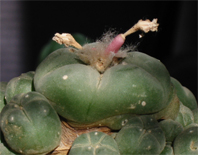
Flowering Lophophora decipiens

Flowering Lophophora decipiens

In 2005 I sowed my first Lophophora decipiens seeds bought from Pavel Pavlicek. The plants grow in my coldhouse and flowered for the first time in the summer of 2008 where these pictures were taken.

Flowering Lophophora decipiens viewed from above

I'm not quite sure what to make of the long, flimsy, pink petals, and the plants are still too young to tell what the adult body morphology will look like so for now I can only say that the plants live up to their name (decipiens meaning “deceiving” ;-)

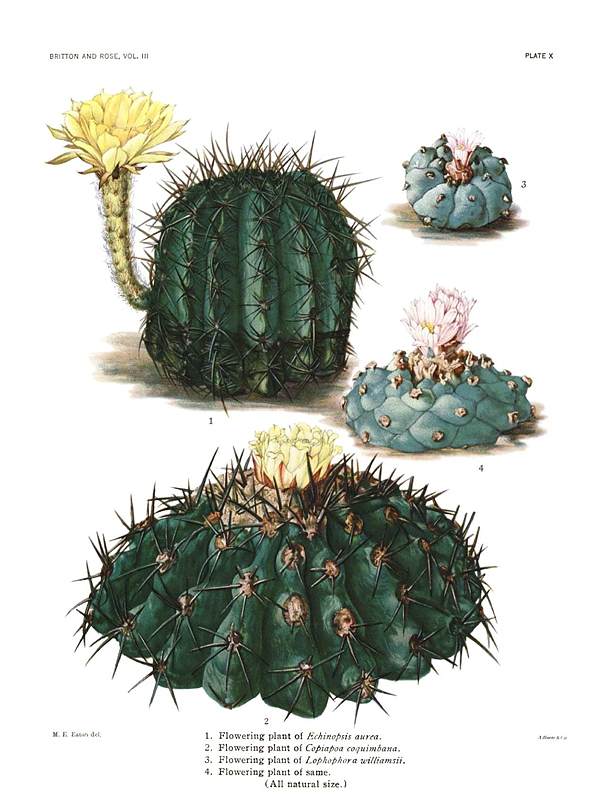
Leon Croizat's description of Lophophora williamsii var. decipiens stated that the vegetative body of this variety was basally tubercled or with distinct podaria rather than ribs, and that the flower extended out of the top of the plant to a greater extent. This description was based entirely on an illustration in Britton and Rose, The Cactaceae volume 3, plate 10, figure 4 (see below). Some researchers, e.g. Anderson, have argued that these characters are not consistent enough in occurrence to justify separate taxonomic status while others, including Gerhard Köhres, state that plants corresponding to Croizat's description grow near El Amparo in the state of Coahuila, Mexico and should be counted to the Lophophora fricii complex.

Britton and Rose, The Cactaceae, Volume III, Plate X
The Cactaceae, Volume III, Plate X

I have recently bought some Lophophora decipiens seeds from Steve Brack and look forward to see how they develops.

Saturday, January 31, 2009

Peyote conservation, trade, harvest and re-growth

A while ago professor Martin Terry, a botanist at Sul Ross University in Alpine, Texas and the authority on Lophophora, appeared on the Cultural Baggage radio show talking about the peyote cactus. Below you find excerpts from the transcript of this very informative radio program.

Asked by the interviewer, Dean Becker, if it is fair to say that the US peyote populations are becoming almost extinct professor Terry replied:


You’re heading in the right direction but I’d like to make a couple of tweaks in the way the situation is described. It’s basically, peyote is not considered an endangered species, yet. It’s a very patchy situation. In other words, on those large ranches with ten foot fences around them to keep deer in, trophy deer, which is their main business and to keep people out, on those ranches where there’s no harvesting going on of the peyote, the populations are quite healthy.

There’s plenty of peyote there and they’re nice mature adults but once you get outside of that subset of large protected ranches then you find, everywhere where the licensed peyote distributors have access, there the populations are being hammered. And it’s essentially a problem of too frequent collecting to maintain sustainability.

Dean Becker: Kind of like the way they’re getting all the fish out of the ocean.

Professor Terry: Very much so. They’re just going back to harvest before adequate reproduction and growth has replaced those ones that they harvested last time. That’s a very good analogy, the one to the over-harvesting of the oceans.

Terry then goes on to discuss who are allowed to legally harvest peyote:


There are three DEA registered distributors of peyote who have a license, which they pay a license fee for, to send their people out to harvest peyote which then, they will sell to members of the Native American Church who have their papers to show that they’re bona-fide Native Americans who are going to use the peyote in their religious ceremonies.

But that’s not the only way that peyote gets harvested. There’s nothing in the laws to prevent a duly registered Native American tribe member, member of the church, to make a contract with a landowner directly so that, in that situation, the licensed distributors are not involved. That never gets accounted for and we have to assume that’s a sizable number of peyote plants that get harvested that way. And that never gets accounted for in the official statistics on peyote numbers and peyote sales.

Terry also elaborates on the growing scarcity of land areas accessible to peyoteros and other harvesters and the effect it has on the availability and price of peyote:


[...] there’s been a change in land tenure over the past few decades. Whereas if you looked at the people who owned most of the land, say in the 1950s, you would have found that most of the people who owned the land were actually living on the land and were making a living from ranching. That is no longer the case. Now much of the land in South Texas, at least the larger tracts, are owned by people who have the money to afford such tracts now, which means they’re not living in South Texas.

They’re living in Houston, Dallas, Austin, San Antonio where the money is made. Their primary interest is to use these tracts for the hunting of trophy deer. And that’s how they make any income, any real income that they make. Cattle would be only for the tax exemption. The people like that are not going to be at all interested in allowing unknown people to be coming onto their land to harvest the peyote there for a few hundred dollars a year. I mean, that’s absurd. That’s totally uninteresting to the new landowners.

[...] if you look at what’s been happening to the [peyote] sales over the last twenty years, and these are public figures, they are readily available, you see that the number of peyote buttons harvested by the distributors and their agents has fluctuated over the last twenty years.

It went up over two million buttons a year during, let’s say the early 1990s, and then came down again. And now it’s as low as it’s been historically. It’s down right around a million and a half buttons per year but the price, the total sales in dollars for those million and half buttons, it’s just under $500,000. So that comes out to, yeah, a little over thirty cents a button.

Peyote is still too cheap when acquired through legal channels and that’s one of the problems when you get to the field because the guys who go out to harvest for the licensed distributors, they’re just interested in beer money and they will harvest these things in a willy-nilly way, not taking care at all because what are they going to get?

They’re maybe get ten or fifteen cents when they sell the buttons to the licensed distributor who ‘employs’ them. And so they don’t have anything invested in taking care of the peyote crop. It’s cheap, it’s just beer money, they want to harvest them as fast as they can, sell them and go buy their beer.

Dean Becker: Yeah. The point being that if it’s done carefully, leaving the root, that the plant can in fact grow back, right?

Professor Terry: It can indeed. Now, to what extent that happens is a very live question. If you talk to people who have a vested interest in the peyote trade then they’ll say ‘Oh yeah, you cut the top off and in two years you’ve got another harvestable plant.’ That’s a gross exaggeration. You cut the top off and, first of all, you don’t know what percentage of the plants are actually going to survive that decapitation. And it’s weather dependent.

If people come along and harvest a ranch and leave the cut tops exposed and then you have this big rain you can get a lot of infection in those plants and they’ll just die. They’re not going to produce anything ever again. So that’s one factor.

On the re-growth side, even those that do re-grow I dare say, from what I can gather as a botanist, you’re not likely to see a harvestable button until about five years after the first harvest. So that re-growth, two things are happening. First of all, they’re going to be smaller stems that grow back from the once harvested plant and secondly, it’s going to take a long time for them to get to harvestable size.

And the fact that people are coming back after two years to re-harvest again they’ve got to be harvesting buttons that are much smaller than the average adult size. And this is one of the things that you see in that marketplace. You see that there’s been a constant decrease in the size of buttons, certainly, over the past ten to fifteen years.

And so now, even though the price hasn’t gone up dramatically, it’s gone up sort of linearly and quite slowly, but if you figure in the fact that the buttons that are costing thirty cents apiece are perhaps one fifth to one tenth of the weight of what the buttons used to be at, say, when they were ten cents apiece...the price has gone up astronomically.

Dean Becker and Martin Terry discuss several other interesting issues including proposals for supplying the Native American Church with sufficient amounts of peyote. These proposals range from increasing the rate of peyote production in situ (by fertilizing natural populations) over greenhouse cultivation to whether the importation of peyote from Mexico is a feasible solution to the problems of the Native American Church of North America (Terry says no, it would basically just extend the problem with over-harvesting from Texas into Mexico).

You can read the full transcript at the Drug Truth Network or download the radio show (13.3 MB).

Tuesday, December 16, 2008

Pictographs record peyote use of earliest Texans

There is well-documented archaeological evidence indicating prehistoric peyote use, including pictographs and ancient peyote specimens found in caves and rock shelters in the lower Pecos River region of Texas. Anthropologist and archaeologist Dr. Carolyn E. Boyd has argued that the Lower Pecos pictographs provide the earliest record of peyotism.

Peyote pictograph at the White Shaman site

The above picture is Carolyn Boyd's rendering of the murals at the White Shaman site. The original rock art panel is high on a bluff overlooking the Pecos River. According to Boyd it depicts the hunt for sacred peyote, a powerful medicinal and sacramental plant. She also interprets it as a ritual re-enactment of the first pilgrimage that led to the birth of gods, the establishment of the seasons and the creation of the cosmos.

The following snippet of text is taken from a recent article on the pictographs at the Mystic Shelter site.


Boyd thinks these murals were inspired by visions the people experienced during trances brought on by the hallucinogen peyote. Some depict a warrior's journey to the "Otherworld." Some describe the hunt for the sacred peyote cactus and how the cosmos was put into place.

"The rock art panels are pictorial narratives of mytho-historical events - like putting the Old Testament creation story or Passover rituals into a visual format rather than textual," Boyd says.

The artists were hunter-gatherers, and lived in an extremely arid environment where deer were prized. Yet they used valuable fat from deer bones to make paint, illustrating the importance of the artwork in their culture, Boyd says. The murals - explosions of orange, red, yellow and black - would have jumped out from the daily landscape of brown, green and gray.

"It must have been spectacular," she says. "Can you imagine the impact that would have?

The record is still in the rock.

Surviving murals are found in rock shelters throughout the Lower Pecos region, where they were protected from rain, sun and wind. According to radiocarbon dating, most, including the ones at Mystic Shelter, were made 2,950 to 4,200 years ago. More sites are still being discovered.

If you (like me;-) dream of having a closer look at the pictographs the Shumla School arranges rock art field trips allowing you to examine the incredible imagery at first hand.


Shumla School participants investigating the pictographs at Mystic Shelter, one of Texas's best sites for prehistoric art.

References
Carolyn E. Boyd, J. Philip Bering (1996), “Medicinal and hallucinogenic plants identified in the sediments and pictographs of the Lower Pecos, Texas Archaic”, Antiquity 70, 256-275

Pictographs, petroglyphs on rocks record beliefs of earliest Texans (austin360.com)

Shumla School

Rock Art Gallery

Saturday, December 06, 2008

Flowering Lophophora koehresii

Flowering Lophophora koehresii; close-up

Back in August this year my grafted Lophophora diffusa var. koehresii (RS 1182; El Sabino, San Luis Potosí) flowered for the first time.

Flowering Lophophora koehresii grafted on Trichocereus pachanoi stock

Despite the difference in size of the two Lophophora diffusa var. koehresii scions in the above photo they were both started as part of the same batch of seeds March 3, 2007. The largest of the scions was grafted June 7, 2007 and when the Trichocereus pachanoi stock grew an offset I grafted another seedling on it May 5, 2008.

Flowering Lophophora koehresii (RS 1182; El Sabino, San Luis Potosí)

Lophophora diffusa var. koehresii is described as being of smaller size than the other Lophophora species (possibly with the exception of the newly described Lophophora alberto-vojtechii), and having a dark green epidermis and pinkish-white flowers with a light brownish mid stripe. The flower and epidermis of my plant fit the description while it might be difficult to say anything useful about size as the plant is grafted. As mentioned above the plant is still very young but I'll watch it closely as it matures.

Friday, December 05, 2008

Flowering Gymnocalycium calochlorum

One more flowering cactus of the summer past. I don't have many Gymnocalycium plants in my collection but find the ones I have quite interesting – especially the large flowers and the naked calyx are fascinating (the genus name Gymnocalycium comes from the Greek for "naked calyx").

Gymnocalycium calochlorum flower buds

I bought this Gymnocalycium calochlorum (Mina Clavero, Córdoba, Argentina) a couple of years ago and it has been growing in my coldhouse since. It is coping well in this environment and is showing off a wealth of flowers each summer.

Gymnocalycium calochlorum flower buds; close-up

The pale pink flowers with the burgundy throat are quite beautiful and almost hide the plant.

Flowering Gymnocalycium calochlorum

Thursday, December 04, 2008

Flowering Matucana madisoniorum

I was sorting out my photos and found a few pictures of plants that flowered this summer.

Flowering Matucana madisoniorum

This Matucana madisoniorum plant was bought earlier in the summer from Kakteen-Haage to experiment with growing it in my coldhouse. The species is said to be pretty cold-tender so the chances for survival are probably not the best - it would be sad, though, not to see it display its beautiful orange-red flower again.

Flowering Matucana madisoniorum - close-up
Flowering Matucana madisoniorum – close-up

The species was originally described as Borzicactus madisoniorum by Hutchison in the journal of the Cactus and Succulent Society of America (vol 35 (6), pp. 167-172) and later transferred to the genus Matucana. The description was accompanied by the plate below.


Plate description: Borzicactus madisoniorum. Composite plate by May Bios, 1958, from different plants under cultivation, all of the type collection. 1, 2. Apical views of spiny and spineless plants. 3. Lateral view of flower. 4. Apical view of flower. 5. Longitudinal section of flower. 6. Stigma. 7. Funicles. 8. Ripe fruit. 9. Dried fruit. 10. Lateral view of seed. 11. Bottom view of seed. 12. Lateral view of seed, the dotted lines showing the extent of invagination of the hilum. 1-5, 8, 9, natural size. 6, x 4.5.10, 11, x 70. 7, greatly enlarged.

Matucana madisoniorum has its natural habitat in Amazonas, Peru with a very limited distribution, it has been heavily collected and faces an unknown future in the wild.

Sunday, November 30, 2008

Lophophora alberto-vojtechii at a glance

I recently received the 2008 (2) issue of the Cactus & Co journal describing a new Lophophora species, Lophophora alberto-vojtechii. The mature plants of the lilliputian species are less than 2 cm (0.8'') wide and the flowers are said often to be larger than the diameter of the plant.

Flowering Lophophora alberto-vojtechii

You can find more details in this post: Lophophora alberto-vojtechii, a new miniature species in the genus Lophophora

Saturday, November 29, 2008

Christmas cacti

The subject line is sordidly misleading as this post has nothing to do with Schlumbergera, Zygocactus or the likes ;-) On the contrary it describes a handful of extreme xerophytes that I treated myself to as an early yuletide present.

I'm just home from Charlotte, North Caroline where I had made a last minute arrangement with Mesa Garden to deliver some plants and seeds to the hotel I stayed at. As usual Steven's plants are hard grown and exquisite.

Ariocarpus fissuratus (SB 403; Crockett Co, Texas)

The A. fissuratus plants are nice and plump – the diameter at the root neck slightly exceeds 2.5 cm (1'').

Ariocarpus fissuratus (SB 403; Crockett Co, Texas)

I hope the A. retusus plants will survive in the coldhouse. As far as I can tell the plants from Cuesta la Muralla are some of the most cold tolerant of this species.

Ariocarpus retusus (SB 310; Cuesta la Muralla, Coahuila)

I only have a few Leuchtenbergia plants but I have grown increasingly fond of this interesting species. This particular variant is alleged to have a branching habit and grow to a height of 1 m.

Leuchtenbergia principis (GL 770; Sierra de la Paila)

There is always room for one more Epithelantha in your collection so I don't think the E. bokei plants need further explanation ;-)

Epithelantha bokei (SB 416; Brewster Co, Texas)

The plants are now home with me and have been potted up. We are all eagerly awaiting the happy, sunny days of spring when the plants can be moved to the coldhouse.

Apart from the above mentioned plants I also bought a selection of seeds including Lophophora decipiens. I'm interested to see what the resulting plants look like – the description in the seed catalog is limited to an intriguing “powdery grey”.

Friday, November 28, 2008

Mumbai musings

I was supposed to have been in Mumbai this week. When visiting I stay, work, and spend my time off in the exact part of town where most of the terrorist attacks happened.

Fortunately my travel plans were changed but still I'm left with a bewildering array of feelings including sorrow, sadness, relief, anger, and fear – combined with a nagging disbelief of how scaringly few “ifs” it would have taken to place me at the scene.

I hope the city and people of Mumbai rise from this attack without giving in to the code of fear and violence imposed on them by the terrorists.

Friday, October 03, 2008

How soon after your Lophophora flowers can you expect a fruit?

I was asked this question in a comment a while ago. I could not give an answer that was more precise than flowers pollinated early in the growing season would set fruit later the same year so I decided to investigate the question further.

Freshly pollinated flowers marked with yellow cotton

Friday July 18 I marked 5 freshly pollinated flowers on my grafted Lophophora williamsii (SB 854; Starr Co, Texas) with yellow pieces of cotton - the cotton was attached to the spent flowers using nail polish. The flowers were all pollinated 1 and 2 days prior to being marked.

All I had to do now was lean back, relax, and wait for the fruits to pop out.

*

Wednesday September 10 – less than 8 weeks after pollinating the flowers – all 5 fruits had appeared.

Lophophora williamsii fruits

Lophophora williamsii fruit up close

The first fruit (in the right hand side of the photo below) appeared more than a week earlier than the others and consequently looks a bit withered.

Offset with fruits
Offset with fruits

Another offset with fruit

So a more precise answer to the question above is that you can expect your Lophophora williamsii plant to set fruits within 7-8 weeks after pollination. At least that is the case for a grafted plant in good growth.

All Time Most Popular Posts