Thursday, December 04, 2008

Flowering Matucana madisoniorum

I was sorting out my photos and found a few pictures of plants that flowered this summer.

Flowering Matucana madisoniorum

This Matucana madisoniorum plant was bought earlier in the summer from Kakteen-Haage to experiment with growing it in my coldhouse. The species is said to be pretty cold-tender so the chances for survival are probably not the best - it would be sad, though, not to see it display its beautiful orange-red flower again.

Flowering Matucana madisoniorum - close-up
Flowering Matucana madisoniorum – close-up

The species was originally described as Borzicactus madisoniorum by Hutchison in the journal of the Cactus and Succulent Society of America (vol 35 (6), pp. 167-172) and later transferred to the genus Matucana. The description was accompanied by the plate below.


Plate description: Borzicactus madisoniorum. Composite plate by May Bios, 1958, from different plants under cultivation, all of the type collection. 1, 2. Apical views of spiny and spineless plants. 3. Lateral view of flower. 4. Apical view of flower. 5. Longitudinal section of flower. 6. Stigma. 7. Funicles. 8. Ripe fruit. 9. Dried fruit. 10. Lateral view of seed. 11. Bottom view of seed. 12. Lateral view of seed, the dotted lines showing the extent of invagination of the hilum. 1-5, 8, 9, natural size. 6, x 4.5.10, 11, x 70. 7, greatly enlarged.

Matucana madisoniorum has its natural habitat in Amazonas, Peru with a very limited distribution, it has been heavily collected and faces an unknown future in the wild.

Sunday, November 30, 2008

Lophophora alberto-vojtechii at a glance

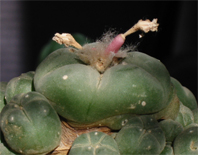
I recently received the 2008 (2) issue of the Cactus & Co journal describing a new Lophophora species, Lophophora alberto-vojtechii. The mature plants of the lilliputian species are less than 2 cm (0.8'') wide and the flowers are said often to be larger than the diameter of the plant.

Flowering Lophophora alberto-vojtechii

You can find more details in this post: Lophophora alberto-vojtechii, a new miniature species in the genus Lophophora

Saturday, November 29, 2008

Christmas cacti

The subject line is sordidly misleading as this post has nothing to do with Schlumbergera, Zygocactus or the likes ;-) On the contrary it describes a handful of extreme xerophytes that I treated myself to as an early yuletide present.

I'm just home from Charlotte, North Caroline where I had made a last minute arrangement with Mesa Garden to deliver some plants and seeds to the hotel I stayed at. As usual Steven's plants are hard grown and exquisite.

Ariocarpus fissuratus (SB 403; Crockett Co, Texas)

The A. fissuratus plants are nice and plump – the diameter at the root neck slightly exceeds 2.5 cm (1'').

Ariocarpus fissuratus (SB 403; Crockett Co, Texas)

I hope the A. retusus plants will survive in the coldhouse. As far as I can tell the plants from Cuesta la Muralla are some of the most cold tolerant of this species.

Ariocarpus retusus (SB 310; Cuesta la Muralla, Coahuila)

I only have a few Leuchtenbergia plants but I have grown increasingly fond of this interesting species. This particular variant is alleged to have a branching habit and grow to a height of 1 m.

Leuchtenbergia principis (GL 770; Sierra de la Paila)

There is always room for one more Epithelantha in your collection so I don't think the E. bokei plants need further explanation ;-)

Epithelantha bokei (SB 416; Brewster Co, Texas)

The plants are now home with me and have been potted up. We are all eagerly awaiting the happy, sunny days of spring when the plants can be moved to the coldhouse.

Apart from the above mentioned plants I also bought a selection of seeds including Lophophora decipiens. I'm interested to see what the resulting plants look like – the description in the seed catalog is limited to an intriguing “powdery grey”.

Friday, November 28, 2008

Mumbai musings

I was supposed to have been in Mumbai this week. When visiting I stay, work, and spend my time off in the exact part of town where most of the terrorist attacks happened.

Fortunately my travel plans were changed but still I'm left with a bewildering array of feelings including sorrow, sadness, relief, anger, and fear – combined with a nagging disbelief of how scaringly few “ifs” it would have taken to place me at the scene.

I hope the city and people of Mumbai rise from this attack without giving in to the code of fear and violence imposed on them by the terrorists.

Friday, October 03, 2008

How soon after your Lophophora flowers can you expect a fruit?

I was asked this question in a comment a while ago. I could not give an answer that was more precise than flowers pollinated early in the growing season would set fruit later the same year so I decided to investigate the question further.

Freshly pollinated flowers marked with yellow cotton

Friday July 18 I marked 5 freshly pollinated flowers on my grafted Lophophora williamsii (SB 854; Starr Co, Texas) with yellow pieces of cotton - the cotton was attached to the spent flowers using nail polish. The flowers were all pollinated 1 and 2 days prior to being marked.

All I had to do now was lean back, relax, and wait for the fruits to pop out.

*

Wednesday September 10 – less than 8 weeks after pollinating the flowers – all 5 fruits had appeared.

Lophophora williamsii fruits

Lophophora williamsii fruit up close

The first fruit (in the right hand side of the photo below) appeared more than a week earlier than the others and consequently looks a bit withered.

Offset with fruits
Offset with fruits

Another offset with fruit

So a more precise answer to the question above is that you can expect your Lophophora williamsii plant to set fruits within 7-8 weeks after pollination. At least that is the case for a grafted plant in good growth.

Tuesday, September 30, 2008

Fruiting Epithelantha micromeris, take two

A few weeks ago I posted on my fruit bearing Epithelantha micromeris (SB1327; near Belen, New Mexico) plants. The color of the fresh fruit is a bright pinkish red that changes to a deep, warm, saturated blood red color as the fruit dries.

Epithelantha micromeris with dry fruits

In close-up the Epithelantha micromeris fruits are strangely reminiscent of small (weirdly colored ;-) cacao pods.

Close-up of dry Epithelantha micromeris fruits

When the last rays of the setting autumn sun shine on the fruits they assume an out of this world, glowing warm red color. I tried to capture it in the photo below but it doesn't quite do justice to the shimmering, radiant quality of the color (as should be evident by now I'm a sucker for the amazing palette of red nuances displayed by these little fruits ;-)

Fruits lit by the setting sun

Sunday, September 28, 2008

Copenhagen Botanical Garden revisited

The first weekend of September I visited Copenhagen Botanical Garden again. As described earlier the garden has a cactus house open to the general public as well as a propagation house that you can't enter. Flowering and otherwise interesting plants are put on display close to the entrance of the propagation house so even though you can't enter you still have a chance to enjoy some of the gems hidden away inside this house. An example is the beautiful flowering Ariocarpus fissuratus pictured below.

Flowering Ariocarpus fissuratus

Ariocarpus fissuratus flower

Lots of interesting plants are on display inside the publicly accessible cactus house. I especially fell for the lone Ariocarpus retusus tucked away among some larger plants.

Ariocarpus retusus
Ariocarpus retusus

Ariocarpus retusus seen from above

Another beauty growing among much larger plants is a (slightly dehydrated) Astrophytum asterias.

Astrophytum asterias

The cactus house holds a large collection of Mammillaria as for example this Mammillaria prolifera var. texana that certainly lives up to its name.

Mammillaria prolifera var. texana

Back in the propagation house a group of Strombocactus disciformis was also on display. The plants are growing in rocks mimicking their natural habitat.

Strombocactus disciformis

My previous post on the Copenhagen Botanical Garden & Museum featured several pictures of the greenhouses so I won't bring any here except for a photo showing the top of the main greenhouse reflected in the water lilly pool in front of it.

Greenhouse reflected in the water lilly pool

Monday, August 11, 2008

Coldhouse grown Lophophora williamsii - the next generation

Four years ago I started my first batch of coldhouse grown Lophophora williamsii (SB 854; Starr Co, Texas) from seed. I've lost a few plants to frost during the years but the survivors have coped surprisingly well, enduring the Danish winters in an unheated greenhouse without problems (that being said, I still worry a bit for the plants every winter ;-).

Flowering Lophophora williamsii (SB 854; Starr Co, Texas)

The plants are now old enough to flower and have been doing so freely all summer. The above photo was taken late June and today the plants are still flowering.

I have pollinated as many flowers as possible - if more plants flower at the same time the flowers are cross-pollinated, otherwise selfed. A cotton-tipped swab can be used for transferring the pollen from the anther and deposit it on the stigma.

Lophophora williamsii pollinated with the help of a Q-tip

Lophophora williamsii with pollen deposited on the stigma

The plants have already set the first fruits (the picture below was taken at the end of July) - I can't say if these fruits are the result of the flowers being pollinated 5 weeks before, but I'm currently conducting some experiments to get a better understanding of how much time passes between a flower is pollinated and the resulting fruit appears.

Fruiting Lophophora williamsii

As mentioned above I cross-pollinate my Lophophora williamsii plants when possible (I don't cross plants from different locations though). This might be a waste of time as preliminary studies by Martin Terry indicate that outcrossing is close to zero (i.e. selfing is virtually 100%) in natural populations and all individuals in a given population are clones. The study is based on data from three Texan populations, including Starr County, and the results are not definite - but if the results are correct it would also mean that my surviving (Starr County) plants are not more fit for the coldhouse, genetically speaking, than the ones that died off as they are/were all clones... and I thought I was witnessing a live "selection of the fittest" drama. Anyway, I'll harvest the seed soon to start the next generation of coldhouse grown Lophophora williamsii ;-)

----------------------
Read the comments for a discussion on the use of the word "clone".

Sunday, August 10, 2008

Fruiting Epithelantha micromeris

Contrary to my Epithelantha micromeris v. greggii plants that have flowered intensively this summer, I have not seen any flowers on my regular Epithelantha micromeris (SB1327; near Belen, New Mexico), but judging from the fruits they must have snuck out some flowers while I was not watching ;-)

Epithelantha micromeris (SB1327; near Belen, New Mexico) fruits

The fruits are a very bright pinkish red - the color almost defies description but it is the kind of screaming color that would seem fit for jelly beans ;-)

Fruiting Epithelantha micromeris (SB1327; near Belen, New Mexico)

Epithelantha micromeris fruits seen from the top

I scanned one of the fruits to get an up-close look at it and the seeds within.

Epithelantha micromeris fruit, close-up

The seeds are not surrounded by pulp, they just sit inside the "dry" outer skin of the berry. The fruits have a bland, uninteresting taste - I wouldn't grow them for marmalade.

Epithelantha micromeris fruit, cut open

The Epithelantha micromeris plants are grown in my coldhouse and they don't seem to mind the cold winters at all - according to Steve Brack this variety of Epithelantha micromeris is from the northernmost known locality of the species.

Read more about the (dry) fruits in this post.

Sunday, July 20, 2008

New plants for the coldhouse

Last week I received a new batch of plants from Kakteen Kliem. The plants are going to live in my coldhouse so I selected plants originating from habitats where they are naturally exposed to frost - I hope this also gives them the ability to withstand the freezing conditions they have to endure during winter here in Denmark.

Lophophora williamsii (JJH 8608293; Pecos River, Texas)

I already have several of these Trans-Pecos Lophophora williamsii plants but decided to procure a few more as Kliem’s stock is running low.

Ariocarpus fissuratus (SB 403; Crockett County, Texas)

My few coldhouse grown Ariocarpus fissuratus plants have all survived until now so I felt like adding some more to the collection ;-)

Homalocephala texensis (DJF 891.3; Yoakum County, Texas)

Homalocephala texensis (aptly named the “Horse Crippler”) is a first for me - I’m looking forward to watching these plants grow and develop their characteristic heavy spine armor.

Normanbokea valdeziana (SB 1468; Ramos Arizpe, Coahuila, Mexico)

Normanbokea valdeziana is another first. I’m not quite sure what to expect from these plants but I fell for their fuzzy looks and beautiful flowers.

As always Gerhard Kliem’s plants are of an excellent quality.

All Time Most Popular Posts