Wednesday, July 04, 2007

Rory’s Lophophora collection

Some time ago Rory contacted me to discuss cacti and mycorrhizal associations (an interesting subject that might be brought up in a later post). During our conversations Rory revealed himself as an avid Lophophora grower with an impressive collection of mature and well-grown plants. Rory has kindly allowed me to share some pictures of his plants.

Flowering Lophophora williamsii, close-up

Large pot of Lophophora williamsii

The largest of the L. williamsii plants in this pot are approximately 25 years old. One of the plants in the central group (a bit above and to the left of the center) has been decapitated and set 4 offshoots. One of these has not yet developed a central growing point and appears somewhat cristate, but Rory expects it to develop as normal with time. The removed top was rooted and is also growing in the central group of plants (slightly below center; wool removed from areoles), and is flowering regularly.

Large pot of Lophophora fricii

According to Rory the compost used for the L. fricii plants are not drying fast enough. Consequently the plants are kept on the dry side which accounts for the red coloration shown by some of them. The largest of the plants (with a total of 9 offsets) has only grown 1cm (~0.4'') in the past 9 years so Rory is planning on repotting the plants in a new mix and expects this to speed up growth.

Lophophora diffusa about to flower

The above L. echinata diffusa plant is just about to flower - unfortunately it’s too overcast for the flowers to open properly.

Large pot of Lophophora williamsii v .caespitosa

To top things off (or just to make me completely envious ;-) Rory also threw in a photo of a nice, mature Ariocarpus fissuratus specimen.

Flowering Ariocarpus fissuratus

I hope you enjoyed this “guest appearance” - I for one would like to see more of Rory’s plants. If you have pictures or information you would like to share, you can drop me a mail at “lophophora [dot] blog [at] gmail [dot] com”.

A visit to Myriad Botanical Gardens and Crystal Bridge Tropical Conservatory, Oklahoma City

I recently visited Oklahoma City and had a Sunday to kill. Being within walking distance from my hotel I decided to visit the Myriad Botanical Gardens and Crystal Bridge Tropical Conservatory.

The garden functions as an urban oasis in downtown Oklahoma City with its verdant hills, perennial gardens, and a tranquil lake with koi and lots of turtles sunning themselves. The cylindrical glass shape of the Crystal Bridge Conservatory is hovering above the waters of the lake connecting its shores - a novel and interesting approach to greenhouse construction.

Crystal Bridge Conservatory

While the garden itself and the special architecture of the conservatory merit a visit I was a bit disappointed with the collection of plants kept in the conservatory. The succulent collection (growing on the so-called Dry Mountain) seems like a mishmash of unrelated and mostly unnamed plants (one of the named exceptions being a large Astrophytum ornatum (Monk's Hood)), but I'm probably heavily prejudiced by my expectations to botanical gardens as collections of plants with a scientific scope - not just a look-and-feel-good assemblage of greenery.

Astrophytum ornatum – one of the few named plants

View of the Dry Mountain

Writing this I realized that I've been consistently complaining about the quality of the cactus collections in my posts on botanical gardens – I guess I'll have to arrange a visit to the Desert Botanical Garden (Phoenix, Arizona) in order to see some real plants ;-)

Monday, June 25, 2007

Lophophora williamsii v. caespitosa graft

I’ve been pretty busy lately and completely forgot to post on the 3rd anniversary (June 7) of my Lophophora williamsii v. caespitosa graft. The main head is 5.5 cm (~2.2'') wide and the total width of the scion has increased to approximately 13 cm (~5.1'').

Lophophora williamsii v. caespitosa graft

The Lophophora williamsii v. caespitosa scion is grafted on a Trichocereus bridgesii stock and was repotted early this spring (hence the supporting props).

Lophophora williamsii v. caespitosa graft - main head
Lophophora williamsii v. caespitosa graft - top view

I’m fascinated by the explosive growth induced by the Trichocereus stock (for comparison you can check the posts on the same plant one and two years ago) but the appearance of the plant tends to become increasingly freakish.

The plant doesn’t bloom with the same vigor as it grows – until now it’s only flowered once.

Monday, June 11, 2007

Flowering Lophophora jourdaniana, take two.

One of my Lophophora williamsii v. jourdaniana plants is flowering again – this time with the full cooperation of the sun, resulting in a much more well-developed flower compared to the previous one.

Flowering Lophophora jourdaniana

My two Lophophora williamsii v. jourdaniana plants are almost in full compliance with Habermann’s description (rose-violet perianth, pistil, and filaments; persistent spines on young areoles) but the open flower clearly contradicts Habermann’s claim of cleistogamic flowers (i.e. flowers that do not open and are self pollinated). Apparently Habermann misunderstood or used this term incorrectly as the photo accompanying the type description also shows a plant with an open flower ;-)

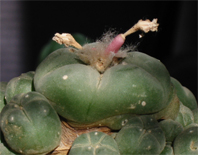
Lophophora jourdaniana – thigmotropic stamens

Like many other species of cacti (including the other Lophophora species/varieties) L. jourdaniana has thigmotropic stamens, i.e. stamens that when touched fold in around the style (as is evident for the front stamens in the rightmost picture).

The following stop motion video provides a better illustration of the thigmotropic mechanism - I'll try to make a higher quality movie the next time the plant flowers.

It seems like the movie couldn't be embedded - you can watch it at http://youtube.com/watch?v=NcID667nZX8

References
Vlastimil Habermann (1975), “Lophophora jourdaniana Habermann species nova”, Kaktusy 11 (1), 3

Tuesday, May 22, 2007

Flowering Lophophora jourdaniana

One of my Lophophora williamsii v. jourdaniana plants flowered last week. I’m hoping the early flower can be seen as a promise for more flowers this season – last year and the year before last the plant only displayed one flower.

Flowering Lophophora jourdaniana

The sun was obscured by clouds most of last week and consequently the flower never unfolded completely before it withered. The picture above shows the flower at its peak – it’s still beautiful in all its rose-violet charm, but for comparison you can check the fully unfolded flower from last year in all its splendor.

Spent Lophophora jourdaniana flower

Saturday, April 21, 2007

The power of grafting – 3rd anniversary

Today one of my Lophophora williamsii (SB 854; Starr Co, Tx) plants is celebrating its 3rd anniversary as a scion grafted onto a Trichocereus pachanoi stock. The plant has set 4 offshoots and grown to a width of 7.3 cm (~2.9''), 3 of the offshoots are wider than 4 cm (~1.6'') while the smallest just exceeds 2.5 cm (~1'').

Grafted Lophophora williamsii (SB 854; Starr Co, Tx)

The plant set 9 flowers last year and has already displayed two flowers this year. The dried fruits resulting from last season’s flowers are clearly visible in the above photo along with the withered remains of the two “fresh” flowers from this week. The photo below was taken a couple of days ago while the flowers were still at their peak.

Two early Lophophora williamsii flowers

Usually I assist the plant with its self-pollination but this season I will not interfere. I’m doing this to test to which degree the plant will be able to set seed without any help – of course I can’t do anything about the thigmotropic reactions of the stamens or insects taking liberties with the flowers ;-)

A couple of days ago a flower bud also appeared on the largest of the offshoots and it will probably bloom within a week; unfortunately I will not be home to witness it. If all the offshoots begin to flower and the main shoot continues to flower in its usual pace, I’ll soon grow more seeds than I’ll ever need.

Offshoot setting a flower

Since last summer the Trichocereus pachanoi stock has also been allowed to grow an offshoot. Usually I remove these from stock plants in order not to starve the scion, but this one appeared almost at soil level and I decided to let it grow and later graft one of last years Lophophora williamsii (SB 854; Starr Co, Tx) seedlings onto it (these seedlings are the result of self-pollinating the above plant, i.e. technically they are clones of the mother plant). I had planned to do the graft today, but I’ll leave for the Netherlands tomorrow and decided to postpone doing the graft till I’m back.

Trichocereus pachanoi stock with offshoot

I was in doubt whether or not to include the last photo but decided to do it anyway. I’m fascinated by the dreamy image of the flowers backlit by the soft light of the setting sun, filtered through the foliage of a sprawling Bowiea volubilis. My girlfriend finds the picture boring and “too green” – but who is she to trust, she’s not into cacti ;-)

Flowers backlit by the setting sun

For comparison you can check the posts on the same graft written one and two years ago.

Update - April 28, 2007
Fortunately I made it home from the Netherlands in time to experience the pup unfold its first flower. The flower is not as sturdy as those of the main shoot, but what’s to expect from a novice ;-)

Flowering Lophophora williamsii pup

Today I also removed the dried fruits of last season’s flowers and freed the seeds.

9 dried Lophophora williamsii fruits

Close-up of dried Lophophora williamsii fruit

The result of the harvest was approximately 100 seeds.

Home grown Lophophora williamsii seeds

Thursday, April 19, 2007

A day at the New York Botanical Garden

During a recent vacation in New York City my girlfriend and I decided to leave the turmoil of the city behind for a day and head for the more tranquil environment of the New York Botanical Garden. I had great expectations for the visit, partly because the garden was established by Nathaniel Lord Britton (of Britton and Rose fame) and partly because of the NYBG Virtual Herbarium, a great information source on the Cactaceae family. As it turned out, the garden’s collection of live cacti is rather sparse; fortunately a handful of flowering Mammillarias saved the day ;-)

Mammillaria bombycina (western central Mexico)

Mammillaria rekoi (Oaxaca, Mexico)

Mammillaria elongata (Hidalgo, Mexico)

Even though the number of cacti plants is limited, the Enid A. Haupt Conservatory is a spectacular place and we spent hours exploring it – also, the orchid show was on during our visit, making it a lot easier to convince “She Who Must Be Obeyed” that we should examine the different plants in detail ;-)

A view of the NYBG cactus house
A view of the NYBG cactus house (and a random visitor)

The Enid A. Haupt Conservatory

The Enid A. Haupt Conservatory is the largest Victorian glasshouse in the US and the beautiful structure is in itself worth a visit.


The NYBG also has an outside bed with cold hardy cactus species.

Saturday, March 31, 2007

Lophophora and Epithelantha - experiments in cold hardiness II

Since 2004 I’ve experimented with growing Lophophora, Epithelantha, and Acharagma in an unheated greenhouse in Denmark. The winter this year has been damp but not very cold - the coldest temperature registered in the coldhouse was -5C (23F) – so even the L. diffusa plants are doing great.

Lophophora williamsii (SB 854; Starr Co, Texas)

The L. williamsii plants (sown May 2004) are thriving in the coldhouse. The epidermis is glaucous bluish-green, much truer to the type than plants grown in my windowsill. All my cold grown Lophs are wrapped in horticultural fleece during winter – not so much because of the temperature, but to avoid attacks from various critters. This kind of damage is not a problem with the spine covered species.

Lophophora diffusa (Higuerillas, Queretaro, Mexico)

In 2005 I sowed L. diffusa and L. decipiens to grow in the coldhouse. Especially the L. diffusa plants had a hard time last winter and only 2 survived. Both are now doing fine and are developing the typical yellowish-green epidermis.

Lophophora decipiens

L. decipiens is not a “good” species; it’s probably just a cultivar form of Lophophora fricii (I couldn’t obtain any collection data for these seeds either when I bought them). Anyway, the plants are doing well and are getting ready to go 8-ribbed at an age of two.

I’m growing both “regular” Epithelantha micromeres and Epithelantha micromeris v. gregii. The gregii variety seems to be a faster grower than the regular micromeres; it also has a very beautiful coverage of spines, as illustrated below.

Epithelantha micromeris v. greggii (Cuesta la Muralla, Coahuila, Mexico)

Epithelantha micromeris v. greggii – closeup

All of the Epithelantha plants made it through this winter without damage.

Monday, March 05, 2007

Seed starting Lophophora, Ariocarpus, and Epithelantha

The last couple of days I’ve been busy starting the next generation of plants from seed. One of the more interesting lophs this year is a variety of Lophophora williamsii originating from El Oso, Coahuila, Mexico. According to The genus Lophophora – Kaktusy Special 2, 2005 this variety forms massive clusters with individual heads measuring up to 15 cm (5.9'') in diameter! Unfortunately it seems the El Oso site is severely threatened by agricultural activities.

Lophophora williamsii - El Oso, Coahuila
Lophophora williamsii - El Oso, Coahuila (picture taken from The genus Lophophora – Kaktusy Special 2, 2005)

I’ve sown the following Lophophora seeds this year:

  • Lophophora diffusa v. koehresii (RS 1182; El Sabino, San Luis Potosí)
  • Lophophora diffusa ssp. kubesai (JJH 0010892; Puente Mezquitio, Querétaro)
  • Lophophora fricii (RS 404B; Viesca, Coahuila)
  • Lophophora williamsii (MMR 89; El Oso, Coahuila)
  • Lophophora williamsii (RS 428A; Cuatro Ciénegas, Coahuila)
I have great expectations for the Lophophora diffusa ssp. kubesai. According to the retailer’s seed catalog this variety is prone to offsetting (in contrast to the typical single stemmed L. diffusa specimens), eventually forming multi-headed clumps as pictured below. Lophophora diffusa ssp. kubesai Lophophora diffusa ssp. kubesai In addition to the Lophophora seeds I also started a handful of Ariocarpus from seed:
  • Ariocarpus fissuratus (JDL 26; Hot Springs, Big Bend, Texas)
  • Ariocarpus fissuratus (VVZ 204; Terlingua, Texas)
  • Ariocarpus fissuratus (VVZ 205; North of Alpine Texas)
  • Ariocarpus kotschoubeyanus v. macdowellii (RS 134; Hipolito, Coahuila)
I’ve specifically selected extreme northerly types of A. fissuratus as most of the Ariocarpus seedlings will be moved to a coldhouse later in spring (along with half of the L. williamsii and L. fricii seedlings) to experiment with the cold hardiness of these species. The move is also a necessity because my windowsills are getting crammed ;-) Finally, the following Epithelantha seeds (also for the coldhouse) were sown:
  • Epithelantha micromeris (JM 101; Sitting Bull Canyon, New Mexico)
  • Epithelantha micromeris v. gregii (MMR 179; El Oso, Coahuila)
The seeds were bought from Jan Martin Jecminek and Jaromír Dohnalík – details for both are listed in the seed and plant retailers section. All seeds are sown in a mix of limestone gravel, regular soil, and loamy sand (mixed in a 2:2:1 ratio). The pots are placed in closed bags where they will stay until the seedlings are well established - check out the post on growing cactus from seeds for more information on seed starting.

Thursday, February 01, 2007

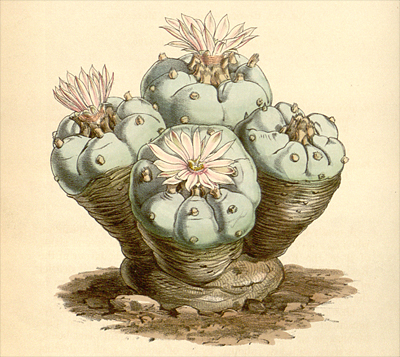
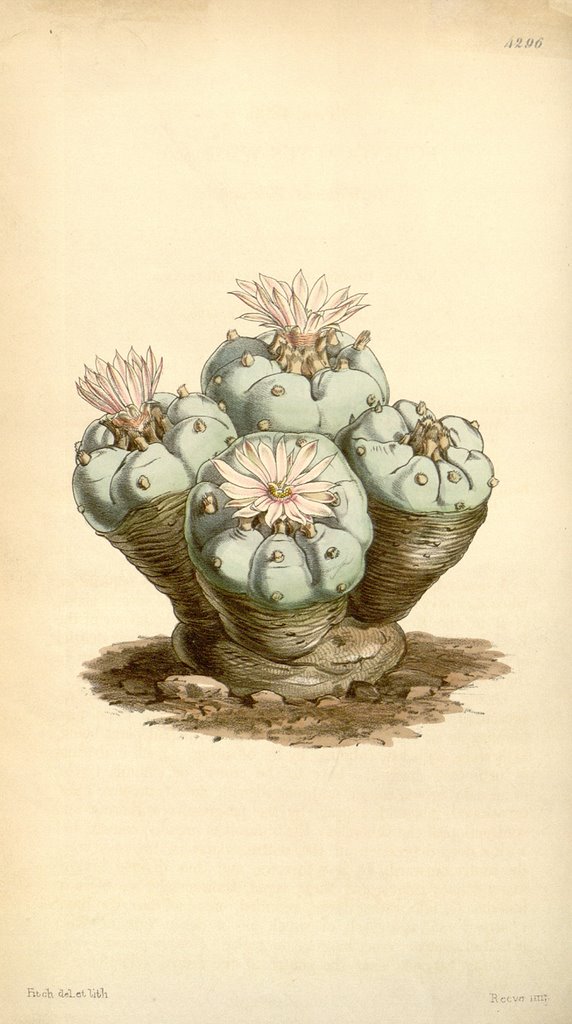
Curtis’s Botanical Magazine – plate 4296 (vol. 73, 1847), Lophophora williamsii

Curtis’s Botanical Magazine – plate 4296, Lophophora williamsiiSince my early days as a “Lophophora aficionado” I’ve heard and read that the first illustration of Lophophora williamsii appeared in Curtis’s Botanical Magazine in 1847 (plate 4296). This fact seems to be very well known – probably because of Anderson’s book Peyote, The Divine Cactus – nevertheless it’s been next to impossible to find a good reproduction of the illustration.

These days are over. The Botanicus Digital Library has scanned the material and made it available online. Below you’ll find copies of the scanned illustration as well as the accompanying description; the description is also reproduced in textual form.


TAB. 4296.

ECHINOCACTUS WILLIAMSII.

Mr. Williams' Echinocactus.
_____________

Nat. Ord. CACTEAE.- ICOSANDRIA MONOGYNIA.

Gen. Char. (Vide supra, TAB. 4190.)
_____________________________

ECHINOCACTUS Williamsii ; humilis caespitosus turbinatus inferne teres transversim cicatricatus cinereo-fuscus superne umbilicato-depressus glaucus 6-8-costatus, costis latis convexis parce tuberculatis inermibus pulvilligeris, pulvillis e pilis fasciculatis densis erectis formatis, floribus parvulis subsolitariis albo-roseis.

ECHINOCACTUS Williamsii. “Lemaire, ex Salm-Dyck in Otto et Dietr. Allgem. Gartenzeit, xiii. p. 385.” Walp. Repert. V. 5. p. 816.
_____________________________

A neatly-formed species, which has a very pretty appearance when its starry blossoms are expanded. We received several plants of it at the Royal Gardens of Kew, through the favour of the Real del Monte Company, from the rocky hills of their district of mines in Mexico, with many other treasures. It flowers in the summer months.

DESCR. Our largest plants do not much exceed the size represented. They grow in a tufted manner and are often proliferous, as in the instance here shown: the parent plant being, as it were, stifled or subdued by its offspring. Each individual is turbinate: from the base to the crown, or summit, terete, of an ashy brown colour, and scarred with close transverse lines, occasioned, it would appear, by the progressive withering and contraction of the tubercles: the summit is broadly convex, but with a deep depression in the centre, glaucous, traversed from the centre outwards by 6-8 furrows, and thus divided into as many convex ridges, and these again, transversely, but more or less deeply, into rather large, rounded, more or less confluent unarmed tubercles, each of which has a dense tuft or short pencil of compact erect hairs:--no aculei. Flowers proceed from a young tubercle, near the centre of the crown. The base of the calyx is downy. The petals lanceolate, rather numerous, white, externally tipped with pale green, and having a rose-coloured line down the centre. Stamens yellow. Stigma of four spreading rays.


Curtis’s Botanical Magazine – plate 4296, Lophophora williamsii, Illustration
Curtis’s Botanical Magazine – plate 4296, Lophophora williamsii, Description p1
Curtis’s Botanical Magazine – plate 4296, Lophophora williamsii, Description p2

The scans are courtesy of the Botanicus Digital Library, Missouri Botanical Garden and are free for non-commercial use, as long as attribution is provided.

High-resolution copies of the scans can be found in the files section of the Lophophora Google group.

Back to online articles.

All Time Most Popular Posts