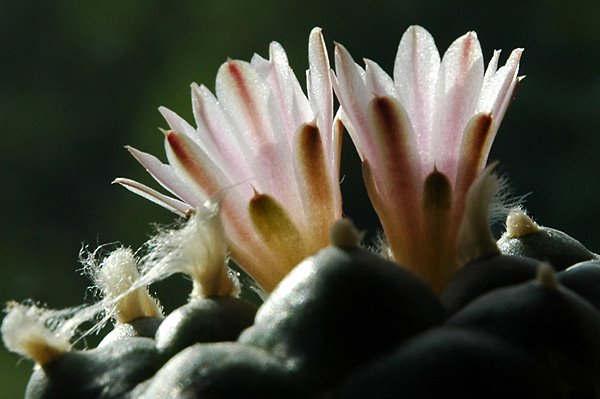
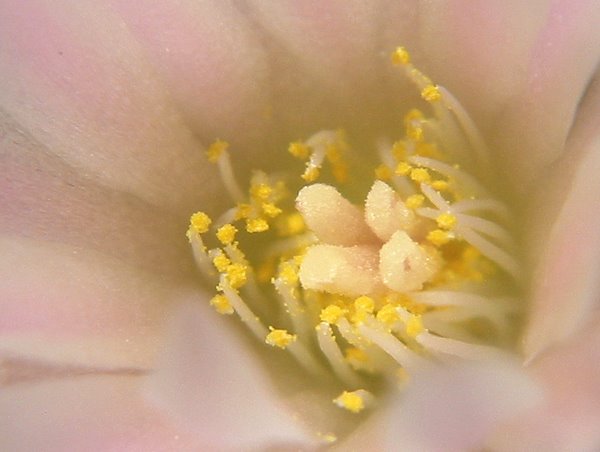
Monday, December 04, 2006

Proper peyote harvesting technique

Lophophora williamsii (peyote) populations have diminished in large areas of South Texas where peyoteros harvest the cactus for ceremonial use by the Native American Church. Habitat destruction caused by urban development, rootplowing, etc., account for much of the reduction, but the regulated commercial harvest of peyote is also taking its toll. Some harvesters cut the peyote too low (it can be very hard to tell where the shoot ends and the root begin) - consequently many of the decapitated plants will not regenerate new stems and are left to die.

To address this problem Martin Terry and James D. Mauseth have investigated the proper technique for harvesting peyote, and found that the cactus must be cut off at or immediately below its base, leaving the subterranean portion of the plant (including all or most of the subterranean part of the stem) in the ground to regenerate new crowns. Their harvesting technique is outlined below.
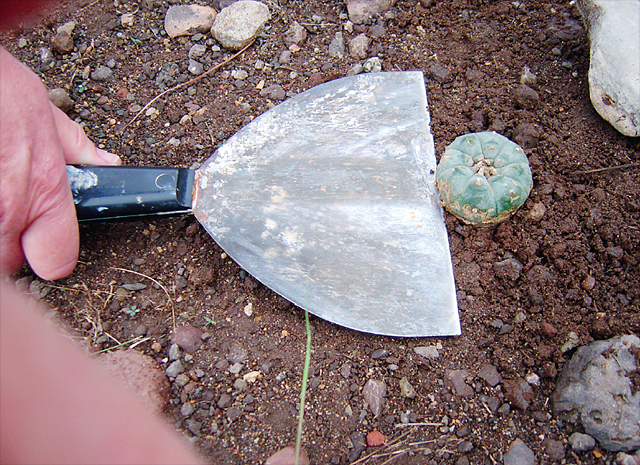
Peyote harvesting aPlant about to be cut transversely at the base of the crown (the photosynthetic part of the stem), i.e., at ground level.
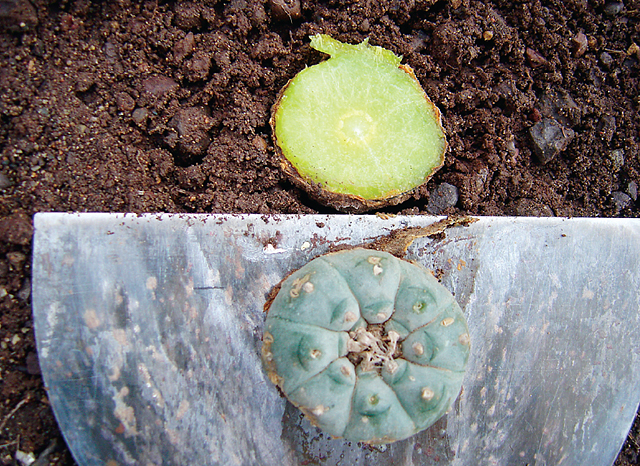


Peyote harvesting bCut has been made parallel to the ground surface, and the harvested crown (below) has been removed from the subterranean portion of the stem (above, remaining in the ground). The cut surface shows a cross section of the vascular cylinder (ring of yellow tissue near center of stem), the pith within the vascular cylinder, and the yellowish green parenchymal tissue of the cortex of the stem (between vascular ring and epidermis).
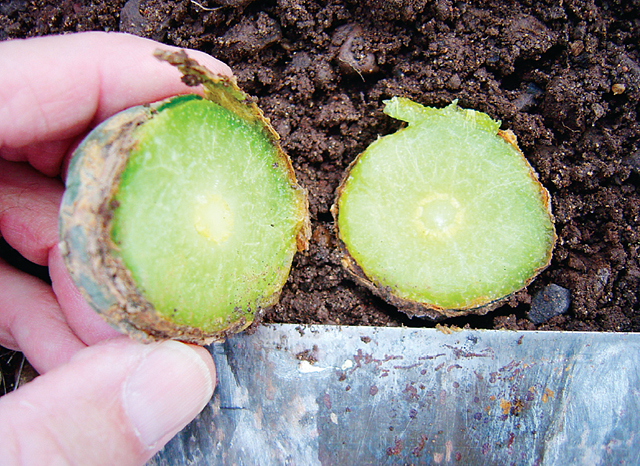
Peyote harvesting cThe underside of the harvested crown (left) shows a very narrow (2–3 mm wide) ring of bark at the perimeter of the cut surface, indicating that the cut was barely below the base of the crown, in the uppermost portion of subterranean stem. The cut surfaces match, except that crown parenchyma (left) is slightly greener due to higher chlorophyll content, whereas the subterranean stem parenchyma (right) is more yellowish.
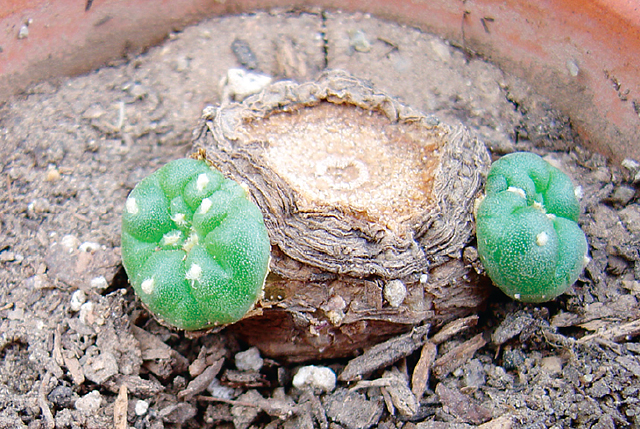
Peyote harvesting dTwo young peyote crowns (“pups”) regenerating by lateral branching from the upper edge of the subterranean stem of a plant that was decapitated 7.5 months previously. This plant is the same individual shown in the 3 previous pictures. Each of the new crowns is ca. 1.5 cm in diameter.

If the peyote is cut too deep no tubercles are left to sprout and continue growing after the top has been removed, i.e. the closer to soil level the plant is cut, the greater the chances are that the remaining parts of the plant will retain healthy tubercles and be able to re-grow new crowns. Terry and Mauseth base their technique on detailed studies of the anatomy of root, shoot and hypocotyl (region between shoot and root) and also give recommendations on how to distinguish shoots from roots without actually cutting the plant open.

References
Martin Terry, James D. Mauseth (2006), “Root-shoot anatomy and post-harvest vegetative clonal development in Lophophora williamsii (Cactaceae: Cacteae): implications for conservation”, Sida, Contributions to Botany 22, 565-592
(Download the article from Sida - 19.2 MB)

Sylvia Moreno, “In Deep South Texas, peyote harvest dwindling”, Seattle Times


See also How to sustainably harvest Lophophora williamsii (Peyote) from Kadas Garden.

Peyote harvesting

Sunday, November 12, 2006

Britton and Rose - The Cactaceae

Britton and Rose: Lophophora

In the period from 1919 to 1923 the Carnegie Institution of Washington, D.C. published the monograph The Cactaceae - Descriptions and Illustrations of Plants of the Cactus Family. This four-volume work, written by Nathaniel Lord Britton and Joseph Nelson Rose, set new standards in cactus botany with meticulous diagnoses based on greenhouse and herbaria studies and years of field work. The four volumes are illustrated by photographs, drawings and color plates with the delicate artwork of Mary Eaton.
In the beginning of the 20th century, cactus taxonomy was a chaos with few but huge genera (in 1903 Schumann recognized about 800 species, which he grouped under 20 very heterogeneous genera). Rose and Britton fragmented this antiquated system of “collective genera” into many, more refined genera (The Cactaceae describes 1255 species under 124 genera). As a rule, the genera were founded on characters of flowers and fruit, combined with vegetative characters and geographical distribution.

The only edition of The Cactaceae - Descriptions and Illustrations of Plants of the Cactus Family available to the general public has for years been the black and white reprint from Dover Publications, but now the original first edition with color plates is being made available in digital form. At the time of writing volume 1 through 3 can be downloaded from Au Cactus Francophone along with other interesting material that are rarely seen by cactophiles (the Britton and Rose files are also available from the Carnegie Institution). The Cactaceae is a classic – go get it!

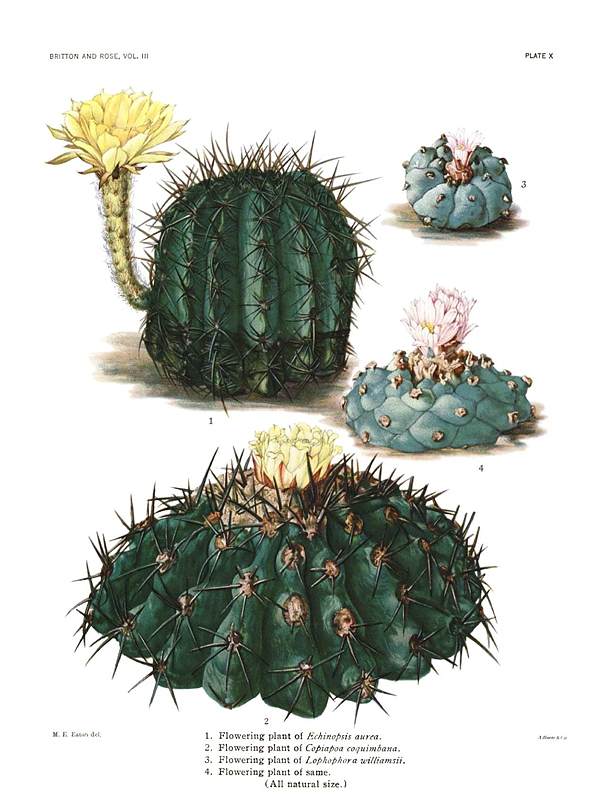
The two plates depicting Lophophora are included below.

Britton and Rose, The Cactaceae, Volume III, Plate X
The Cactaceae, Volume III, Plate X

Britton and Rose, The Cactaceae, Volume III, Plate IX
The Cactaceae, Volume III, Plate IX

References
A. Berger (1924), “Book Reviews: The Cactaceae. Descriptions and Illustrations of Plants of the Cactus Family”, Botanical Gazette, Vol. 77, No. 4, pp. 454-458.

Update
As of March 2, 2007 all four volumes of The Cactaceae are available from Au Cactus Francophone.

Tuesday, October 31, 2006

lophophora.info by Gerhard Köhres

I've posted on Gerhard Köhres's Lophophora information site before, but thought it worth mentioning again.

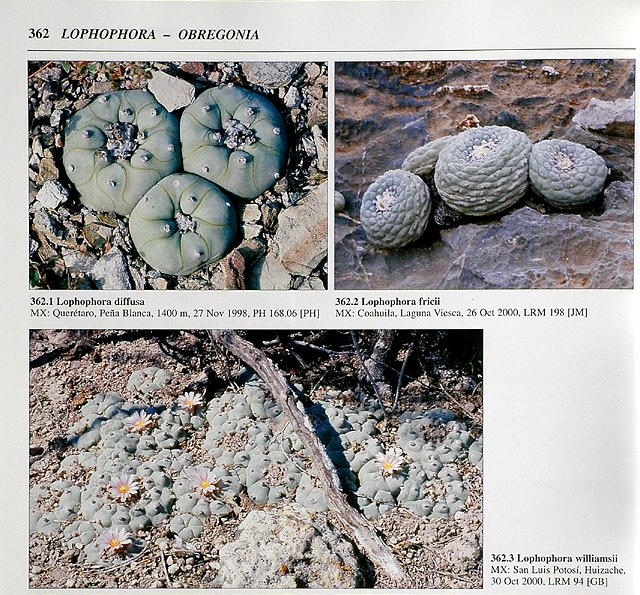
The site is packed with photos of Lophophora plants growing in habitat (see the samples included below) and constitutes the most comprehensive pictorial documentation of the genus that I'm aware of. The pictures are ordered by state and location and can be found at http://lophophora.info/.

Lophophora williamsii (Hipolito, Coahuila)

Lophophora williamsii (Hipolito, Coahuila)

Lophophora diffusa (Higuerillas, Queretaro)

Lophophora diffusa (Higuerillas, Queretaro)

Lophophora diffusa var. koehresii (San Francisco, San Luis Potosi)

Lophophora diffusa var. koehresii (San Francisco, San Luis Potosi)

Lophophora fricii (El Amparo, Coahuila)

Lophophora fricii (El Amparo, Coahuila)

Monday, October 23, 2006

The quest for Texan Lophophora williamsii

For a while I’ve been searching for L. williamsii seeds and plants originating from Trans-Pecos, Texas. It’s been quite hard to find any – probably because of the legal status of Lophophora williamsii in the USA. Earlier this year I finally found a retailer selling plants originating from material collected in the Pecos River area, Val Verde County, Texas (JJH 8608293), and promptly ordered a handful of plants.

Lophophora williamsii, Pecos River, Val Verde Co.

The plants have been grown very hard and are of a high quality with good, sturdy roots; the width of the plants are in the range from 1.5 to 2.25 cm (0.6-0.9''). They were reasonably priced at 4 euro (~ 5 USD) each.

I recently received a second batch that I planned to grow in an unheated cold house, but I now have second thoughts and will probably postpone the cold house experiment until I’m able to propagate the plants from seed.

The plants were bought at Kakteen Kliem, a German retailer with a good selection of plants with locality information (I also bought some of his Lophophora fricii, Parras, Coahuila, Mexico (JJH 9602115) and Astrophytum asterias, Rio Grande City, Texas (PQ 91)). I would be glad to hear of any other sources of Trans-Pecos Lophophora with detailed locality information.

Saturday, September 30, 2006

Lophophora williamsii – autumn flowers

Having passed the autumnal equinox I hadn’t expected any more flowers from my lophs – nevertheless two of them decided to bloom this week, one for the first time.

Lophophora williamsii (SB 854; Starr Co, Tx) flower

My grafted Lophophora williamsii (SB 854; Starr Co, Tx) has been flowering abundantly all summer. Several fruits have already ripened and more are budding; still the plant took the opportunity to squeeze in yet another flower before going dormant. The flowers of this plant are quite large, approximately 2.75cm (~1.1'') in diameter.

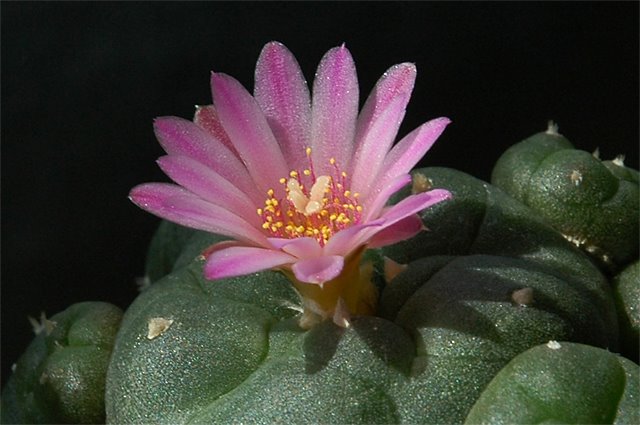
Lophophora williamsii var. caespitosa flower

The Lophophora williamsii var. caespitosa graft has been growing profusely but never felt like flowering before now. The flowers are small, less than 2cm (~0.8'') in diameter, compared to those of L. williamsii (SB 854; Starr Co, Tx), and the midstripes are a slightly darker shade of pink.

Lophophora williamsii var. caespitosa

The scion used for this graft was taken from the plant shown in the blog profile. Unfortunately this plant later caught rot and died.

Sunday, September 17, 2006

The New Cactus Lexicon: A Review

The New Cactus LexiconThe New Cactus Lexicon
David Hunt, Nigel Taylor, Graham Charles
dh books, 2006
ISBN 0 9538134 4 4


After a lengthy gestation period, the New Cactus Lexicon was published this summer. For ease of handling it’s divided into two volumes – the text volume is a concise alphabetical catalogue of cactus genera, species and subspecies accepted or proposed in the current standard literature on cacti, while the atlas volume contains more than 2500 illustrations covering nearly all of the species and subspecies recognized in the text, sometimes with two or more images.

Atlas volume
With its 526 pages of illustrations this volume is a stunning visual masterpiece, and the most comprehensive pictorial record of cacti ever published (the slightly blurred quality of the examples is entirely due to my reproduction).

Illustrations of Lophophora speciesThe aim of the atlas volume is to illustrate all of the recognized species, with an emphasis on using photographs of plants in habitat at a specified locality or in cultivation from a known source, whenever possible.

The entries in the atlas are not grouped alphabetically but rather ‘like with like’, making it easier for the user to compare related species or identify unnamed plants.

Text volume
The text volume comprises 373 pages and is a no-frills dictionary of the currently recognized genera, species and subspecies of cacti. It does not include any chapters of general information about the family, its history, morphology, ethnobotany, cultivation and so on – so don’t expect an encyclopedic work like Anderson’s The Cactus Family or Benson’s Cacti of the United States and Canada.

David Hunt is a known lumper and some of the main genera changes (Parodia now includes the former Notocactus, Echinopsis including Lobivia and Trichocereus etc.) have already been the cause of much debate (maybe that’s the reason for Hunt quoting Bill Bryson for having said “Taxonomy is sometimes described as a science and sometimes as an art, but really it’s a battleground” ;-).

Illustrations of Acharagma speciesStill, there has been room for some splitting , e.g. the division of Opuntia has added 12 genera, Lophophora fricii is now recognized as a valid species, Acharagma is not submerged in Escobaria, etc.

Whether you agree with Hunt’s classification or not, the New Cactus Lexicon is an excellent reference and certainly will become the reference book for years to come. As already mentioned the atlas volume is in a league of its own with excellent illustrations of the majority of the recognized cacti species and subspecies.

You can find more information on the New Cactus Lexicon in this post.

The book can be acquired directly from dh books or from specialized bookstores like Rainbow Gardens Bookshop or Keith’s Plant Books.

Thursday, August 24, 2006

Flowering Lophophora williamsii – III

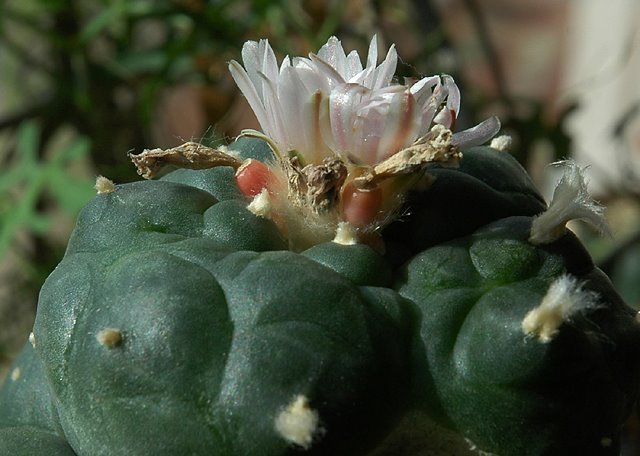
My Lophophora williamsii (SB 854; Starr Co, Tx) graft has gone on a flowering spree and is currently flashing its 7th and 8th flower this season.

Flowering Lophophora williamsii

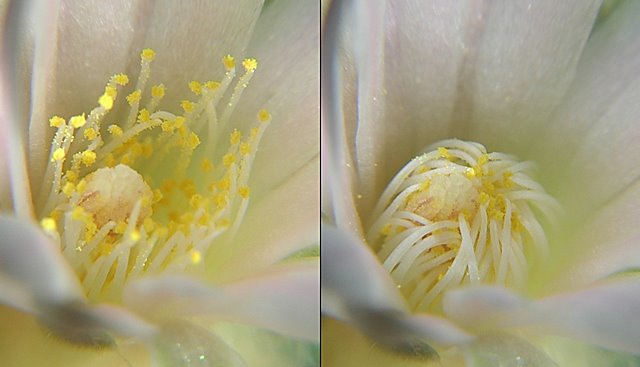
Like other species of Lophophora, L. williamsii has sensitive stamens, closing around the style when touched.

L. williamsii stamens closing around the style

In this flower the anthers are actually brushing the stigmas when the stamens react to a touch, i.e. the thigmotropic reaction will assist the flower to self-pollinate. I have to test if this is sufficient to pollinate the flower (in a previous post I also wondered if it was necessary to manually self-pollinate the Lophophora williamsii (SB 854; Starr Co, Tx) flowers or if they could cope without any help ;-)

For comparison you can check a photo of thigmotropic behavior in Lophopohora jourdaniana. In this case the stamens fold in below the stigmas, apparently not touching them.

The fruits (or berries, pods, whatever;-) from the plants first two flowers this season have just appeared.

Lophophora williamsii fruits

I’m looking forward to see how many of the flowers will actually result in a fruit.

< previous |

Monday, July 31, 2006

Flowering Lophophora williamsii v. jourdaniana

According to Habermann’s description Lophophora williamsii v. jourdaniana differs from other L. williamsii varieties by having rose-violet perianth, pistil and filaments as well as having small persistent spines on young areoles.

Flowering Lophophora williamsii v. jourdaniana

One of my Lophophora williamsii v. jourdaniana plants flowered today, beautifully illustrating the description (even some spines can be seen faintly in the photos ;-)

Lophophora williamsii v. jourdaniana flower

Like L. williamsii v. williamsii the jourdaniana variety has thigmotropic stamens, i.e. stamens that when touched fold in around pollinating insects or the style. I wonder if this mechanism is used for actively depositing pollen on pollinators or for avoiding self-pollination (or both)?

Lophophora williamsii v. jourdaniana flower
L. williamsii v. jourdaniana – thigmotropic stamens

The flowering of this plant coincided with the flowering of my grafted Lophophora williamsii (SB 854; Starr Co, Tx). I decided not to outcross the plants but instead self-pollinate both of them; first of all to keep my SB 854’s “clean”, but also because I want to test the alleged self-incompatibility of the jourdaniana variety.

This Lophophora williamsii v. jourdaniana plant also flowered last year – it was then outcrossed with pollen from a regular L. williamsii and yielded 2 seeds.

Flowering Lophophora williamsii – II

As mentioned in an earlier post flowering was late this year. My grafted Lophophora williamsii (SB 854; Starr Co, Tx) is now making up for this by showing off its sixth flower this season.

Flowering Lophophora williamsii – 6th flower this season

The three previous flowers unfolded while I was away on vacation – the remains of all the spent flowers are visible beneath the current one.

This flowering coincided with the flowering of a Lophophora williamsii v. jourdaniana. I decided not to outcross the plants but instead self-pollinate both of them; first of all to keep my SB 854’s “clean”, secondly I want to test the alleged self-incompatibility of the jourdaniana variety.

< previous | next >

Friday, July 14, 2006

Flowering Lophophora williamsii

Flowering has been late this year but finally my grafted Lophophora williamsii (SB 854; Starr Co, Tx) decided to come back with a vengeance by setting two flowers simultaneously.

Lophophora williamsii with two flowers

The scar visible in the upper left-hand corner of the photo formed after the epidermis ripped, caused by too vigorous growth.

The flowers are funnelform, pinkish white with a light pink midstripe.

Funnelform Lophophora flowers reaching for the sun
Funnelform flowers reaching for the sun

I self-pollinated the flowers but am wondering if it’s necessary – the anthers are virtually brushing the stigmas, depositing pollen without any help.

Lophophora anthers brushing stigmas
Anthers brushing stigmas

Last growing season I also posted on this plants flowering and fruit setting (use the previous and next links to navigate the posts).

< previous | next >

All Time Most Popular Posts