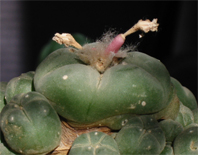
The fact that the last many winters have been mild in Denmark has made me act with presumption, ignoring several basic rules for growing cacti in freezing conditions. The week before Christmas Denmark was hit by an early cold spell, bringing hard frost that made many of my coldhouse grown plants suffer the consequences of my folly.
Frozen Lophophora williamsii (SB 854; Starr Co, Texas)
The family spent the Christmas holidays in the summerhouse arriving late December 21, the day of the winter solstice. Of course I had to check up on my plants in the coldhouse first thing, but was met by a disheartening sight: The beautiful turgid, dark jade green Lophophora williamsii plants pictured above are frozen solid.
Lophophora williamsii draped in horticultural fleece
The greenhouse walls are covered with curtains and the plants are draped in horticultural fleece to protect them from the cold, still the temperature was measured to slightly less than -7 C (~ 19 F) just next to the plants. The temperature alone shouldn't be a problem as these plants have endured conditions in the coldhouse since 2004 (actually these very plants started my experiments in Lophophora cold hardiness so I'm double sad to loose them), but freezing conditions combined with plants that haven't had the time to go flaccid before subjected to the frost is a deadly cocktail. I'm sad to admit that I watered the above Lophophora williamsii plants along with a couple of Gymnocalyciums and two large pots of 3 year old L. williamsii seedlings very late in the season (late September). To make things worse October and November came with a perpetual overcast sky and constant, high humidity levels, leaving the plants no chance to dry out thoroughly. Finally, to top things off, December brought very early and double digit freezing temperatures (measured in celsius) killing off the plants still bloated with water. I have learned my lesson and will never water any of my coldhouse plants later than the end of August (the exception being very young seedlings that might otherwise succumb to drought).
Thawed Lophophora williamsii (SB 854; Starr Co, Texas)
Come Boxing Day the frost went away, leaving me with thawing plants and the possibility to asses the damage – unfortunately I had to leave for home the day after, so the exact casualty figures will follow in a later post.
The thawed Lophophora williamsii plants pictured above felt soft and slightly mushy to the touch but I didn't have the heart to squish them to see if they were fluid inside.
Thawed Lophophora williamsii seedlings
The two large pots of 3 year old Lophophora williamsii seedlings are gone for sure. Upon thawing the seedlings first felt like small bags of slush ice before the interior turned completely fluid. Subjected to a light pressure the epidermis broke and liquid oozed out, indicating that the cell walls are lacerated by the frost.
Frost killed Lophophora diffusa
Another mistake I made was to move new plants into the coldhouse without leaving them sufficient time to acclimatize properly for the winter – the plants were moved to the coldhouse in late September/early October. On that account I lost 3 large Lophophora diffusa like the one pictured above.
As is evident from the flaccid (and very much alive) L. diffusa pictured below, these plants are able to survive the cold conditions if treated properly. The two plants are from the same batch, are growing under the same conditions (and the pictures were taken the same day). The only difference being that the survivor was given proper time to adjust to its harsh environment.
Alive Lophophora diffusa
I also recently introduced a handful of new Ariocarpus plants to the coldhouse – they had me somewhat worried but seem to cope. 
Frost damaged Penis Cactus
My last mistake was to leave a collection of columnar cacti out on the terrace until mid October, exposing them to precipitation and moisture for much longer than what's healthy for plants that must winter in freezing conditions. This has taken its toll on my formerly so erect Penis Cactus - I'm not sure if the plant is completely killed off by the frost but it is certainly damaged. I'm worried for the rest of my Trichocereus collection also; many of the plants felt completely frozen to the touch but are not showing any evident signs of damage yet – time will tell, though.
The lesson I have learned from this experience is to always expect the worst from the weather and prepare accordingly (which should have been evident in the first place!). Even if the last many winters have been mild, I should have known that frost can set in suddenly and quite early in Denmark – instead of being lulled into the assumption that most of the winter would be mild with hard frost arriving late, as the situation has been the last few years. I won't be that careless in the future.
After a couple of mild days the weather reports again predict a period of hard, day- and nighttime, frost extending into the new year.
Update, April 11, 2010
Read more about the casualties and survivors of the frost.
Tuesday, December 29, 2009
The killing frost
Tuesday, December 15, 2009
Flowering Ariocarpus kotschoubeyanus var. macdowellii

Flowering Ariocarpus kotschoubeyanus var. macdowellii
As mentioned in an earlier post I'm fairly inexperienced when it comes to growing Ariocarpus and still in the process of building a collection of these fascinating plants. A few months ago I bought a handful of plants from Mesa Garden including three Ariocarpus kotschoubeyanus var. macdowellii plants (SB 100; El Pilar, Coahuila).
I didn't really expect the plants to bloom this season but mid-September one of them greeted me with a beautiful, pale purple flower, so large that it completely covered the plant.
Ariocarpus kotschoubeyanus var. macdowellii flower, top view
I'm growing the plants in an unheated greenhouse in Denmark and specifically selected this variety of Ariocarpus kotschoubeyanus as it comes from the northern extreme of the species' range. The Living Rocks website has the following to say on A. kotschoubeyanus var. macdowellii:
The northern populations are characterized by a form, which has become known as A. kotschoubeyanus var. macdowellii, this is found to the west and east of Parras with a range of over 100km from Viesca to Estatcion Marte in Coahuila. A. kotschoubeyanus var. macdowellii is a smaller plant than the type, with small beak-like tubercles and pale mauve flowers, often with a high white content in the outer petals.
If the macdowellii plants survive the winter in the cold house I'm probably also going to test the larger, magenta flowered, southern form of the species, Ariocarpus kotschoubeyanus var. elephantidens.

Ariocarpus kotschoubeyanus var. macdowellii flower bud
I'm growing the plants in a greenhouse at my summerhouse and can't check in on them on a regular basis, so it felt like a stroke of luck when I was met by a budding A. kotschoubeyanus var. macdowellii one late Friday evening in the middle of September. The next day the plant was in full bloom as illustrated by the pictures above. In early October one of the other macdowellii plants also developed a bud, but unfortunately I didn't see it flower.
Regarding cold hardiness, the A. kotschoubeyanus var. macdowellii plants are going to be tested sooner than expected. Denmark has a cold spell coming and the weather report shows temperatures below -10 C (14 F) within the next few days.
Sunday, November 08, 2009
Lophophora williamsii f. cristata (crested / fasciated peyote cactus)

Lophophora williamsii f. cristata, top view
Last Sunday I went on a shopping spree and ordered some Lophophora alberto-vojtechii seeds from Köhres and a Lophophora williamsii f. cristata plant from Cactus Plaza.

Crested Lophophora williamsii, front view
The crested L. williamsii arrived yesterday without a scratch and looks exactly as advertised with a length of 4.2 cm and grafted on a Trichocereus pachanoi stock; the width of the crest is 2.5 cm.

Lophophora williamsii f. cristata, side view
I have never grown fasciated Lophophora before and look forward to follow the plant in the years to come. I'm particularly curious to see if the fasciation also affects the flowers or if they develop normally.

Fasciated Lophophora williamsii, the other front
I'm happy as can be with my new acquisition while “She Who Must Be Obeyed” gently shakes her head in silent disbelief ;-)

Crested Lophophora williamsii grafted on Trichocereus pachanoi stock
Friday, November 06, 2009
Lophophora alberto-vojtechii seeds

Flowering Lophophora alberto-vojtechii, San Luis Potosi
Yesterday I received my first ever seeds of the newly described Lophophora alberto-vojtechii. These seeds are still rarely offered and consequently the price is quite high so I only bought one packet containing 10 seeds. I got the L. alberto-vojtechii (San Luis Potosi, Mexico) seeds from Gerhard Köhres who charges 16 euro (~ 24 USD) per packet.
Lophophora alberto-vojtechii, San Luis Potosi
I'm exited to see how these seeds develop and look forward to the coming growing season (I suppressed a momentary urge to plant the seeds immediately and they are now safely awaiting the coming spring in the refrigerator ;-)
If you also want some of Köhres's Lophophora alberto-vojtechii seeds you can buy them from Lophophora.info (go to the "list" submenu) or from the online shop at Köhres Kaktus. It's too early to say anything about the quality of the seeds but the delivery was impressive; the seeds arrived only 3 days after I ordered them.
The photos featured in this post are from Gerhard Köhres's Lophophora.info site (go to the "habitat gallery" submenu). You can find the original pictures here and here along with more Lophophora alberto-vojtechii photos from the San Luis Potosi habitat.
Tuesday, November 03, 2009
Lophophora williamsii v. caespitosa graft – 5th anniversary
I'm sad to say that I have neglected this plant in more than one respect. First I forgot to post on its 5th “grafting anniversary” (this post is almost 5 months due), secondly I didn't check up on it all summer even though it had recently been under attack by red spider mites.

Lophophora williamsii v. caespitosa grafted on Trichocereus stock
As is evident from the pictures I didn't manage to get the mites fully under control before leaving the plant unattended for most of the hot summer months, during which the mites prospered and had a feast on the poor cactus.

Severe spider mite damage
I'm controlling the mites using neem oil, soap, and regular showers – I have considered miticides but am convinced that Darwinistic selection forces will kick in, leaving me with a population of miticide resistant spider mites in the windowsill ;-) I read somewhere that sulfur mixed in with the topsoil repels mites so I might try that (the less aesthetically pleasing solution is to dust the plants with sulfur). Hydrogen peroxide is also said to kill off mites so I still have a couple of options to try out before opting for the harsher chemicals.

Relatively undamaged button
Large areas of the grafted Lophophora williamsii v. caespitosa are still relatively unaffected by the mites so I'm sure it will grow back given time. I'm a bit puzzled, though, why this particular plant is so popular with the mites compared to most other plants in my collection.

Top view of grafted Lophophora williamsii v. caespitosa
For comparison you can check the posts on the same plant one, two, three, and four years ago.
Wednesday, October 14, 2009
A few Ariocarpus plants and a handful of Echinocactus seeds from Mesa Garden
I'm not a seasoned Ariocarpus grower but still in a slow but steady process of building a collection of these magnificent plants. I'm learning to handle the deep levels of patience required to grow Ariocarpus from seed, but sometimes I give in to my eagerness and have to buy a few plants ;-)
Ariocarpus kotschoubeyanus v. macdowellii
I like Mesa Garden's hard grown plants that almost invariably come with locality information. As I live in Denmark and Mesa Garden is located in New Mexico it is quite cumbersome and expensive to import plants (I once contacted the Danish plant directorate to get directions on importing cacti from countries outside of the European Union and was told it would involve import permits, CITES and phytosanitary documents plus an inspection of the plants upon arrival). To work around these obstacles I order plants whenever in the US and have them shipped to my hotel; from there they travel to Denmark packed in my suit case.
Ariocarpus kotschoubeyanus v. macdowellii, side view
I have only praise for the service offered by Mesa Garden, they are always responsive and extremely helpful in arranging timely deliveries - even within very short windows of time. Remember to specify substitutes, though. 
Ariocarpus fissuratus
I spent part of my summer vacation in New York City and again took the opportunity to order plants and seeds from Mesa Garden. Apart from the Ariocarpus kotschoubeyanus var. macdowellii (SB 100; El Pilar, Coahuila) and A. fissuratus (JM 122; Fort Stockton, Texas) featured in this post, I also ordered some Ariocarpus intermedius and A. retusus. Unfortunately Steven was out of the varieties I ordered of the latter two species, and I forgot to specify substitutes and consequently received only half of the plants that I ordered. Disappointing as it may be not to receive all the plants you are eagerly expecting, this is the only approach that makes sense (especially when you are focusing on the finer details like locality information) - I for sure would have been disgruntled to receive random substitutes as I was going specifically for the more cold hardy varieties of Ariocarpus as these plants will be growing in my cold house. I'll remember to specify substitutes with my next order ;-) 
Ariocarpus fissuratus, side view
As usual the plants received from Mesa Garden are compact and healthy. The Ariocarpus kotschoubeyanus var. macdowellii (SB 100; El Pilar, Coahuila) plants are approximately 4 cm high and 2.5 cm wide while the A. fissuratus (JM 122; Fort Stockton, Texas) plants are 4.5 cm high (excluding the fine roots) and 3.5 cm wide.
The plants were potted in the soil mix described in a recent post. The photo below illustrates quite well that these plants are so “cryptic” that you can walk right past them or trample them underfoot in the wild without noticing it, especially the A. fissuratus plants are extremely well camouflaged in this case.
Newly potted Ariocarpus plants
Lately I have been taken by Echinocactus and thus also ordered 100 seeds each of Echinocactus horizonthalonius (SB 409; Shafter, Texas), E. polycephalus (SNL 91; Las Vegas, Nevada), and E. texensis (SB 2006; Roosevelt Co, New Mexico) - E. texensis is also known as Homalocephala texensis. I'm completely new to raising Echinocactus from seed and decided to do a test run a couple of months ago, using only a few of the seeds (as it was very late in the season for seed starting). I scarified the seeds by rubbing them against a whetstone and soaked them in water for 24 hours. Today 25% of the E. texensis and 10% of the E. horizonthalonius have germinated while the E. polycephalus seeds still show no signs of activity. I know that the seeds probably need more heat and light than I can supply at this time of year, in order to germinate properly.
If you have more advice on starting Echinocactus from seed (especially the above mentioned species ;-) I would love to learn about it.
The Lophophora Blog is on Facebook
Just to let you know that I have set up a profile for the Lophophora Blog on Facebook along with a couple of pages. One of the pages more or less heralds all of the posts from this blog while the other, The Peyote Post, focuses on the traditional, indigenous use of the peyote cactus (to be honest I'm not exactly sure where to draw the line between the subjects covered on these two pages but figured they in general might cater to different audiences). I will also use these Facebook pages to link to subject matters that will be covered in detail on this blog later.
This blog will continue to be my main platform - the Facebook presence is just meant as an easy means of letting Facebook users follow the blog.
Tuesday, September 29, 2009
Recipe for cactus soil mix
On various occasions I've been asked what growing media I'm using for my cactus plants. I don't have a set soil mix recipe as such – the mix is a continuous work in progress influenced by earlier results combined with input from friends, articles, etc (and sometimes laziness drives me to use whatever ingredients I have readily at hand ;-) Anyway, a few weeks ago I mixed a large batch of growing media and decided to document the details. If you have any comments or suggestions for improvement, please let me know.

Cactus soil mix
As mentioned, I'm not religious regarding soil ingredients as long as the mix meets a few simple criteria. Good drainage and aeration is essential in any growing media used for raising cacti, still the growing media must have adequate moisture retention properties in order not to dry out too fast after you water it. Depending on the type of cacti you are growing you might vary the amount of organic matter (or omit it completely). I don't worry too much about nutrients in the soil – if you are using a pure mineral soil you'll have to supply most nutrients via fertilizers anyway. Finally it is also important to tailor the mix to the environment you grow the plants in, i.e. you have to factor in if your pots are clay or plastic, the climate you live in, your water regimen, etc.
I've heard it said that there are probably as many soil mixes as there are cacti growers. This post is the current take on my recipe for a cactus soil mix ;-)
The ingredients
Below you'll find the list of ingredients that I'm currently using for my cactus soil mix.
Unprocessed, raw moler

Unprocessed moler
Moler is a naturally occurring mixture of diatomaceous earth (a soft, chalk-like sedimentary rock) and bentonite clay, approximately 60% diatoms and 40% clay. Moler is quarried not too far from where I live, so once in a while I swing by one of the defunct quarries that are open to the public and fill up the car ;-) Instead of moler you could use chunks of granite or whatever rock is available to you – the advantage of moler is that it is very lightweight, but it is probably not very easy to obtain outside of Denmark. These larger pieces of rock are added to keep the soil open and allow air to get to the roots, furthermore the rock will reduce the volume of water a given amount of soil can hold.
Sharp sand

Sharp sand
Sharp or coarse sand (grit) should be readily available everywhere (otherwise ask your mason ;-). The sand reduces the soil's ability to retain water.
Limestone gravel

Limestone gravel
Many cacti, including Ariocarpus and peyote (Lophophora), are native to limestone areas, often growing within cracks in the limestone boulders themselves. For such species I'm adding a bit of limestone gravel to the soil mix – please note we are talking limestone and NOT lime which will scorch your plants. The limestone gravel also reduces the volume of water a given amount of soil can hold
Cat litter, baked moler

Cat litter, baked moler
It almost goes without saying that the water absorbing and retaining qualities of this product are excellent ;-) Still, this type of cat litter don't feel soaked even when fully wet. To the best of my knowledge this product is widely available, but watch out for the scented variety – unless you want your plants to smell of cheap perfume ;-) If you can't find this type of cat litter you can try substituting it with crushed brick.
I once used small LECA pellets but stopped as they have a tendency to float on top of the soil and also they don't retain much water.
Cat litter, bentonite clay

Cat litter, bentonite clay
Another water absorbent. I read somewhere that peyote and Ariocarpus enjoy pellets of clay in their soil, so I decided to try adding some of these bentonite clay granules.
The clay granules do not dissolve when watered, i.e. the bottom of the pot will not clog up because of the clay pellets.
The mix
I recently repotted a handful of newly acquired Ariocarpus plants in the following mix:
- 4 parts unprocessed moler
- 3 parts sharp sand
- 2 parts limestone gravel
- 2 parts baked moler (cat litter)
- 2 parts betonite clay (cat litter)
Coir

Coir
If you want your soil to hold more water you can add coir (a product made from coconut fibers). I used to add peat moss (sphagnum) but nowadays I prefer coir for several reasons. First of all completely dry coir is easy to wet while completely dry sphagnum moss seems to almost repel water. Also, peat moss is mined out of bogs, and takes years to renew. Avoiding peat and going for coir will make a bog somewhere very happy ;-)
What others say about soil mixes
Soil mixes were also recently discussed on the cacti_etc mailing list resulting in some interesting replies, like:
Now pretend that I also gave you 500 additional words explaining why this mix, or any other general mix, may or may not kill all of your plants. The appropriateness of any mix depends on so many things, like what plants you're growing, what kind of pots you use, the size of your pots, your local climate, whether or not you have a greenhouse or are a windowsill grower, your watering habits, etc.
And the slightly more humoristic approach:
Just keep in mind that, for succulents and cacti, you want a pot and soil mix that dries out in about 5-7 days after you water it. You can't control the humidity and temperature but you can control the soil mix, the size of the pot, whether the pot is clay or plastic, and how often you water. (Well, some people can control how often they water--others can't. Those are the same people who can't stop giving their dogs treats.)
If you are looking for general information on cactus growing the cacti_etc mailing list is a good place to go.
Tuesday, September 22, 2009
Elusive Leuchtenbergia principis flowers
I'm growing a few Leuchtenbergia principis plants (also known as agave cactus or prism cactus) in my cold house and have become quite fond of this atypical cactus with its greatly elongated gray-green tubercles and papery spines. Only one of my plants is old enough to flower and has attempted to do so for the last couple of years, but unfortunately the buds wither and die before the blooms unfold so I have yet to see a flower.
Withered Leuchtenbergia principis flower bud
Allegedly this species should be relatively easy to flower. In his book The Cactus Family Edward F. Anderson says “Leuchtenbergia is popular in cultivation, for it flowers freely during the day throughout late spring and summer and is quite hardy.” And according to the CSSA website L. principis plants “do not require any unique attention.”
Leuchtenbergia principis with dud flower buds
As mentioned above I grow the L. principis in my cold house but I brought the budding plant indoors not to miss the flower. I suspect this abrupt change in growing environment provoked the plant to stop developing its flower buds. I haven't seen the same behavior in any other species, but my Leuchtenbergia plant followed exactly the same pattern last year. Next time it develops flower buds I'll leave the plant in the cold house – even if it means that I'm going to miss the flowers (the cold house is located at my summerhouse, so I don't frequent it on a daily basis ;-)
Leuchtenbergia is a monotypic (having only one species) genus that is found in limestone soil throughout the Chihuahuan Desert of northern and central Mexico in Coahuila, San Luis Potosi, Guanajuato, Zacatecas and Hidalgo. According to Anderson Leuchtenbergia principis almost always grow in or beside a clump of Agave lechuguilla or a rosette-forming yucca in habitat and are nearly invisible except when flowering.
Saturday, September 05, 2009
A visit to Brooklyn Botanic Garden
As is evident from several posts on this blog I enjoy visiting botanical gardens whenever I have the chance. Spending part of my summer vacation in New York City it was natural to visit one of the city's gardens.
I went to the New York Botanical Garden a couple of years ago so this time around I wanted to have a look at one of the other botanical gardens in the NYC area. Unfortunately not all of my household are as enthusiastic about spending time in botanical gardens as I am, but I managed to lure “She Who Must Be Obeyed” into going to Brooklyn Botanic Garden using a visit to the DUMBO district in Brooklyn as a bait ;-)

Steinhardt Conservatory and the Lily Pool Terrace
Sights in the garden include a number of specialty “gardens within the garden” and the Steinhardt Conservatory that houses several climate-themed plant pavilions. Our visit fell on a very hot day with temperatures soaring above 30 C (~90 degrees Fahrenheit) and it was great to leave the confinement of the city behind for a few hours. That being said several areas of the garden gave a somewhat untended, dilapidated impression, as for example the rock garden where the outdoor cactus bed seemed at serious risk of being completely taken over by weeds.

The Desert Pavilion
Inside the Steinhardt Conservatory the Desert Pavilion houses plants from arid regions in both the Old and New World. I don't know if the heat made me grumpier than usual because I didn't find the Desert Pavilion particularly impressive either; the plants in the collection are rather ordinary, and worse, some show signs of neglect – also, an Ariocarpus fissuratus had either rotted away, been dug up, or somehow else gone missing, but even without a sign of the plant in question the tag announcing it was still left in the soil.
It didn't add to the experience that the garden's outdoor cafeteria, catering to the herd of weekend visitors, was deep-frying stuff and the resulting nauseating fumes were billowing into the hot greenhouses making them a rather unpleasant place to be.

The Desert Pavilion from a different angle
Outside the Steinhardt Conservatory lies the Lily Pool Terrace with two large pools that are planted with nearly 100 varieties of hardy and tropical water-lilies (Nymphaea species) and sacred lotus (Nelumbo nucifera) cultivars.
+.jpg)
Flowering hardy water-lily (Nymphaea sp.)
I am developing a thing about water-lilies and lotus so I ended up spending quite a while enjoying the different flowers and the distinctive lotus seed pods.
_seed_pod_20090905.jpg)
Sacred lotus (Nelumbo nucifera) seed pod
The Brooklyn Botanic Garden also houses the C.V. Starr Bonsai Museum that, according to the BBG's home page, is considered one of the finest bonsai collections in the world and is the second largest on public display outside Japan. Some of the trees in the collection are well over a century old.

Bonsai Pinus parviflora, informal upright style
I don't know much about bonsai but have to admit that the dwarfed trees are quite fascinating.

Bonsai Juniperus chinensis var. sargentii, driftwood style
The garden is easily accessible by subway – take the 2 or 3 train and get off at the Eastern Parkway – Brooklyn Museum station and walk right in.
In conclusion, if in New York City and having an urge to visit a botanical garden I would opt for the New York Botanical Garden - on the other hand I have not visited Queens Botanical Garden yet so I might end up giving that a chance also ;-)
All Time Most Popular Posts
-
On various occasions I've been asked what growing media I'm using for my cactus plants. I don't have a set soil mix recipe as su...
-
Lophophora williamsii (peyote) populations have diminished in large areas of South Texas where peyoteros harvest the cactus for ceremonial ...
-
Below is a list of retailers/nurseries selling cactus seed and plants. I've only listed vendors I've done business with. If you ar...
-
Most cacti are easily grown from seed - and with a little patience and care they can be grown into beautiful plants. Lophophora williamsi...
-
In last month’s post on the troubled Texan peyoteros I referred to Anderson’s article on the peyote situation in Texas. Given the importanc...
-
Yet another slightly off topic and probably not entirely politically correct post, but I couldn’t help noticing the similarity of my monstr...
-
Flowering stand of San Pedro cacti (Trichocereus pachanoi) To me the main draw of the San Pedro cactus ( Trichocereus pachanoi (syn. Ech...
-
In the June 2008 issue of the Cactus & Co magazine Jaroslav Šnicer, Jaroslav Bohata, and Vojtěch Myšák described a new Lophophora spec...
-
There seems to be an increased focus on the alarming Texas peyote situation. A couple of weeks ago the Houston Press published a mournful, i...
-
I spent two weeks working in Delhi, India during January. I had one weekend off and had planned to spend it in Delhi at my own leisure, but ...