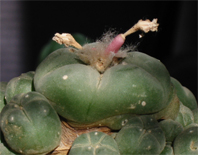
Sunday, September 23, 2007

In search of Echinocereus reichenbachii in Wichita Mountains Wildlife Refuge

I recently revisited Oklahoma City. Having heard that Echinocereus reichenbachii is abundant in the millions in Oklahoma, I decided to see if I could find some of these fascinating plants in habitat where they occur in many stem forms and spine colors. E. reichenbachii grows in several of the state parks in western Oklahoma, but after a bit of research I decided on visiting the Wichita Mountains Wildlife Refuge. The refuge is within easy driving distance from OKC (head southwest on highway 44 for an hour or so, then take the Medicine Park exit just north of Lawton) and apart from cacti it also boasts a rare remnant mixed grass prairie, an island where the natural grasslands escaped destruction thanks to the granite outcrops rendering the land impossible to plow.

A cluster of Echinocereus reichenbachii var. albispinus

All the Echinocereus plants I found were of the variety Echinocereus reichenbachii var. albispinus (or Echinocereus baileyi if you consider it a full species). It seems like the plants prefer to grow in fissures in the granitic rock, especially if moss is also growing in the fissures.

E. reichenbachii var. albispinus growing in moss

The pictured plants are growing in the open prairie grasslands south-east of Mount Scott. It’s quite amazing that most of the plants seem undamaged by the grazing herds of bison and longhorn; I would expect such a large animal could trample an Echinocereus underfoot without even noticing it, but that doesn’t seem to be the case.

Grazing bison
Grazing bison

I also saw a few Opuntia plants – probably O. phaeacantha – with beautiful carmine-red fruits. The pictured plant is growing on the southern bank of Quanah Parker Lake; named for the Quanah Parker of Native American Church fame.

Fruiting Opuntia sp. (O. phaeacantha?)

The Wichita Mountains Wildlife Refuge is a very interesting place to visit and I wish I had had more time (unfortunately I had to deal with delayed baggage, limiting the visit to half a day). It comes highly recommended if you are looking for Echinocereus reichenbachii var. albispinus (= Echinocereus baileyi) or bison ;-)

You can find more photos from my visit at http://public.fotki.com/WichitaMountainsWR/.

Friday, August 17, 2007

Time-lapse videos of a flowering Lophophora jourdaniana

I’ve previously made an attempt at a stop-motion video showing the thigmotropic behavior of Lophophora stamens. It so happened that the Lophophora williamsii var. jourdaniana plant flowered again during my summer vacation, leaving me plenty of time to experiment with time-lapse videos.

The first video shows the Lophophora williamsii var. jourdaniana flower unfold (I’m not exactly an early bird so I missed the first part of the unfolding ;-)

It seems like the movie couldn't be embedded - you can watch it at http://www.youtube.com/watch?v=rMlCPyZsB6E

The above video covers a time span of approximately 90 minutes, i.e. playback is sped up by a factor of 150. This is my first attempt at a time-lapse “flower movie”, as can be seen by the quality of the film. The first 11 seconds were shot while the camera was in auto-focus mode, resulting in a “wobbly” feel. I then disabled auto-focus (and lost a couple of frames in the process, which can be seen as a “jump” 11 seconds into the video) and later had to re-focus (28 seconds into the video), so it's not perfect, but not bad either. The frames were shot with the sun as the only source of light.

Next, I wanted to make a better (i.e. more frames per second) version of the thigmotropic stamens video but ended up with a version looking a lot like the original one.

It seems like the movie couldn't be embedded - you can watch it at http://www.youtube.com/watch?v=KHCQb6JIvNE

The playback of the above video is sped up by a factor of 12. Unfortunately I stopped taking pictures just as the stamens started to revert to their original position. In an attempt to achieve more frames per second I played around with my cameras continuous shooting mode. Suddenly the flower was visited by an industrious bee beautifully illustrating the purpose of the touch sensitive stamens ;-)

It seems like the movie couldn't be embedded - you can watch it at http://www.youtube.com/watch?v=wuUif0M5tG8

I guess the last 2 clips would be more illustrative if they had been filmed with a regular video camera instead of an SLR, but they’ll have to do for now. Unfortunately my camera ran out of power effectively putting an end to the filming of this particular flower.

Finally I have to mention the Hydrocactus – cactus video page as the main inspiration for these experiments and the best source of cactus videos I’m aware of.

Thursday, August 16, 2007

Copenhagen Botanical Garden & Museum

I spent part of my summer vacation in Copenhagen and naturally had to visit the Botanical Garden and Museum. The garden is located in the center of the city and has many visitors. Unlike most other gardens and parks in Copenhagen, the purpose of the botanical garden is research. Therefore, “it is not allowed to run, to ride a bicycle, climb the trees, stay on or walk on the lawns, pick the flowers or picnic.” These rules are a gross limitation on Danes who generally light bonfires and run around naked on lawns ;-)

The Conservatory
The Conservatory

The botanical garden was established August 2, 1600, and has moved and changed during the centuries. The fourth and present incarnation of the garden was opened to the public on October 9, 1874, 274 years after the founding of the first botanical garden (the vanes on the conservatory roof date the construction to 1873).

The cactus and succulent plants have their own dedicated greenhouse in these wonderful settings. Facing the stairs leading to the main conservatory building (the palm house), the cactus and succulent house is located to the left of the stairs, one level lower than the palm house.

The cactus and succulent house

Inside the cactus house you’ll find an abundance of plants – both small globular types and huge columnar plants. It seems like theft of the smaller plants is a problem as they are protected by glass plates and the whole house is monitored by video.

Inside the cactus and succulent house

The plants all look vigorous and well tended for, as for example this group of flowering Astrophytum ornatum plants (for comparison you can check the A. ornatum growing in the Myriad Botanical Gardens, Oklahoma City).

Flowering Astrophytum ornatum

Astrophytum ornatum flower

A large, fat Astrophytum asterias was hiding in the shadows of the larger plants.

Astrophytum asterias

And a Mammillaria geminispina was displaying its last flowers along with a multitude of dark red fruits.

Mammillaria geminispina

Unfortunately I couldn’t find any Lophophora, Ariocarpus, or Strombocactus in the publicly accessible houses; but the garden also has houses that are not open to the public and reserved for experiments and plant propagation. Maybe it’s just wishful thinking, but I’m almost positive I glimpsed a collection of ariocarpi and a few lophs inside one of these houses.

Propagation house – closed to the public

If you happen to be in Copenhagen a visit to the Botanical Garden and Museum is highly recommended. It’s a tranquil oasis situated in the center of a bustling city, and the historical conservatory buildings are beautiful in their own right (the garden was declared a preserved site on January 31, 1977). You might not find a lot of the rarer species in the houses open to the public, but the plants on display are abundant, well grown, and clearly marked.

Wednesday, July 04, 2007

Rory’s Lophophora collection

Some time ago Rory contacted me to discuss cacti and mycorrhizal associations (an interesting subject that might be brought up in a later post). During our conversations Rory revealed himself as an avid Lophophora grower with an impressive collection of mature and well-grown plants. Rory has kindly allowed me to share some pictures of his plants.

Flowering Lophophora williamsii, close-up

Large pot of Lophophora williamsii

The largest of the L. williamsii plants in this pot are approximately 25 years old. One of the plants in the central group (a bit above and to the left of the center) has been decapitated and set 4 offshoots. One of these has not yet developed a central growing point and appears somewhat cristate, but Rory expects it to develop as normal with time. The removed top was rooted and is also growing in the central group of plants (slightly below center; wool removed from areoles), and is flowering regularly.

Large pot of Lophophora fricii

According to Rory the compost used for the L. fricii plants are not drying fast enough. Consequently the plants are kept on the dry side which accounts for the red coloration shown by some of them. The largest of the plants (with a total of 9 offsets) has only grown 1cm (~0.4'') in the past 9 years so Rory is planning on repotting the plants in a new mix and expects this to speed up growth.

Lophophora diffusa about to flower

The above L. echinata diffusa plant is just about to flower - unfortunately it’s too overcast for the flowers to open properly.

Large pot of Lophophora williamsii v .caespitosa

To top things off (or just to make me completely envious ;-) Rory also threw in a photo of a nice, mature Ariocarpus fissuratus specimen.

Flowering Ariocarpus fissuratus

I hope you enjoyed this “guest appearance” - I for one would like to see more of Rory’s plants. If you have pictures or information you would like to share, you can drop me a mail at “lophophora [dot] blog [at] gmail [dot] com”.

A visit to Myriad Botanical Gardens and Crystal Bridge Tropical Conservatory, Oklahoma City

I recently visited Oklahoma City and had a Sunday to kill. Being within walking distance from my hotel I decided to visit the Myriad Botanical Gardens and Crystal Bridge Tropical Conservatory.

The garden functions as an urban oasis in downtown Oklahoma City with its verdant hills, perennial gardens, and a tranquil lake with koi and lots of turtles sunning themselves. The cylindrical glass shape of the Crystal Bridge Conservatory is hovering above the waters of the lake connecting its shores - a novel and interesting approach to greenhouse construction.

Crystal Bridge Conservatory

While the garden itself and the special architecture of the conservatory merit a visit I was a bit disappointed with the collection of plants kept in the conservatory. The succulent collection (growing on the so-called Dry Mountain) seems like a mishmash of unrelated and mostly unnamed plants (one of the named exceptions being a large Astrophytum ornatum (Monk's Hood)), but I'm probably heavily prejudiced by my expectations to botanical gardens as collections of plants with a scientific scope - not just a look-and-feel-good assemblage of greenery.

Astrophytum ornatum – one of the few named plants

View of the Dry Mountain

Writing this I realized that I've been consistently complaining about the quality of the cactus collections in my posts on botanical gardens – I guess I'll have to arrange a visit to the Desert Botanical Garden (Phoenix, Arizona) in order to see some real plants ;-)

Monday, June 25, 2007

Lophophora williamsii v. caespitosa graft

I’ve been pretty busy lately and completely forgot to post on the 3rd anniversary (June 7) of my Lophophora williamsii v. caespitosa graft. The main head is 5.5 cm (~2.2'') wide and the total width of the scion has increased to approximately 13 cm (~5.1'').

Lophophora williamsii v. caespitosa graft

The Lophophora williamsii v. caespitosa scion is grafted on a Trichocereus bridgesii stock and was repotted early this spring (hence the supporting props).

Lophophora williamsii v. caespitosa graft - main head
Lophophora williamsii v. caespitosa graft - top view

I’m fascinated by the explosive growth induced by the Trichocereus stock (for comparison you can check the posts on the same plant one and two years ago) but the appearance of the plant tends to become increasingly freakish.

The plant doesn’t bloom with the same vigor as it grows – until now it’s only flowered once.

Monday, June 11, 2007

Flowering Lophophora jourdaniana, take two.

One of my Lophophora williamsii v. jourdaniana plants is flowering again – this time with the full cooperation of the sun, resulting in a much more well-developed flower compared to the previous one.

Flowering Lophophora jourdaniana

My two Lophophora williamsii v. jourdaniana plants are almost in full compliance with Habermann’s description (rose-violet perianth, pistil, and filaments; persistent spines on young areoles) but the open flower clearly contradicts Habermann’s claim of cleistogamic flowers (i.e. flowers that do not open and are self pollinated). Apparently Habermann misunderstood or used this term incorrectly as the photo accompanying the type description also shows a plant with an open flower ;-)

Lophophora jourdaniana – thigmotropic stamens

Like many other species of cacti (including the other Lophophora species/varieties) L. jourdaniana has thigmotropic stamens, i.e. stamens that when touched fold in around the style (as is evident for the front stamens in the rightmost picture).

The following stop motion video provides a better illustration of the thigmotropic mechanism - I'll try to make a higher quality movie the next time the plant flowers.

It seems like the movie couldn't be embedded - you can watch it at http://youtube.com/watch?v=NcID667nZX8

References
Vlastimil Habermann (1975), “Lophophora jourdaniana Habermann species nova”, Kaktusy 11 (1), 3

Tuesday, May 22, 2007

Flowering Lophophora jourdaniana

One of my Lophophora williamsii v. jourdaniana plants flowered last week. I’m hoping the early flower can be seen as a promise for more flowers this season – last year and the year before last the plant only displayed one flower.

Flowering Lophophora jourdaniana

The sun was obscured by clouds most of last week and consequently the flower never unfolded completely before it withered. The picture above shows the flower at its peak – it’s still beautiful in all its rose-violet charm, but for comparison you can check the fully unfolded flower from last year in all its splendor.

Spent Lophophora jourdaniana flower

Saturday, April 21, 2007

The power of grafting – 3rd anniversary

Today one of my Lophophora williamsii (SB 854; Starr Co, Tx) plants is celebrating its 3rd anniversary as a scion grafted onto a Trichocereus pachanoi stock. The plant has set 4 offshoots and grown to a width of 7.3 cm (~2.9''), 3 of the offshoots are wider than 4 cm (~1.6'') while the smallest just exceeds 2.5 cm (~1'').

Grafted Lophophora williamsii (SB 854; Starr Co, Tx)

The plant set 9 flowers last year and has already displayed two flowers this year. The dried fruits resulting from last season’s flowers are clearly visible in the above photo along with the withered remains of the two “fresh” flowers from this week. The photo below was taken a couple of days ago while the flowers were still at their peak.

Two early Lophophora williamsii flowers

Usually I assist the plant with its self-pollination but this season I will not interfere. I’m doing this to test to which degree the plant will be able to set seed without any help – of course I can’t do anything about the thigmotropic reactions of the stamens or insects taking liberties with the flowers ;-)

A couple of days ago a flower bud also appeared on the largest of the offshoots and it will probably bloom within a week; unfortunately I will not be home to witness it. If all the offshoots begin to flower and the main shoot continues to flower in its usual pace, I’ll soon grow more seeds than I’ll ever need.

Offshoot setting a flower

Since last summer the Trichocereus pachanoi stock has also been allowed to grow an offshoot. Usually I remove these from stock plants in order not to starve the scion, but this one appeared almost at soil level and I decided to let it grow and later graft one of last years Lophophora williamsii (SB 854; Starr Co, Tx) seedlings onto it (these seedlings are the result of self-pollinating the above plant, i.e. technically they are clones of the mother plant). I had planned to do the graft today, but I’ll leave for the Netherlands tomorrow and decided to postpone doing the graft till I’m back.

Trichocereus pachanoi stock with offshoot

I was in doubt whether or not to include the last photo but decided to do it anyway. I’m fascinated by the dreamy image of the flowers backlit by the soft light of the setting sun, filtered through the foliage of a sprawling Bowiea volubilis. My girlfriend finds the picture boring and “too green” – but who is she to trust, she’s not into cacti ;-)

Flowers backlit by the setting sun

For comparison you can check the posts on the same graft written one and two years ago.

Update - April 28, 2007
Fortunately I made it home from the Netherlands in time to experience the pup unfold its first flower. The flower is not as sturdy as those of the main shoot, but what’s to expect from a novice ;-)

Flowering Lophophora williamsii pup

Today I also removed the dried fruits of last season’s flowers and freed the seeds.

9 dried Lophophora williamsii fruits

Close-up of dried Lophophora williamsii fruit

The result of the harvest was approximately 100 seeds.

Home grown Lophophora williamsii seeds

Thursday, April 19, 2007

A day at the New York Botanical Garden

During a recent vacation in New York City my girlfriend and I decided to leave the turmoil of the city behind for a day and head for the more tranquil environment of the New York Botanical Garden. I had great expectations for the visit, partly because the garden was established by Nathaniel Lord Britton (of Britton and Rose fame) and partly because of the NYBG Virtual Herbarium, a great information source on the Cactaceae family. As it turned out, the garden’s collection of live cacti is rather sparse; fortunately a handful of flowering Mammillarias saved the day ;-)

Mammillaria bombycina (western central Mexico)

Mammillaria rekoi (Oaxaca, Mexico)

Mammillaria elongata (Hidalgo, Mexico)

Even though the number of cacti plants is limited, the Enid A. Haupt Conservatory is a spectacular place and we spent hours exploring it – also, the orchid show was on during our visit, making it a lot easier to convince “She Who Must Be Obeyed” that we should examine the different plants in detail ;-)

A view of the NYBG cactus house
A view of the NYBG cactus house (and a random visitor)

The Enid A. Haupt Conservatory

The Enid A. Haupt Conservatory is the largest Victorian glasshouse in the US and the beautiful structure is in itself worth a visit.


The NYBG also has an outside bed with cold hardy cactus species.

All Time Most Popular Posts