Monday, July 04, 2011

Mongolian wildflowers

I’m recently back from a journey that took me through Russia, Mongolia, China, Tibet, and Nepal (and I’m aware that China considers Tibet an “autonomous region” of China and not a nation in its own right; that China “liberated” Tibet 60 years ago. But nobody - absolutely nobody in their right mind and not brainwashed by the chinese dictatorship - can see the ruthless chinese oppression of Tibet as anything else than a blatant occupation! More on that in an upcoming post).

I visited Russia (Siberia) during very early spring and my photos from that part of the trip mainly boils down to those of leafless birch trees; so I’ll skip Russia and jump straight to Mongolia in this floristic travelogue ;-) I’m in the unfortunate situation that I don’t know the names of most of the plants featured in this post so any help is appreciated ;-)

Mongolian plant with cream flowers
Cream flowers

Mongolian plant with yellow flowers
Yellow flowers

Mongolian plant with lilac flowers
Light blue / lilac flowers

After spending some days in Ulan Bator (Ulaanbaatar), the capital and largest city of Mongolia, we set out for Gorkhi-Terelj National Park. It was still early spring but a few plants were flowering, including the cream, yellow, and light blue/lilac flowered plants pictured above. Especially the latter was abundant, in many places almost covering the grassy slopes with its beautiful flowers.

My expectations to Gorkhi-Terelj involved imagery of serene, unperturbed nature allowing for days of pure trekking bliss ;-) However the “developed” part of the park we visited is on the verge of being destroyed by golf courts, tourist ger camps, ubiquitous signs and posters, road construction, housing development, and the like. In their eagerness to attract more visitors the very soul of what people are coming to see are being destroyed. It’s a big shame.

That being said it’s still possible to find undisturbed spots among the rolling, grassy hills and beautiful rock formations (in many ways reminding of the monzogranite formations at Joshua Tree National Park) where you can get a sense of being in the wilderness. If you are of an imaginative temperament it’s not even hard to envision Genghis Khan (Chinggis Khaan) galloping across the steppes; otherwise you can go see the (quite clumsy and ugly, yet colossal) Genghis Khan monument ;-)

A few of the ubiquitous signs and posters

Road construction near Turtle Rock

Another plant that is abundant in Terelj is (what I take to be) Orostachys spinosa, a cold-tolerant alpine native to Siberia and Mongolia. Its fleshy leaves are arranged in a rosette, growing to 10 cm (4'') in diameter at maturity. The plant is said to be able to survive extreme freezing temperatures down to -40°C. I collected a few of these plants in the hope to grow them on my balcony here in Copenhagen, but unfortunately most of them died off in a storage room in Kathmandu - one small plant is still alive though, so I keep my hopes high ;-)

A cluster of Orostachys spinosa

Back in Ulan Bator the only plants we could find were made of plastic. At first I found it a bit strange to have outdoor plastic flower arrangements in a park, but it seemed like a common practice.

Red plastic flowers
Red plastic flowers

Yellow plastic flowers

Monday, April 11, 2011

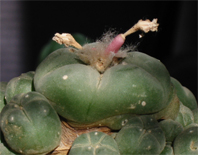
Peyote flowers - fisheye/tilt-shift photography

Flowering Lophophora williamsii - tilt-shift

I just got me a Lensbaby Composer lens and of course had to experiment taking pictures of some of my flowering peyote plants. Even though the subject line mentions “tilt-shift” the Composer technically only qualifies for the “tilt” part (a rotation of the lens plane relative to the image plane) and actually doesn’t “shift” (i.e. doesn’t allow for movement of the lens parallel to the image plane) but I’ll stick to the “tilt-shift” label as it is often used to specifically refer to the use of tilt for selective focus as illustrated in the photo above.

Flowering Lophophora jourdaniana - fisheye/tilt-shift

Adding the Lensbaby fisheye optic to the Composer allows for an even more distorted and warped view on reality.

Warped peyote flower - fisheye/tilt-shift

Wednesday, March 30, 2011

Non-cactus flora of Joshua Tree National Park

Unknown blue flower
Unknown blue flower

Unfortunately I’m not that well versed in the non-cactus flora of the Mojave and Colorado deserts so I’m afraid I don’t know the names of most of the plants featured in this post. If you have more details I would appreciate a comment.

Unknown blue flower in habitat

I was especially fascinated by this small plant growing in the lower Colorado portion of the Joshua Tree National Park. I visited too early in the spring to experience a full blooming desert but this guy was flashing its bright blue flower, standing out among all the earth tones amidst a wash crossing the trail from Cottonwood Spring to Lost Palm Oasis. I studied the plant and its surroundings for a while, intrigued by the habitat it had chosen to grow in - it would for certain be washed away by torrents of water during the next flash flood.

Unknown yellow flower

Another interesting plant displayed this beautiful yellow flower that looks like it might belong to the Fabaceae (Leguminosae) family but I’m not certain.

Unknown yellow flower in habitat

The yellow flowered plant had found a much more secure habitat, growing safely among the boulders in the rock-enclosed Hidden Valley (rumored to have been used by cattle rustlers in the past).

Nolina parryii in habitat

One species I’m pretty sure of is Nolina parrayii (Parry's Nolina or Giant Nolina) that has long thin leaves (and is sometimes called beargrass). It seems to be especially abundant in the lower Colorado portion of the park but also grows in some of the higher Mojave parts like e.g. the aforementioned Hidden Valley.

Nolina parryii seeds

Its tall flower stalk is said to be edible after being baked, with a somewhat bitter taste. Alas, no fresh flower stalks were to be found at the end of February and I didn’t want to try the old dry ones out for taste ;-)


In order to be better prepared I plan to buy the following desert flora books before my next visit to Joshua Tree National Park: Sonoran Desert Wildflowersand Mojave Desert Wildflowers;-)
Friday, March 18, 2011

Ocotillo (Fouquieria splendens) in Joshua Tree National Park

Flowering Ocotillo (Fouquieria splendens)

Near the closing of February I spent a weekend in Joshua Tree National Park. It was my third visit to the park and this time I targeted in on teddy-bear cholla (and of course cacti in general), Yucca brevifolia (one could argue they are hard to miss in the park;-), and another of my favorites that is covered in this post: the ocotillo (Fouquieria splendens) with its sprawling canes soaring for the sky.

Ocotillo flower, close-up

Fortunately my visit followed a period of heavy rains so the ocotillos were both draped in leaves and flowering. On the downside a strong gale was blowing making it extremely difficult to get a clear shot of the flowers (but as the pictures show I finally managed to snap a few;-)

Ocotillo in the Colorado Desert

The ocotillo, characteristic of the Colorado Desert, prefers to root in gravelly slopes of alluvial fans. Flash floods flush sand, gravel, and rock out of the canyons and onto the valley floor creating these fans.

Ocotillo displaying new growth

Fouquieria splendens is sometimes confused for a cacti, but is not. The thorny multi-stem shrub is in fact a woody deciduous plant. Unlike other deciduous shrubs, which normally grow leaves in the spring and drop them in the fall, the ocotillo may grow and drop leaves as often as five times during the year. Its leaves aren’t season dependent but rain dependent.

Fouquieria splendens leaves

Following a sufficient rain, the ocotillo puts forth a cluster of leaves above each torn, adorning the otherwise dead-looking canes with a flourish of green. At the same time red blossoms may appear at the tip of the canes. The leaves go about the business of photosynthesis until the next drought; then they turn red or brown and drop.

Sprawling ocotillo canes reaching for the sky

The above picture was taken standing on the ground looking up into the sprawling canes of an ocotillo. It gives an impression of the height of the plant as I stand 190 cm (6 feet 3 inches) tall and these plants tower above me.

You can find more information on Fouquieria splendens in the book Sonoran Desert Wildflowers: A Field Guide to the Common Wildflowers of the Sonoran Desert.

Friday, February 04, 2011

Balboa Park, San Diego - The Desert Garden

Balboa Park, The Desert Garden

As mentioned in the previous post I recently visited southern California. During a day off I and a couple of colleagues decided to visit the San Diego Zoo - I have to confess that I also had a cunning plan to lure my not-so-cacti-interested colleagues into visiting the Desert Garden located in Balboa Park just next to the Zoo.

Balboa Park, The Desert Garden

Balboa Park, The Desert Garden

My plan succeeded and after enjoying the fabulous Zoo we spent some quality time among the cacti and succulents growing on the slopes of the Desert Garden. Unfortunately the visit was improvised and rather badly planned so I missed the Old Cactus Garden, the Botanical Building, and several other interesting gardens in Balboa Park, places that I in hindsight would have liked to visit. Then again, now I have a good excuse for going back to San Diego ;-)

Balboa Park, The Desert Garden

Balboa Park, The Desert Garden

According to their website “the Desert Garden contains more than 1,300 plants, including succulents and drought-resistant plants from around the world, within its 2.5 acres. The peak blooming period is January through March”. I guess my visit in very early January was a tad too early to experience the full-throttle flower fest as only a few of the plants were blooming (several of the cacti were budding, though - again a good reason for revisiting Balboa Park ;-)

Balboa Park, The Desert Garden

Balboa Park, The Desert Garden

Yet another reason for coming back is that several of the pathways in the Desert Garden were closed during my visit due to heavy rains just a few days prior.

Balboa Park, The Desert Garden

Saturday, January 22, 2011

Cacti in Crystal Cove State Park

During a recent visit to Orange County I had a weekend to kill. I neither had the energy nor the time to head for the open desert so instead I decided for a stroll at Laguna Beach.

Cylindropuntia prolifera (coastal cholla) overlooking the Pacific Ocean

I never made it to Laguna Beach though. Cruising south on the Pacific Coast Highway I noticed a sign advertising Crystal Cove State Park and decided to check it out.

Opuntia littoralis (coastal prickly-pear)

And I’m glad I did - the park turned out to comprise a secluded and pristine stretch of beach, almost completely deserted in spite of its location smack in the middle of the SoCal urban sprawl. And best of all cacti were abundant ;-)

I have to admit I was a bit surprised to see cactus growing that close to the sea - they even grow on the dramatic slopes of the coastal bluffs overlooking the Pacific Ocean. It just goes to show how diverse environments cacti are capable of coping with.

I’m not well versed in opuntioids but according to this Flora of Crystal Cove State Park the Cactaceae growing in the park are Opuntia littoralis (coastal prickly-pear) and Cylindropuntia prolifera (coastal cholla).

The beach at Crystal Cove State Park

Entering the park I was greeted by a friendly ranger who recommended a hike that takes you down the coastal bluffs and onto the beach - I followed her advice and spent a couple of hours walking the beautiful trails and enjoying the peaceful beach (and of course the cacti ;-)

It was quite magical walking the beach where the only sounds were the rumble of the breaking waves and the squeaking of seagulls, knowing that only a few hundred meters inland you would be engulfed in the ubiquitous noise of cars hissing by.

Tide pool at Crystal Cove State Park

I love the rock formations along California’s beaches, savor the fascinating sea cliffs that have been sculpted by winds and the relentless battering by waves through the ages.

Rock hoof
Rock “hoof”

Unfortunately I didn’t bring my Nikon SLR for this trip and my phone is a less than ideal camera, but the pictures will have to suffice.

You can find more information on hiking Crystal Cove State Park in the book California's Coastal Parks: A Day Hiker's Guide.

Tuesday, December 07, 2010

Intermission

I’ve been a bit lax updating the blog lately as a new beautiful flower has entered my life - she is more wonderful than even the most stunning peyote so my priorities have shifted slightly ;-)

That being said, I’ll be back with new posts soon, so stay tuned. In the meantime enjoy the music ;-)

It seems like the movie couldn't be embedded - you can watch it at http://www.youtube.com/v/EHOBw6XwqRo?fs=1&hl=en_US

Sunday, September 19, 2010

Peyote plants for sale

Peyote plant with flower and fruit

A couple of weeks ago I was contacted by Kevin who has lost the time for his collection of peyote plants and now would like to sell them on. Kevin lives in the UK and has around 40 peyote plants for sale, mostly between 4 and 6 cm wide and many flowering every year. I asked Kevin for photos of the plants and as you can see from the handful of pictures accompanying this post his plants look healthy and well tended to.

If you are interested in buying some of the plants you will need to contact Kevin directly to agree on a price and arrange for shipping.

As always when you are looking to buy peyote plants or seeds, please check your local laws before doing so. All parts of peyote (Lophophora williamsii) plants and the seeds thereof are classified as Schedule I substances in the United States. Also, peyote is illegal to posses in France, Russia, and possibly more countries (if you have information on other countries where peyote has been illegalized please let me know; preferably with references)

Update, October 4, 2010
Kevin just informed me that all plants are sold. You might want to check this list of cactus vendors instead.

Peyote with seeds scattered in the tufts of trichomes

Mature peyote plant
Mature peyote plant

Monday, September 06, 2010

Pavlovsk Experimental Station, world's first seed bank, faces destruction – part two

As mentioned in the previous post the Pavlovsk Experimental Station (part of the N.I. Vavilov Institute of Plant Industry), one of the biggest and most important seed banks in the world, is at risk of being replaced by a private housing development. Fortunately international attention has started to focus on the looming disaster. Al Jazeera’s Neave Barker reports from Pavlovsk in the St Petersburg Region:

“[The Pavlovsk seed bank] is one of the biggest and oldest of its kind anywhere in the world. It has one of the largest collections of fruit – a thousand different types of strawberry from 40 different nations, 900 different types of blackcurrant and 300 different strains of cherry; and most of them are unique to Pavlovsk […] Scientists warn that if important genotypes are destroyed the world’s food security will be weakened. A case in point: Russian food supplies for example are already under serious strain following the worst drought in living memory.”

You can watch Neave Barker’s video reportage below.

It seems like the movie couldn’t be embedded - you can watch it at http://www.youtube.com/watch?v=q7rVT7Bf2Ek&feature=player_embedded

The National Public Radio also reports on the importance of the Pavlovsk collection:

The collection is rare, scientists say, one in a handful of places around the world where scientists carefully study fruit that could sustain through future generations even if temperatures warm and the world’s food supply is threatened […] the research station has collected fruit and berry varieties from around the world, stayed in touch with scientists abroad and cataloged everything.

"Like [what is] winter-resistant, resistant to different kind of fungi, diseases or bacteria," Burmistrov says. "What is the quality? What is the taste? And so, so on."

Russian plum (Prunus rossica) growing at  Pavlovsk
Russian plum (Prunus rossica) growing at Pavlovsk (photo by Global Crop Diversity Trust via Flickr)

The Farming Futures blog also has a say on this topic:

Both seed banks and wild populations are crucial resources to maintain genetic variety and traits that could be crucial to maintaining robust and productive harvests. Examples from history support this: grassy stunt virus decimated the Indian rice crop in the 1970s, and genetic resistance was found in just one of 6200 species. Again in the 1970s, when corn blight destroyed 15% of the US maize crop, resistance was found in the last remaining wildtype in an endangered Mexican habitat.

The loss of biodiversity therefore represents not only a significant business risk to the agricultural industry but a genuine threat to future food security – how will we create new varieties for our changing climate if we have only a handful of types to work with? Whilst stopping the loss of biodiversity in the wild is the ideal option, seed banks represent an important resource or ‘back-up plan’. Pavlovsk contains specimens of over 5,000 varieties of seeds and berries from a multitude of countries, and more than 90% of them cannot be found in any other research collection.

On an even more sinister note RIA Novosti recently reported that scientists were denied access to the Pavlovsk Experimental Station by the housing construction development fund.

A few days ago the N.I. Vavilov Institute of Plant Industry wrote on their website that the Pavlovsk Experimental Station had had an unscheduled inspection on 31st of August 2010 – the station was visited by representatives of the government as well as representatives of the development fund. After visiting two plots the commission was convinced that, indeed, the disputed plots harbor plants that must be considered valuable genetic resources and the auctioning off of the land was postponed (this is definitely a step in the right direction, but saving Pavlovsk is far from a done deal – so it’s still too early to celebrate).

There is a certain irony in the fact that this is happening in 2010, the year the United Nations declared to be the International Year of Biodiversity!

Help save the Pavlovsk Experiment Station: Sign the Global Crop Diversity Trust’s petition to tell President Medvedev to stop the closure of Pavlovsk.

Or tweet Russian President Dmitry Medvedev on behalf of Pavlovsk Station:

@KremlinRussia_E Mr. President, protect the future of food - save #Pavlovsk Station! http://bit.ly/d2H96s

Monday, August 30, 2010

Pavlovsk Experimental Station, world's first seed bank, faces destruction

The Guardian recently wrote: “Twelve Russian scientists famously chose to starve to death rather than eat the unique collection of seeds and plants they were protecting for humanity during the 900-day siege of Leningrad in the second world war. But the world’s first global seed bank now faces destruction once more, to make way for a private housing estate.”

Sadly, a few days ago a court in Moscow ruled in favor of the Russian Federal Fund of Residential Real Estate Development, recognizing the legitimate transfer of the land housing the Pavlovsk Station for the construction of residential properties. That being said, President Medvedev has announced on Twitter that this issue needs to be “scrutinised” so the valuable field genebank is not lost yet. You can help save the Pavlovsk Station by signing the Global Crop Diversity Trust’s petition to the President of Russia to stop the destruction of the future of food or you can tweet Dmitry Medvedev on behalf of Pavlovsk Station:

@KremlinRussia_E Mr. President, protect the future of food - save #Pavlovsk Station! http://bit.ly/d2H96s

Redcurrant berries (Ribes rubrum)

The Pavlovsk Experimental Station was established in 1926 by Nikolai Vavilov, the botanist who conceived the idea of creating seed banks as repositories of plant diversity that could be used to breed new improved varieties of food crops.

You might ask why it is important to save the Pavlovsk genebank – the Guardian article puts it this way: “At stake, say Russian and British campaigners for the station, is not just scientific history but one of the world’s largest collection of strawberries, blackcurrants, apples and cherries. Pavlovsk contains more than 5,000 varieties of seeds and berries from dozens of countries, including more than 100 varieties each of gooseberries and raspberries.

More than 90% of the plants are found in no other research collection or seed bank. Its seeds and berries are thought to possess traits that could be crucial to maintaining productive fruit harvests in many parts of the world as climate change and a rising tide of disease, pests and drought weaken the varieties farmers now grow. As it is predominantly a field collection, Pavlovsk cannot be moved. Experts estimate that even if another site were available nearby, it would take many years to relocate the plants.”

In a weirdly twisted, almost tragicomical, logic the property developers have argued that the collection at the Pavlovsk Station is “priceless” and since no monetary value can be assigned to it the collection must consequently be worthless! The Russian Federal Fund of Residential Real Estate Development has applied a similar distorted “logic” by saying that the collection doesn’t really exist as it was never officially registered. Let’s hope that the ongoing campaigns can convince the Russian authorities that this important genebank needs to be preserved.

Half a strawberry
Half a strawberry

The strawberry and redcurrant photos are taken from Wikipedia and are licensed under the Creative Commons Attribution-Share Alike 2.0 Generic license and the GNU Free Documentation License, Version 1.2 respectively.


Read more on the Pavlovsk situation in this post.

All Time Most Popular Posts