All of the photos in this post were taken at the beginning of April to illustrate some of the spring activity in my coldhouse. The plants have been kept dormant all through winter and received their first drink of water only a few days before these pictures were shot.
Flowering Lophophora williamsii (El Huizache, San Luis Potosí)
The first plant I want to show off is a flowering Lophophora williamsii grown from seed originating from the El Huizache, San Luis Potosí, Mexico population (the population Anderson assigned as the neotype for the species). These plants are from a more southerly location than the ones I'm usually growing and I'm happy to see they are coping so well with the cold conditions during winter. I was getting used to thinking of all L. williamsii varieties as self-fertile but according to the Cactus Conservation Institute, greenhouse breeding experiments by Bohata and colleagues in the Czech Republic and by Köhres in Germany have shown that plants from the El Huizache population are self-sterile and therefore obligate outcrossers (leading one to suspect a great deal of genetic diversity within plants from this population – in contrast to the self-fertile populations that have little to no genetic diversity among individuals as they outcross very little). 
Lophophora williamsii (El Huizache) flower with long style
The flowers of the El Huizache plants also seem to have a very long style that raises the stigma well above the stamens, making it hard, if not impossible, for the plants to reproduce without the help of a pollinator.
Bumble bee having fun with a Lophophora williamsii flower
Speaking of pollinators a bumble bee visited while I took these pictures – unfortunately only this one Lophophora flowered at the time making it impossible for the bee to fertilize the plant. The bumble bees that are active in early spring are huge; I don't know much about bees but am told that these large slow individuals are queen bees looking for nectar and pollen to feed their newly hatched brood.
Lophophora williamsii (SB 854; Starr Co, Texas) with fresh fruit
One of the Lophophora williamsii (SB 854; Starr Co, Texas) plants that I recently repotted has spawned a fruit. This variety of Lophophora williamsii is self-fertile to an extent where it happily sets seed if you just shake the flower a bit.
Flowering Acharagma roseana (LX 578; Ramon Arizpe, Coahuila)
My Acharagma roseana plants (LX 578; Ramon Arizpe, Coahuila - “Ramon” should probably read “Ramos” but I'll stick to the information from the vendors seed list) are coming of age. The plants were started from seed 4 years ago and are all ready to flower, displaying a wealth of flower buds. Only one, shown in the picture above, flowered when I took the pictures. Unfortunately it will be a while before I can visit my summerhouse (and coldhouse) again – I hope at least a few of the flowers will be saved for then. My Echinocereus reichenbachii plants are also growing a multitude of buds, getting ready for a flower fest I would hate to miss.
Frost damaged Matucana madisoniorum
Until now I have focused entirely on the success stories but a few of my plants didn't like being without heat during winter. My Matucana madisoniorum definitely didn't like the cold conditions (even being wrapped in multiple layers of horticultural fleece). The plant is heavily marked by the experience but survives.
I also lost a few plants: a couple of Carnegia gigantea (saguaro cactus), a Cylindropuntia bigelovii (teddy-bear cholla), and a Cylindropuntia tunicata (thistle cholla); I managed to save cuttings of the chollas though. These plants were kept out on the terrace all summer and I probably left them out for too long, exposing them to the autumn storms so the plants were not able to dry out completely before winter. I'm especially sad about the Carnegia gigantea plants as they were great specimens and are now completely reduced to mush.
Thursday, April 23, 2009
Spring awakening in the coldhouse
Tuesday, April 21, 2009
The power of grafting – 5th anniversary
Five years ago today, I grafted a tiny Lophophora williamsii (SB 854; Starr Co, Tx) seedling onto a robust Trichocereus pachanoi stock. The Lophophora scion has since grown considerably – the main head is approximately 8 cm (~3.2'') wide; the total width including the offshoots now exceeds 14 cm (~5.5'').

Lophophora williamsii grafted onto Trichocereus pachanoi stock
This growing season the plant hasn't flowered yet but one of the “pups” (new offshoot stems) will do so within days as is evident from the next picture.

Flower bud and red spider mites
Unfortunately not only the plants are returning to life after their winter hibernation – the dreaded red spider mites are also fully active again (you should be able to spot at least four mites in the photo above) so the fight is on once more.

Ripe Lophophora williamsii fruit
Even though most of last year's fruits have long since ripened (and been harvested) the odd fruit is still showing. A plant this size gives hundreds of seeds each year making it a virtual seed “factory”.

Lophophora williamsii - rib count increasing?
The plant seems set on increasing its rib count beyond 8 – if I'm lucky it will not be content with growing just a few more ribs but go straight for the next number in the Fibonacci sequence, 13. The more ribs the merrier as it means more areoles and consequently more flowers and seeds.
The main head of the grafted Lophophora williamsii has grown 14 pups (15 if you also count a pup's pup – I guess you could call that a grandpup ;-) and has reached a size where it needs to be repotted soon.
For comparison you can check the posts on the same graft as one, two, three, and four years old.
Monday, April 06, 2009
Peyote harvest regrowth
In 2008 the Cactus Conservation Institute launched a four-year study on the effects of harvesting on regrowth and mortality of peyote in habitat in South Texas.
50 plants were transected (harvested March 13, 2008) and tagged, and follow-up data were collected eight months later (November 22-23, 2008). Mortality of a harvested plant is inferred if it produces no regrowth of buttons - after 8 months 5 of the 50 plants had not grown any new pups (coming surveys will provide a more certain estimate of post-harvest mortality). Interestingly 11 out of the original 50 numbered tags and the plants to which they referred had gone missing – maybe washed down by rains, maybe dug up and buried by feral hogs. The 11 plants where neither plant nor tag were found are, at present, eliminated from the study resulting in a preliminary figure for mortality attributable to harvesting of 5/39, or about 13%.
20 more plants were harvested, measured and tagged on November 23, 2008, bringing the total number of plants in the “harvested” group up to 59. Furthermore a control group of 50 plants were also tagged and measured on November 23, 2008 – these plants will be used to indicate the magnitude of natural mortality not associated with harvesting in the future.
The surviving plants show good regrowth which is attributed to the benefit of the good harvesting practice of cutting high (at or above the junction of green aerial stem and the beige subterranean stem) and relatively level.
You can read an update on the results in the “Peyote harvest regrowth – observations after one year” post and find the complete data from the peyote harvest regrowth study here.
Yavia cryptocarpa habitat pictures
As mentioned in the Blossfeldia liliputana post Sebastián Santecchia from Salta, Argentina has been kind enough to let me post some of his wonderful habitat pictures. The following Yavia cryptocarpa photos are all courtesy of Sebastián.
Yavia cryptocarpa mimicking its environment
The genus and species Yavia cryptocarpa was described from Argentina by Kiesling and Piltz in 2001. Yavia is only known from a small area just on the Argentinian side of the border with Bolivia, in the province of Jujuy, near La Quiaca, at 3,700m. Although the species probably has a wider distribution, its small size plus the strongly camouflaged aspect make it difficult to know its distribution with any degree of confidence.
Hydrated Yavia cryptocarpa
As is evident from the above photo, a fully hydrated Yavia is very exposed to the sun. As the plant dehydrates the small spines “lock up” to form an armor that helps protect the plant from the sun.
The genus is named after the Department of Yavi, Argentina and the specific name cryptocarpa refers to the plant being a cryptocarp, i.e. bearing fruits that are retained concealed inside the stem of the plant, only becoming visible when the plant shrinks in the drought period. 
Yavia cryptocarpa with two fruits
You can find more of Sebastián's Yavia photos here and view all his pictures of cactuses in habitat (Bolivia and northern Argentina) at the SagtaCactus flickr photostream.
References
Roberto Kiesling & Jörg Piltz, Yavia cryptocarpa R. Kiesling & Piltz, gen. & sp. nov. Kakteen und andere Sukkulenten 52 (3): 57-63, 2001.
Roberto Kiesling & O Ferrari, Yavia cryptocarpa – conservation action on a new and interesting cactus. British Cactus and Succulent Journal 21 (1): 20–25, 2003
Sunday, April 05, 2009
Blossfeldia liliputana habitat pictures
Sebastián Santecchia from Salta, Argentina has generously allowed me to post some of his amazing habitat photos. 
Blossfeldia liliputana (Tupiza, Potosí, Bolivia) displaying a fruit
I was immediately taken with the beauty of the above picture – it almost seems surreal seeing a Blossfeldia liliputana in such a lush green environment. According to Sebastián the individual stems of the Tupiza plants grow to a maximum size of 2 cm in diameter – a fairly large size for this species. The plants grow in rock crevices, usually associated with mosses.
Blossfeldia liliputana habitat (Tupiza, Potosí, Bolivia)
The habitat of Blossfeldia is severe and plants are subjected to extreme desiccation. In contrast to most other cactus species Blossfeldia has no thickened cuticle (thickened outer cell wall) but instead appears to be poikilohydric, meaning the plants can endure severe drying out, like many mosses and lichens (see this link for a more detailed explanation of what being poikilohydric means).
Another interesting feature of Blossfeldia is that the plants virtually lack stomata, their being restricted to the areolar pits. According to Ted Anderson, Blossfeldia probably has the lowest number of stomata per unit of surface area of any photosynthesizing plant.
Blossfeldia liliputana about to flower (Alemania, Salta, Argentina)
The flowers of Blossfeldia liliputana are capable of self-pollination. The photo above shows a plant at the beginning of flowering in early spring.
Blossfeldia liliputana is fairly common and widespread, occurring over a north-south range of more than 1200 km, primarily on the eastern side of the Andes in southern Bolivia and northern and northwestern Argentina at elevations of 1200-3500m. Several species of Blossfeldia have been described but most botanists agree that there is but one species (given the extent of its habitat the plants are bound to show some variation).
You can find more of Sebastián's Blossfeldia photos here and view all his pictures of cactuses in habitat (Bolivia and northern Argentina) at the SagtaCactus flickr photostream.
References
Edward F. Anderson, The Cactus Family (Timber Press, 2001) ISBN 0-88192-498-9, pp. 129-130
Ramsons covering the forest floor
This post is very much off the usual topic – now you are warned ;-)

Ramsons basking in the spring sun
Spring has finally arrived in Denmark and is being heralded by one of its early messengers: ramsons. Ramson (Allium ursinum) (also known as buckrams, wild garlic, broad-leaved garlic, wood garlic, and bear's garlic) is a wild relative of chives and grows in deciduous woodlands – fortunately such a forest is located only a couple of kilometers from where I live.

Ramsons covering the forest floor
Ramson is easily distinguished from other plants of the forest by the distinctive, garlicky smell of its leaves. On calm warm days, during the ramson season, the whole forest is enveloped in a cloud of mild garlic odors. When the plants flower the smell can grow really intense – some might even refer to it as a pungent stench ;-)

Carpet of ramsons

Ramson leaves, close-up
When not flowering, the extremely poisonous Lily of the Valley (Convallaria majalis) might be mistaken for ramsons – fortunately you can tell ramson by its smell ;-) All parts of ramson are edible and make for a great supplement to your spring menu.

Lesser celandine flower, close-up
Another messenger of spring in many Danish deciduous forests is the lesser celandine (Ranunculus ficaria (syn. Ficaria verna)) (also known as fig buttercup, and fig wort). Their extremely shiny, looking almost plastic-like, yellow flowers and lustrous dark-green heart-shaped leaves make these plants stand out on the spring forest floor.

Lesser celandine
Last but not least, I must mention the white anemone (Anemone nemorosa) (also known as wood anemone, windflower, thimble weed, and smell fox) – in select locations the anemones virtually blanket the forest floor.

Wood anemone flower, close-up

Wood anemone blanket

Flowering wood anemones
In a few weeks the canopy will be covered in foliage again – until then the dwellers of the forest floor rule.

Forest overlooking the Aarhus bay
Update - May 11, 2009
The deciduous forest is now almost fully leafed-out and it is time for the ramsons to flower.

Flowering ramsons covering the forest floor
The older leaves tend to have a more pungent smell than the small, younger ones and if you trample through a stand of flowering ramsons the garlicky odor can be really overwhelming.

Ramsons flower, close-up
As all other parts of ramsons the flowers may also be eaten and are said to make an interesting garnish for salads – I haven't tried that though.
Sunday, March 15, 2009
Repotting Lophophora williamsii in the coldhouse
Since 2004 I have experimented with growing Lophophora williamsii in an unheated greenhouse in Denmark. During this period the plants have been repotted only once a couple of years ago.
Coldhouse grown Lophophora williamsii (SB 854; Starr Co, Texas)
The plants are growing in 11 cm (4.33'') clay pots and it might not be apparent from a superficial inspection that they are in need of being repotted again. But on closer investigation it turns out that the taproots are visible through the drainage hole in the bottom of the pots.
Taproot visible through drainage hole
I consequently decided to repot the plants. I'm usually not repotting plants in the coldhouse this early in the year as we still might get the occasional night with sub-freezing temperatures, but I figured that the plants are completely dormant – i.e. there are no actively growing roots to harm – and if repotted in bone-dry soil the plants will not notice they have been disturbed when the growing season starts in a few weeks. Anyway, that's my theory ;-)
Lophophora williamsii plants removed from the pots
Close-up of three Lophophora williamsii crowns
Close-up of exposed Lophophora williamsii taproot-ball
After removing the plants from their pots I could smell that some of the roots had been damaged; a broken Lophophora root gives off an easily detectable smell reminiscent (to me anyway ;-) of that of fresh green peas. This stressed the fact that the soil really had to be bone-dry before potting the plants, so I let them sit for a day in order for the broken roots to dry out a bit, and shoved the soil into the oven to remove every last bit of moisture it might hold (this gave off an... let's call it interesting... smell and I weren't popular at all with the rest of the house).
The soil ended up being so dry that I was literally working in a cloud of dust while repotting – my throat was still irritated the day after so I'll probably buy a dust mask to avoid this situation in the future (not that I expect to get pneumoconiosis or anything but it's annoying to go “ahem”, “hrmph”, “cough” for a day when it can be avoided ;-).
Freshly repotted Lophophora williamsii plants
The dry and dusty soil is also evident by the dusted fingerprints on the pots (12 x 12 x 20 cm, ideal for plants with large taproots) in the picture above.
Lastly I would like to make a note on the soil. I am adding unperfumed (and unused ;-) cat litter made from baked “moler” to my soil as this material is very lightweight and retains water easily without the soil getting soaked. I'm not quite sure how to translate “moler” into English but it is a diatomite deposit that Skamol, a “moler” processing plant, defines as:
Moler - a diatomaceous earth
Diatomaceous earth is a naturally occurring, soft, chalk-like sedimentary rock that is easily crumbled into a fine white to off-white powder. This powder has an abrasive feel, similar to pumice powder, and is very light, due to its high porosity. Moler is a special mixture of diatomaceous earth and bentonite clay, ca. 60% diatoms and 40% clay. The clay gives the raw moler a brownish colour, and due to a high iron oxide content the materials become pink, when baked.
The pinkish granules visible in the topsoil in the photo above is “moler” cat litter.
As I live within driving distance of where the “moler” is quarried I decided to get some raw and unbaked “moler” to mix into my soil. Last summer I collected a few bags in the, now defunct, quarry pictured below; the plants described in this post are the first to be planted in soil with chunks of raw “moler” mixed in (visible as large, grayish flakes in the above picture), so I'm eager to see how the plants agree with this new additive to their soil. Even though “moler” contains large fractions of clay (the Danish word “ler” means clay, i.e. a literal translation of “moler” would be mo-clay) it's a relatively stable material that doesn't dissolve in water, so it will not clog up the soil when watered.

Old moler quarry on the island of Mors
I'm a bit curious as to what effect diatomaceous earth has on insects. According to Wikipedia “diatomite is also used as an insecticide, due to its physico-sorptive properties. The fine powder absorbs lipids from the waxy outer layer of insects' exoskeletons, causing them to dehydrate”, i.e. the diatomaceous earth in the “moler” might actively help me control pests.
Monday, March 02, 2009
Flowering Lophophora diffusa, time-lapse video
I took the pictures for this time-lapse video of a flowering Lophophora diffusa in early May, 2008. I can't quite remember why I decided to not publish it back then – I was probably disgruntled by the glitches (a couple of seconds into the movie you can see the plant shift a bit, and after 14 seconds there's an abrupt change in focus) and decided I could do better. Anyways, I never got around to doing that and now, after all these flowerless winter months, the small errors don't seem to matter ;-)
The L. diffusa flower opened amazingly fast. The time-lapse video covers a time span of only 45 minutes and is made from 154 still photos taken at intervals of 15 seconds; the photos are played back at a rate of 10 photos per second (the attentive reader will notice that the above numbers don't add up – the focus change 14 seconds into the video indicates a problem that resulted in loosing images for a period of approximately 6 minutes)
Flowering Lophophora diffusa, time-lapse video
The plant was bought just a couple of months prior to these pictures being taken, as described in my post on a Lophophora bargain.
Update - March 28, 2009
You can now watch the flowering Lophophora diffusa in blazing high-definition ;-) I cropped the photos used for the time-lapse video to a size of 1280x720 in order to make the 16x9 HD movie shown below.
Saturday, February 07, 2009
Lophophora alberto-vojtechii, a new miniature species in the genus Lophophora
In the June 2008 issue of the Cactus & Co magazine Jaroslav Šnicer, Jaroslav Bohata, and Vojtěch Myšák described a new Lophophora species, Lophophora alberto-vojtechii, characterized by its small size, adult plants typically reaching just about 2 cm (less than one inch) in diameter.
Flowering Lophophora alberto-vojtechii at the type locality. Scale is indicated by the coin that is 23 mm in diameter
The full description of the lilliputian species reads:
The stem is a greyish green with a touch of mauve (greenish, greenish grey to mauve), for the most part concealed in the ground. The aerial part (crown) is flat to slightly convex, 18 mm wide (10 to 50 mm in adult plants); the subterranean part of the stem is cylindrical, extending 25 mm down from the base of the crown (the depth in adult plants increases with age). The stem is distinctively small and divided into five ribs (up to eight ribs in exceptional cases). The trichomes are visible only near the apical meristem; they drop off early, leaving the areoles inconspicuous.
The root is thick and bulbous, 30 mm long and 16 mm in diameter where it joins the subterranean stem, smooth, and a dirty white to creamy yellow colour.
The flower is 23 mm wide (15 mm to 35 mm). The tepals and style are long, the same as in other members of the Diffusae section. The filaments are white, the anthers a yellowish orange. The style is white, while the stigma is yellowish (white to yellowish or pinkish). The tepals are light pink with a distinctive darker stripe (white to dirty pink, rarely creamy yellowish with a stripe in a brownish, salmon or darker pink shade) on the adaxial surface.
The fruit is round to slightly claviform, and dries out over time. The fruit is a dirty white colour, ranging to yellowish or pinkish.
The seed is black, round, 1.45 mm long (1.15 to 1.45 mm) and 1.45 mm wide (1.0 to 1.45 mm). The hilum is compressed into a broad V-shape. The perimeter of the hilum consists of a pronounced edge. The testa is nodulated with protruding outer cell walls. The individual cells of the testa are clearly demarcated.
Type locality: northern San Luís Potosí, Mexico, 1700 metres above sea level.
The type specimen was collected by G. B. Hinton on 1st August 2007 and is kept at the G. B. Hinton herbarium filed under number 28642.
We are naming the plant alberto-vojtechii in honour of two persons, the late prominent Czech traveler and cactus-hunter Alberto Vojtěch Frič and the current Lophophora enthusiast Vojtěch Myšák.

Lophophora alberto-vojtechii just finished flowering. At this size plants flower regularly
The authors place L. alberto-vojtechii within the section Diffusae (see the Kaktusy 2005, Lophophora Special) along with L. diffusa, L. fricii, and L. koehresii. Based on similarities in habitat (mud flats), growth form, body, fruit, and flower morphology, and loss of trichomes in older areoles, Šnicer et al. conclude that L. alberto-vojtechii is closest related to L. koehresii. However the two species differ in size, the color of the epidermis, seed morphology, and the number of ribs.

Flowering Lophophora alberto-vojtechii at the site in Zacatecas
Šnicer et al. argue that even though the small Lophophora alberto-vojtechii plants might look immature at a first glance they are not, as is evident by old growth epidermis at the ground level and the subterranean part of the shoot.

Lophophora alberto-vojtechii (a) Flat, photosynthetic crown (b) Subterranean part of stem (c) The root
The habitat comprises flat, alluvial sediments, as in the case of Lophophora koehresii. Lophophora alberto-vojtechii has a distinctively geophytic lifestyle, withdrawing into small cavities below ground during dry periods. Here the plants are covered with dust and dry leaves, protected from the sun until the next rains.
The type locality of Lophophora alberto-vojtechii is in the northern part of San Luís Potosí, but it has also been found growing in the states of Zacatecas and Coahuila. The flowers of the Zacatecas plants are more white than those of the plants at the type locality (see picture above).

Flowering Lophophora alberto-vojtechii at the type locality
All in all the description is credible and well argued. Adding to the credibility is the fact that George Hinton collected the holotype and stores it in his herbarium, I doubt he would do that if he wasn’t convinced that this new taxon is for real.

The flower buds are visible very early, as they are not hidden in the wool.
References
Jaroslav Šnicer, Jaroslav Bohata, and Vojtěch Myšák (2008), “Lophophora alberto-vojtechii - an exquisite new miniature from the genus Lophophora”, Cactus & Co 12 (2), 105-117
Monday, February 02, 2009
Flowering Lophophora decipiens

Flowering Lophophora decipiens
In 2005 I sowed my first Lophophora decipiens seeds bought from Pavel Pavlicek. The plants grow in my coldhouse and flowered for the first time in the summer of 2008 where these pictures were taken.
Flowering Lophophora decipiens viewed from above
I'm not quite sure what to make of the long, flimsy, pink petals, and the plants are still too young to tell what the adult body morphology will look like so for now I can only say that the plants live up to their name (decipiens meaning “deceiving” ;-)
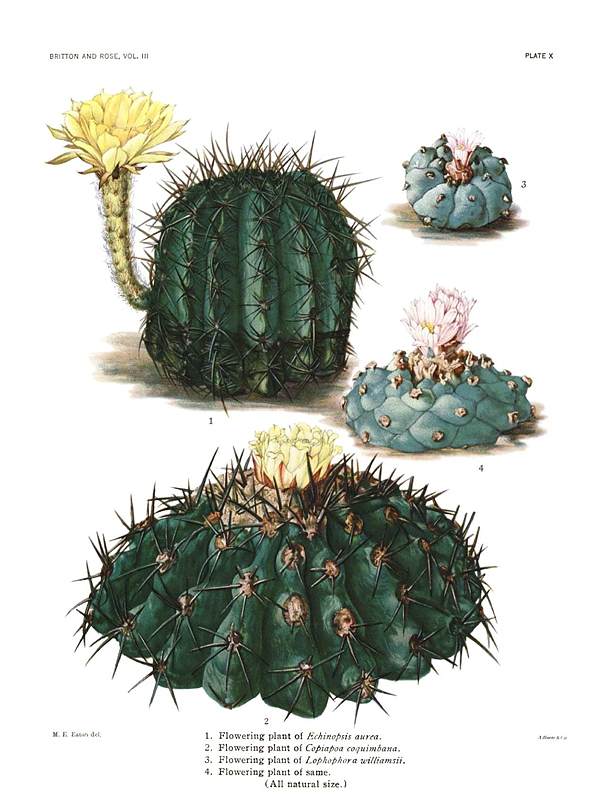
Leon Croizat's description of Lophophora williamsii var. decipiens stated that the vegetative body of this variety was basally tubercled or with distinct podaria rather than ribs, and that the flower extended out of the top of the plant to a greater extent. This description was based entirely on an illustration in Britton and Rose, The Cactaceae volume 3, plate 10, figure 4 (see below). Some researchers, e.g. Anderson, have argued that these characters are not consistent enough in occurrence to justify separate taxonomic status while others, including Gerhard Köhres, state that plants corresponding to Croizat's description grow near El Amparo in the state of Coahuila, Mexico and should be counted to the Lophophora fricii complex.
The Cactaceae, Volume III, Plate X
I have recently bought some Lophophora decipiens seeds from Steve Brack and look forward to see how they develops.
All Time Most Popular Posts
-
On various occasions I've been asked what growing media I'm using for my cactus plants. I don't have a set soil mix recipe as su...
-
Lophophora williamsii (peyote) populations have diminished in large areas of South Texas where peyoteros harvest the cactus for ceremonial ...
-
Below is a list of retailers/nurseries selling cactus seed and plants. I've only listed vendors I've done business with. If you ar...
-
Most cacti are easily grown from seed - and with a little patience and care they can be grown into beautiful plants. Lophophora williamsi...
-
In last month’s post on the troubled Texan peyoteros I referred to Anderson’s article on the peyote situation in Texas. Given the importanc...
-
Yet another slightly off topic and probably not entirely politically correct post, but I couldn’t help noticing the similarity of my monstr...
-
Flowering stand of San Pedro cacti (Trichocereus pachanoi) To me the main draw of the San Pedro cactus ( Trichocereus pachanoi (syn. Ech...
-
In the June 2008 issue of the Cactus & Co magazine Jaroslav Šnicer, Jaroslav Bohata, and Vojtěch Myšák described a new Lophophora spec...
-
There seems to be an increased focus on the alarming Texas peyote situation. A couple of weeks ago the Houston Press published a mournful, i...
-
I spent two weeks working in Delhi, India during January. I had one weekend off and had planned to spend it in Delhi at my own leisure, but ...