Sunday, July 20, 2008

New plants for the coldhouse

Last week I received a new batch of plants from Kakteen Kliem. The plants are going to live in my coldhouse so I selected plants originating from habitats where they are naturally exposed to frost - I hope this also gives them the ability to withstand the freezing conditions they have to endure during winter here in Denmark.

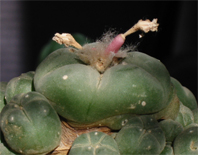
Lophophora williamsii (JJH 8608293; Pecos River, Texas)

I already have several of these Trans-Pecos Lophophora williamsii plants but decided to procure a few more as Kliem’s stock is running low.

Ariocarpus fissuratus (SB 403; Crockett County, Texas)

My few coldhouse grown Ariocarpus fissuratus plants have all survived until now so I felt like adding some more to the collection ;-)

Homalocephala texensis (DJF 891.3; Yoakum County, Texas)

Homalocephala texensis (aptly named the “Horse Crippler”) is a first for me - I’m looking forward to watching these plants grow and develop their characteristic heavy spine armor.

Normanbokea valdeziana (SB 1468; Ramos Arizpe, Coahuila, Mexico)

Normanbokea valdeziana is another first. I’m not quite sure what to expect from these plants but I fell for their fuzzy looks and beautiful flowers.

As always Gerhard Kliem’s plants are of an excellent quality.

Sunday, June 15, 2008

Lophophora williamsii v. caespitosa graft – 4th anniversary

June 7 my grafted Lophophora williamsii v. caespitosa plant could celebrate its 4th anniversary on top of its Trichocereus bridgesii stock. After four years the main head has grown to a width of 6 cm (~2.4'') and the scion is more than 14 cm (>5.5'') wide in total.

Lophophora williamsii v. caespitosa grafted on Trichocereus stock

Unfortunately the plant was maimed by spider mites last year. I didn't check my plants for mites before leaving them unattended for several weeks during my summer holiday. When I returned the damage was done and much of the plant ended up severely scarred.

Spider mite damage with new growth

Fortunately the spider mites stayed off most of my other plants, and the scarred epidermis of the grafted Lophophora williamsii v. caespitosa will soon be replaced by new growth.

To avoid spider mites I'm now showering my plants as often as the weather and my patience permit ;-) Any remaining mites are sprayed with isopropyl alcohol on sight. So far this treatment has kept my plants safe from mites, but the big test will be the coming hot summer months where the plants are left on their own to a great extent.

Lophophora caespitosa scarred by spider mites

As always I’m fascinated with the explosive growth induced by the Trichocereus stock – for comparison you can check the posts on the same plant one, two, and three years ago.

Sunday, June 01, 2008

Munching on alphonso mangoes in Mumbai

This is very much off-topic, I know, but I’m just home from Mumbai (Bombay), India and have to share this ;-) I visited Mumbai for two weeks, just before the monsoon set in. As it turned out this period coincided with the last part of the alphonso mango season. I had never tasted alphonso mangoes before, but their warm, deep orange-yellow color (almost like an egg yolk), the smooth, firm texture of the fruit flesh (not fibrous at all, reminiscent of an almost ripe avocado), and their sweet, mild, mild, mild bergamot-like taste immediately won me over. I ate alphonso mangoes whenever I could find them and even brought home a dozen ;-)

A box of alphonso mangoes

Alphonso mangoes surrounded by straw

Alphonso mangoes close-up

Alphonso mango ready to eat

Wednesday, May 14, 2008

Lophophora flower fest

Several of my plants are flowering right now, including many of the large undetermined Lophophora plants I bought earlier this spring. The plants were sold as Lophophora williamsii but body morphology and flower color suggest that many of them are actually Lophophora diffusa. Even though they flower, it is still difficult to determine the species of some of the plants conclusively, so I suspect them to be of hybrid origin. A handful of flower photos are included below.

Lophophora flower
Lophophora flowers
Lophophora flowers
Lophophora flower
Lophophora flower
Lophophora flowers

Flowering Echinocereus reichenbachii

I have been growing Echinocereus reichenbachii in my coldhouse for a while but never seen any flowers until last week. Several of the plants flowered for the first time - an impressive sight.

Flowering Echinocereus reichenbachii

The flowers are excessively beautiful with their silvery pink to magenta petals, bright yellow anthers, and the fresh green stigma in the center of it all.

Echinocereus reichenbachii flower, close-up

The flowers seem rather variable both in the number and color of the petals. The flower pictured below has fewer, larger, and darker petals than the one above.

Echinocereus reichenbachii flower with a slightly darker hue
E. reichenbachii flower with a slightly darker hue

I outcrossed the flowers and hope for seeds next year.

Sunday, May 04, 2008

Time-lapse video of a flowering Lophophora williamsii

I've been away on a short vacation and it seems my grafted Lophophora williamsii (SB 854; Starr Co, Tx) has spent its "lone time" wisely and grown three flowers.

Lophophora williamsii displaying three flowers

Even though the flowers were already quite open when I returned home, I decided to attempt a time-lapse video showing the flowers open fully. Unfortunately I forgot to disable the cameras autofocus function which gives the video a shaky appearance as the camera continuously changes focus slightly.

It seems like the movie couldn't be embedded - you can watch it at http://www.youtube.com/watch?v=wjKgkNyeP68

That being said, I'm impressed by the agility of the Lophophora stamens - they seem almost to be dancing around the style. A dazzling display of thigmotropic behavior is shown 50some seconds into the video; the stamens are disturbed and fold rapidly in around the style only to resume their perpetual wiggle shortly after. In contrast to this Epithelantha micromeris v. greggii stamens never seem to move during flowering.

I yet haven't managed to create a time-lapse video that is fully satisfying (the flower must be shown from bud to full bloom, the image must not shake/autofocus, no drop outs must occur in the stream of images, etc). I'll keep trying though, but I'll bet that when everything is set for the perfect time-lapse the shutter of my good old D70 gives up the ghost just before the shoot is finished ;-)

The photos for the time-lapse were shot at intervals of 15 seconds during a period of 160 minutes. The pictures are played back at a rate of 10 frames per second, i.e. the flowering is speed up by a factor of 150 resulting in a video running for 64 seconds.

Time-lapse video of a flowering Epithelantha micromeris v. greggii

Most of my coldhouse grown Epithelantha micromeris v. greggii (Cuesta la Muralla, Coahuila, Mexico) flowered big time this week. The plants were started from seed in 2004 and are flowering for the first time.

Flowering Epithelantha micromeris v. greggii

The small creamy, off-white flowers are not spectacular but still quite a beautiful sight, especially when several are blooming at the same time. The following time-lapse video shows a flower going from bud to full bloom.

It seems like the movie couldn't be embedded - you can watch it at http://www.youtube.com/watch?v=sCIWpwFgFsw

The pictures used for the time-lapse were taken every 15 seconds over a two hour period. The pictures are played back at a rate of 10 frames per second, i.e. the flowering is speed up by a factor of 150 resulting in a 48 second video. The camera was placed on an old wooden floor resulting in a couple of "wobbly" sequences. The photos were taken using natural light only, the shifting light levels are caused by drifting clouds.

I attempted to cross-pollinate several of the plants and are hoping for seeds next year.

Monday, April 21, 2008

The power of grafting – 4th anniversary

Four years ago today, I grafted a tiny Lophophora williamsii (SB 854; Starr Co, Tx) seedling onto a robust Trichocereus pachanoi stock. The Lophophora scion has since grown to a width of 8 cm (~3.2'') and set 6 offshoots - the total width including the offshoots exceeds 13 cm (~5.1'').

Grafted Lophophora williamsii (SB 854; Starr Co, Tx)

The plant flowered throughout summer last year and many of the resulting seed pods are ready to be harvested. This season's first flower already appeared last week and the remains can be seen in the photo below.

Lophophora williamsii - ready for seed harvest

Last year's flowers were allowed to self-pollinate with minimal human intervention. Today I harvested all freely exposed fruits and left the rest to fully mature. So far the result seems good as the plant set a lot of seed, time will show if it is viable.

Dried Lophophora williamsii fruit

Many of the fruits have a dry and brittle husk that is easily ripped and some of them almost spilled open when harvested. I probably ought to harvest the seeds sooner and not allow the fruits to sit and dry on the plant for too long.

Ripped Lophophora williamsii fruit with seeds exposed

As mentioned the plant has set lots of (selfed) seeds: the initial harvest totalled 101 seeds and there are still a few fruits left on the plant to be harvested later.

101 home grown Lophophora williamsii seeds

For comparison you can check the posts on the same graft as one, two, and three years old.

Anaglyph and "cross-eyed" 3D Lophophora images

I've always been fascinated by anaglyphs and "cross-eyed" images and their stereoscopic 3D effects. To celebrate the 4th anniversary of my Lophophora williamsii (SB 854; Starr Co, Tx) graft I've created a couple of stereograms depicting the plant. So whisk out your blue and red filter glasses, open the picture below in a separate, maximized window, and enjoy the mesmerizing 3D effects ;-)

Anaglyph image - Lophophora williamsii graft

The next stereo pair is in the "cross-eyed" format. This type of stereogram can be difficult to view until you get the technique right. However the color rendering is bright and accurate, something not easily achieved with anaglyphs. Open the image in a separate, maximized window for the best viewing experience.

Cross-eyed image - Lophophora williamsii graft
"Cross-eyed" image - Lophophora williamsii graft

While I was at it, I also made an anaglyph stereogram showing one of my Lophophora jourdaniana plants.

Anaglyph image - Lophophora jourdaniana

Saturday, April 05, 2008

Starting Pelecyphora and Lophophora from seed, 2008

Yesterday I started this year’s first batch of seed. I’m usally sowing my cactus seeds at the beginning of March, but I’ve been otherwise occupied so I had to start a bit later than usual. 30 seeds each of the following species were sown:

  • Lophophora williamsii (SB 418; Presidio County, Texas)
  • Pelecyphora aselliformis (MMR 111.1; El Pedernal, San Luis Potosí, Mexico)

Lophophora williamsii, Shafter, Presidio County, Texas
Lophophora williamsii, Shafter, Presidio County, Texas (photo from http://lophophora.info/)

I’ve been looking for L. williamsii originating from the Trans-Pecos region of Texas for a while, so I was pretty exited to find the SB418 seeds from Presidio County, Texas. I’m looking forward to see how these plants develop (and also bought a batch of these seeds to start in my coldhouse).

Pelecyphora aselliformis in habitat
Pelecyphora aselliformis in habitat (photo from http://www.cact.cz/)

Pelecyphora aselliformis is a first for me. I’ve always wanted to grow this distinctive species but for some reason never got around to it until now.

The seeds were started as described in the post on growing cactus from seeds and are bought from Jan Martin Jecminek.

Most of the seeds I’m growing this year have been selected for their (alleged;-) cold hardiness and will be sown later in my unheated greenhouse.

Update - April 12, 2008
Prompted by Patrick's comment I decided to include more detailed information on how the germination progresses. 5 days after sowing the seeds one Lophophora and 8 Pelecyphora seedlings had germinated (L=1/P=8). After 6 days the numbers were L=6/P=14, after 7 days L=13/P=17, and today (day 8) L=15/P=20. This means that after 8 days the germination rates for the Lophophora and Pelecyphora seeds are respectively 50% and 67%.

Update - April 25, 2008
April 19 the germination numbers were L=16/P=24, on April 22 the Lophophora germination count had risen to 19, and today April 25 the counts still are L=19/P=24. So after approximately 3 weeks the germination rates for the Lophophora and Pelecyphora seeds are respectively 63% and 80%. It should be mentioned that one of the Lophophora seedlings died off but is still included in the germination count (as it actually started growing but didn't make it from there).

All Time Most Popular Posts