Thursday, February 01, 2007

Curtis’s Botanical Magazine – plate 4296 (vol. 73, 1847), Lophophora williamsii

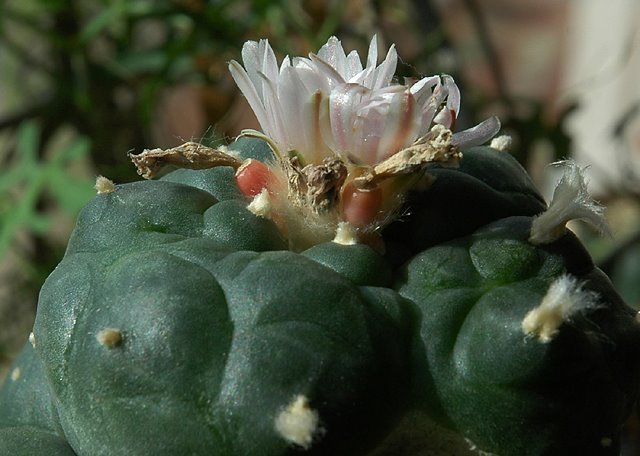
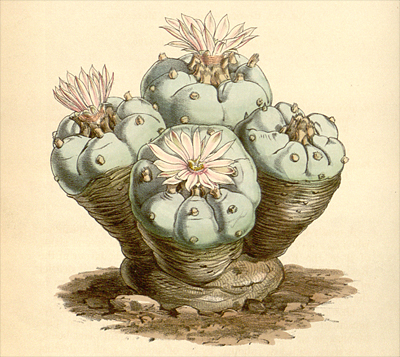
Curtis’s Botanical Magazine – plate 4296, Lophophora williamsiiSince my early days as a “Lophophora aficionado” I’ve heard and read that the first illustration of Lophophora williamsii appeared in Curtis’s Botanical Magazine in 1847 (plate 4296). This fact seems to be very well known – probably because of Anderson’s book Peyote, The Divine Cactus – nevertheless it’s been next to impossible to find a good reproduction of the illustration.

These days are over. The Botanicus Digital Library has scanned the material and made it available online. Below you’ll find copies of the scanned illustration as well as the accompanying description; the description is also reproduced in textual form.


TAB. 4296.

ECHINOCACTUS WILLIAMSII.

Mr. Williams' Echinocactus.
_____________

Nat. Ord. CACTEAE.- ICOSANDRIA MONOGYNIA.

Gen. Char. (Vide supra, TAB. 4190.)
_____________________________

ECHINOCACTUS Williamsii ; humilis caespitosus turbinatus inferne teres transversim cicatricatus cinereo-fuscus superne umbilicato-depressus glaucus 6-8-costatus, costis latis convexis parce tuberculatis inermibus pulvilligeris, pulvillis e pilis fasciculatis densis erectis formatis, floribus parvulis subsolitariis albo-roseis.

ECHINOCACTUS Williamsii. “Lemaire, ex Salm-Dyck in Otto et Dietr. Allgem. Gartenzeit, xiii. p. 385.” Walp. Repert. V. 5. p. 816.
_____________________________

A neatly-formed species, which has a very pretty appearance when its starry blossoms are expanded. We received several plants of it at the Royal Gardens of Kew, through the favour of the Real del Monte Company, from the rocky hills of their district of mines in Mexico, with many other treasures. It flowers in the summer months.

DESCR. Our largest plants do not much exceed the size represented. They grow in a tufted manner and are often proliferous, as in the instance here shown: the parent plant being, as it were, stifled or subdued by its offspring. Each individual is turbinate: from the base to the crown, or summit, terete, of an ashy brown colour, and scarred with close transverse lines, occasioned, it would appear, by the progressive withering and contraction of the tubercles: the summit is broadly convex, but with a deep depression in the centre, glaucous, traversed from the centre outwards by 6-8 furrows, and thus divided into as many convex ridges, and these again, transversely, but more or less deeply, into rather large, rounded, more or less confluent unarmed tubercles, each of which has a dense tuft or short pencil of compact erect hairs:--no aculei. Flowers proceed from a young tubercle, near the centre of the crown. The base of the calyx is downy. The petals lanceolate, rather numerous, white, externally tipped with pale green, and having a rose-coloured line down the centre. Stamens yellow. Stigma of four spreading rays.
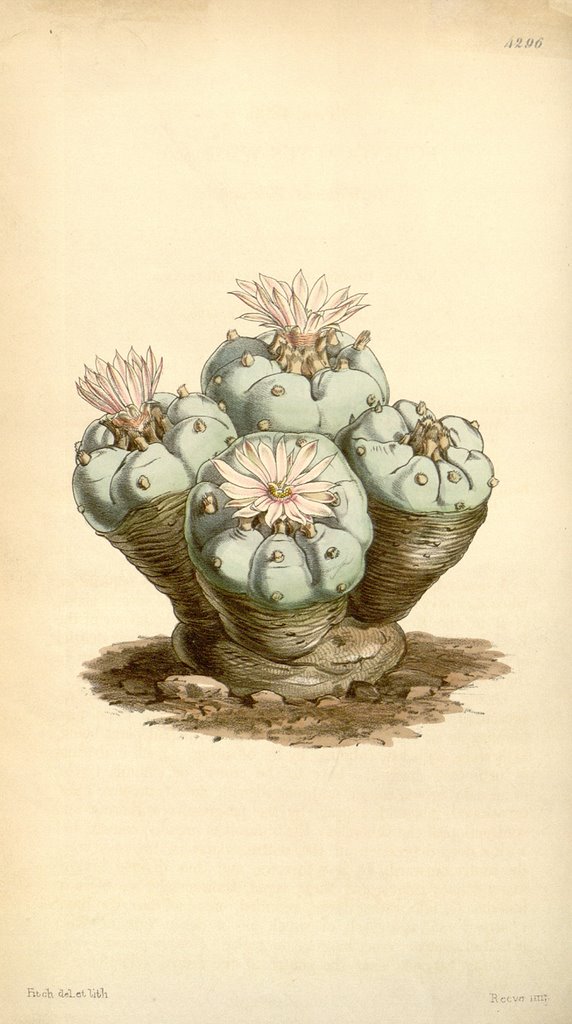


Curtis’s Botanical Magazine – plate 4296, Lophophora williamsii, Illustration
Curtis’s Botanical Magazine – plate 4296, Lophophora williamsii, Description p1
Curtis’s Botanical Magazine – plate 4296, Lophophora williamsii, Description p2

The scans are courtesy of the Botanicus Digital Library, Missouri Botanical Garden and are free for non-commercial use, as long as attribution is provided.

High-resolution copies of the scans can be found in the files section of the Lophophora Google group.

Back to online articles.

Wednesday, January 24, 2007

In Deep South Texas, peyote harvest dwindling

I’m aware that this Seattle Times article has been available on the net for some time; but I think it fits well with the theme intoned by the posts on proper peyote harvesting techniques and the Huichol peyote pilgrimage, so here goes...


In Deep South Texas, peyote harvest dwindling

By Sylvia Moreno (2005)

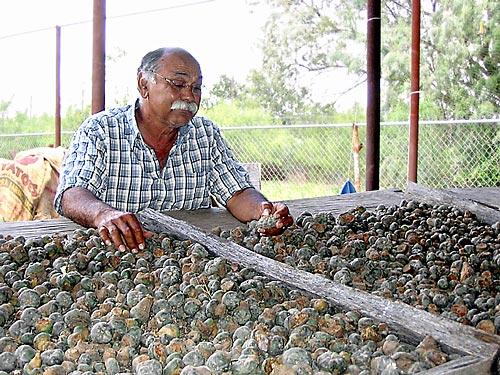
Salvador Johnson, licensed peyote distributor
Salvador Johnson is one of four licensed peyote distributors left in the United States. He has harvested the plant for 47 years.
MIRANDO CITY, Texas — In the heart of Rio Grande brush country, Salvador Johnson works a patch of land just east of the Mexican border that is sacred to Native Americans.

Spade in hand, eyes scanning the earth as he pushes through the spiny brush, Johnson searches the ground carefully. “This is good terrain for peyote,” he says. “There’s a low hill — the rain starts on top and goes down to water this — and there’s a lot of brown ground.”

He stops, points the tip of his shovel at a 3-inch spot of green that barely crests the soil under a clump of blackbrush and announces: “This is what you look for. You look for something that is not ordinary on the terrain. I saw that green.”

One of the last remaining “peyoteros,” Johnson, 58, has been harvesting the small round plant in and around this tiny community for 47 years — long before the hallucinogenic Lophophora williamsii cactus was classified as a narcotic and outlawed by federal and state governments. Then as now, it is for use by Native Americans as the main sacrament in their religious ceremonies.

Johnson is part of a nearly extinct trade of licensed peyote harvesters and distributors, at a time when the supply of the cactus and access to it is dwindling. The plant grows wild only in portions of four southern Texas counties and in the northern Mexico desert just across the Rio Grande.

But some Texas ranch owners have stopped leasing land to peyoteros and now offer their property to deer hunters or oil and gas companies for considerably higher profits. Others have plowed under peyote, and still others have never opened their land.

On the ranchland that is worked by peyoteros, conservationists are concerned about the overharvesting of immature plants as the Native American population and demand for the cactus grows.

“Will there be peyote for my children and my children’s children?” asked Adam Nez, 35, a Navajo who had driven 26 hours with his father-in-law from their reservation in Page, Ariz., to stock up on peyote at Johnson’s home.

That question and possible solutions to the problem — such as trying to legalize the importation of peyote from Mexico, and creating legal cultivation centers in the United States — are being studied by members of the Native American Church, Indian rights advocates and conservationists.

There are an estimated 200,000 to 500,000 members of the church in the United States. Although 90 percent of the peyote in North America grows in Mexico, the number of ceremonial users there — mostly Huichol Indians — is a small fraction of the number in the United States and Canada.

“In effect, you have a whole continent grazing on little pieces of south Texas,” said Martin Terry, a botany professor at Sul Ross State University in Alpine, Texas, who specializes in the study of peyote.

The church was incorporated in 1918 in Oklahoma to protect the religious use of peyote by indigenous Americans. Its charter was eventually expanded to other states, and in 1965, a federal regulation was approved to protect the ceremonial use of peyote by Indians. In 1978, Congress passed the American Indian Religious Freedom Act.

But subsequent conflicts between federal policy and state drug laws precipitated the passage of a federal law in 1994 to guarantee the legal use, possession and transportation of peyote “by an Indian for bona fide traditional ceremonial purposes in connection with the practice of a traditional Indian religion.”

The law extends protection against prosecution for the possession and use of peyote only to members of federally recognized tribes.

“Over the last 40 years, there have been lots of equal-protection defenses to criminal prosecution thrown up, with people saying ‘my use of this controlled substance is religiously derived,’ ” said Steve Moore, a senior staff attorney with the Native American Rights Fund.

Though not considered addictive, peyote is included in the Drug Enforcement Agency’s list of Schedule I controlled substances along with heroin, lysergic acid diethylamide (LSD), marijuana and methaqualone.

Although the DEA acknowledges the importance of the hallucinogenic cactus to the religious rites of Native American peyote users, the agency says the drug has a high potential for abuse and has no accepted medicinal purpose in the United States.

The Texas Department of Public Safety has licensed peyote distributors since the mid-1970s, when the number in the state peaked at 27. It dwindled to four last year. State records show that only three distributors have harvested and sold peyote so far this year.

For the past five years, an average of almost 1.9 million peyote buttons have been sold annually, according to state records.

References
Sylvia Moreno, “In Deep South Texas, peyote harvest dwindling”, Seattle Times

Thursday, January 18, 2007

Huichol peyote pilgrimage

Once a year groups of Huichols (an indigenous people with a population of about 20,000) embark on a pilgrimage to collect peyote, a trip taking them approximately 300 miles (~480 km) from their home in the Sierra Madre Occidental in western Mexico to the peyote fields in San Luis Potosí (a sacred area known as Wirikuta). The rituals surrounding the pilgrimage have been described in detail by e.g. Carl Lumholtz and Ted Anderson, but Nicola Frioli’s photos are the best pictorial documentation of the journey I’ve seen yet.

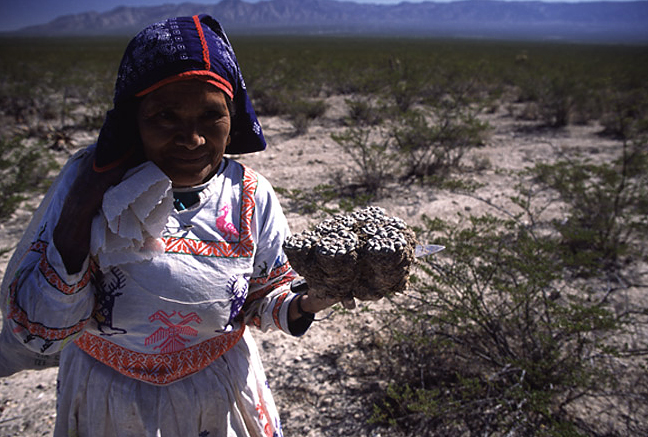
Huichol woman holding large peyote

Sack full of peyote
Sack full of peyote

The images are courtesy of Nicola “Okin” Frioli (you can find more pictures at his home page by selecting your language, e.g. “english”, then select “Reportages” and “Mexico”, finally click on “In the Sacred Land of the Blue Deer”

It’s interesting to compare the above plants with the peyote harvesting technique recommended by modern research.

Monday, December 04, 2006

Proper peyote harvesting technique

Lophophora williamsii (peyote) populations have diminished in large areas of South Texas where peyoteros harvest the cactus for ceremonial use by the Native American Church. Habitat destruction caused by urban development, rootplowing, etc., account for much of the reduction, but the regulated commercial harvest of peyote is also taking its toll. Some harvesters cut the peyote too low (it can be very hard to tell where the shoot ends and the root begin) - consequently many of the decapitated plants will not regenerate new stems and are left to die.

To address this problem Martin Terry and James D. Mauseth have investigated the proper technique for harvesting peyote, and found that the cactus must be cut off at or immediately below its base, leaving the subterranean portion of the plant (including all or most of the subterranean part of the stem) in the ground to regenerate new crowns. Their harvesting technique is outlined below.

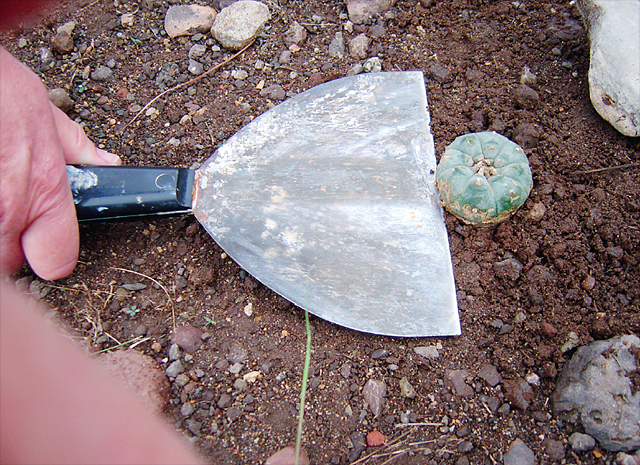
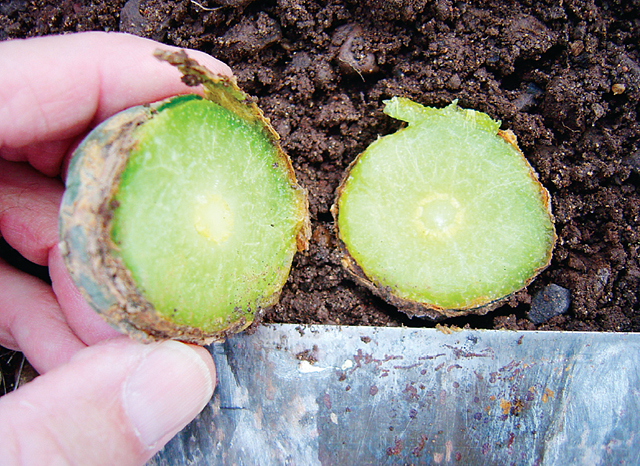
Peyote harvesting aPlant about to be cut transversely at the base of the crown (the photosynthetic part of the stem), i.e., at ground level.


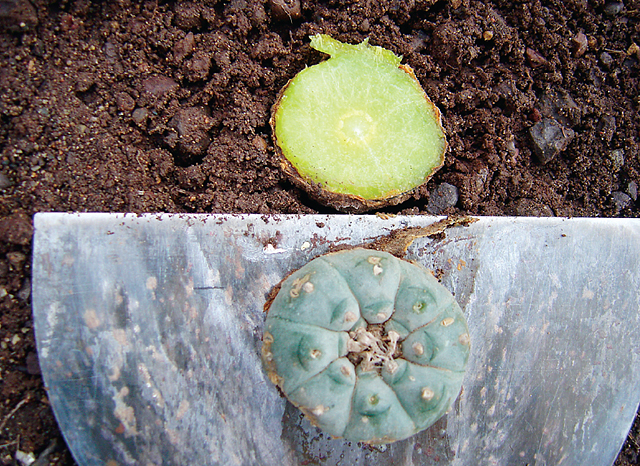
Peyote harvesting bCut has been made parallel to the ground surface, and the harvested crown (below) has been removed from the subterranean portion of the stem (above, remaining in the ground). The cut surface shows a cross section of the vascular cylinder (ring of yellow tissue near center of stem), the pith within the vascular cylinder, and the yellowish green parenchymal tissue of the cortex of the stem (between vascular ring and epidermis).

Peyote harvesting cThe underside of the harvested crown (left) shows a very narrow (2–3 mm wide) ring of bark at the perimeter of the cut surface, indicating that the cut was barely below the base of the crown, in the uppermost portion of subterranean stem. The cut surfaces match, except that crown parenchyma (left) is slightly greener due to higher chlorophyll content, whereas the subterranean stem parenchyma (right) is more yellowish.

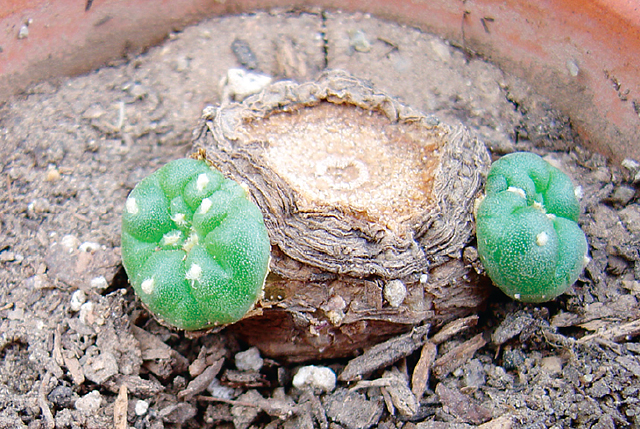
Peyote harvesting dTwo young peyote crowns (“pups”) regenerating by lateral branching from the upper edge of the subterranean stem of a plant that was decapitated 7.5 months previously. This plant is the same individual shown in the 3 previous pictures. Each of the new crowns is ca. 1.5 cm in diameter.

If the peyote is cut too deep no tubercles are left to sprout and continue growing after the top has been removed, i.e. the closer to soil level the plant is cut, the greater the chances are that the remaining parts of the plant will retain healthy tubercles and be able to re-grow new crowns. Terry and Mauseth base their technique on detailed studies of the anatomy of root, shoot and hypocotyl (region between shoot and root) and also give recommendations on how to distinguish shoots from roots without actually cutting the plant open.

References
Martin Terry, James D. Mauseth (2006), “Root-shoot anatomy and post-harvest vegetative clonal development in Lophophora williamsii (Cactaceae: Cacteae): implications for conservation”, Sida, Contributions to Botany 22, 565-592
(Download the article from Sida - 19.2 MB)

Sylvia Moreno, “In Deep South Texas, peyote harvest dwindling”, Seattle Times


See also How to sustainably harvest Lophophora williamsii (Peyote) from Kadas Garden.

Peyote harvesting

Sunday, November 12, 2006

Britton and Rose - The Cactaceae

Britton and Rose: Lophophora

In the period from 1919 to 1923 the Carnegie Institution of Washington, D.C. published the monograph The Cactaceae - Descriptions and Illustrations of Plants of the Cactus Family. This four-volume work, written by Nathaniel Lord Britton and Joseph Nelson Rose, set new standards in cactus botany with meticulous diagnoses based on greenhouse and herbaria studies and years of field work. The four volumes are illustrated by photographs, drawings and color plates with the delicate artwork of Mary Eaton.

In the beginning of the 20th century, cactus taxonomy was a chaos with few but huge genera (in 1903 Schumann recognized about 800 species, which he grouped under 20 very heterogeneous genera). Rose and Britton fragmented this antiquated system of “collective genera” into many, more refined genera (The Cactaceae describes 1255 species under 124 genera). As a rule, the genera were founded on characters of flowers and fruit, combined with vegetative characters and geographical distribution.

The only edition of The Cactaceae - Descriptions and Illustrations of Plants of the Cactus Family available to the general public has for years been the black and white reprint from Dover Publications, but now the original first edition with color plates is being made available in digital form. At the time of writing volume 1 through 3 can be downloaded from Au Cactus Francophone along with other interesting material that are rarely seen by cactophiles (the Britton and Rose files are also available from the Carnegie Institution). The Cactaceae is a classic – go get it!

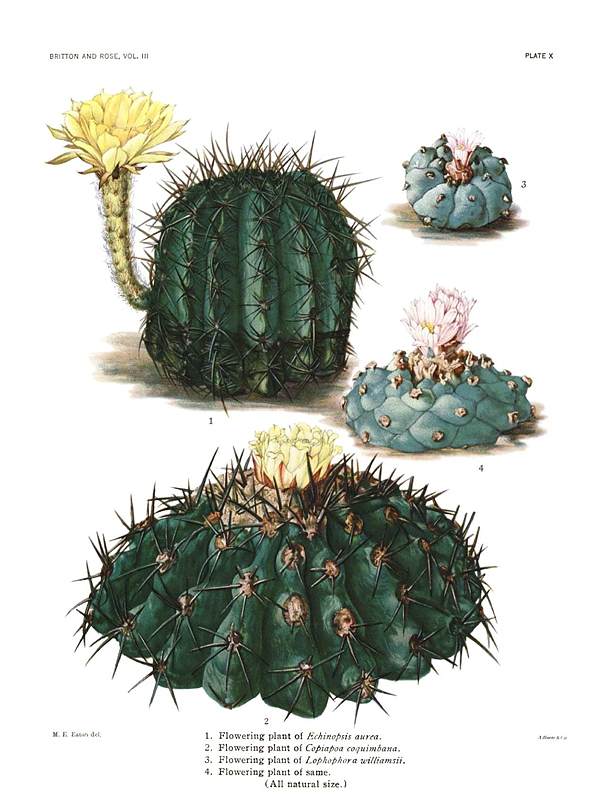
The two plates depicting Lophophora are included below.

Britton and Rose, The Cactaceae, Volume III, Plate X
The Cactaceae, Volume III, Plate X

Britton and Rose, The Cactaceae, Volume III, Plate IX
The Cactaceae, Volume III, Plate IX

References
A. Berger (1924), “Book Reviews: The Cactaceae. Descriptions and Illustrations of Plants of the Cactus Family”, Botanical Gazette, Vol. 77, No. 4, pp. 454-458.

Update
As of March 2, 2007 all four volumes of The Cactaceae are available from Au Cactus Francophone.

Tuesday, October 31, 2006

lophophora.info by Gerhard Köhres

I've posted on Gerhard Köhres's Lophophora information site before, but thought it worth mentioning again.

The site is packed with photos of Lophophora plants growing in habitat (see the samples included below) and constitutes the most comprehensive pictorial documentation of the genus that I'm aware of. The pictures are ordered by state and location and can be found at http://lophophora.info/.

Lophophora williamsii (Hipolito, Coahuila)

Lophophora williamsii (Hipolito, Coahuila)

Lophophora diffusa (Higuerillas, Queretaro)

Lophophora diffusa (Higuerillas, Queretaro)

Lophophora diffusa var. koehresii (San Francisco, San Luis Potosi)

Lophophora diffusa var. koehresii (San Francisco, San Luis Potosi)

Lophophora fricii (El Amparo, Coahuila)

Lophophora fricii (El Amparo, Coahuila)

Monday, October 23, 2006

The quest for Texan Lophophora williamsii

For a while I’ve been searching for L. williamsii seeds and plants originating from Trans-Pecos, Texas. It’s been quite hard to find any – probably because of the legal status of Lophophora williamsii in the USA. Earlier this year I finally found a retailer selling plants originating from material collected in the Pecos River area, Val Verde County, Texas (JJH 8608293), and promptly ordered a handful of plants.

Lophophora williamsii, Pecos River, Val Verde Co.

The plants have been grown very hard and are of a high quality with good, sturdy roots; the width of the plants are in the range from 1.5 to 2.25 cm (0.6-0.9''). They were reasonably priced at 4 euro (~ 5 USD) each.

I recently received a second batch that I planned to grow in an unheated cold house, but I now have second thoughts and will probably postpone the cold house experiment until I’m able to propagate the plants from seed.

The plants were bought at Kakteen Kliem, a German retailer with a good selection of plants with locality information (I also bought some of his Lophophora fricii, Parras, Coahuila, Mexico (JJH 9602115) and Astrophytum asterias, Rio Grande City, Texas (PQ 91)). I would be glad to hear of any other sources of Trans-Pecos Lophophora with detailed locality information.

Saturday, September 30, 2006

Lophophora williamsii – autumn flowers

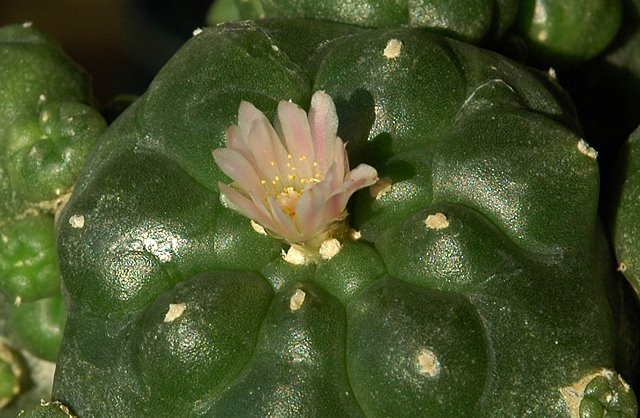
Having passed the autumnal equinox I hadn’t expected any more flowers from my lophs – nevertheless two of them decided to bloom this week, one for the first time.

Lophophora williamsii (SB 854; Starr Co, Tx) flower

My grafted Lophophora williamsii (SB 854; Starr Co, Tx) has been flowering abundantly all summer. Several fruits have already ripened and more are budding; still the plant took the opportunity to squeeze in yet another flower before going dormant. The flowers of this plant are quite large, approximately 2.75cm (~1.1'') in diameter.

Lophophora williamsii var. caespitosa flower

The Lophophora williamsii var. caespitosa graft has been growing profusely but never felt like flowering before now. The flowers are small, less than 2cm (~0.8'') in diameter, compared to those of L. williamsii (SB 854; Starr Co, Tx), and the midstripes are a slightly darker shade of pink.

Lophophora williamsii var. caespitosa

The scion used for this graft was taken from the plant shown in the blog profile. Unfortunately this plant later caught rot and died.

Sunday, September 17, 2006

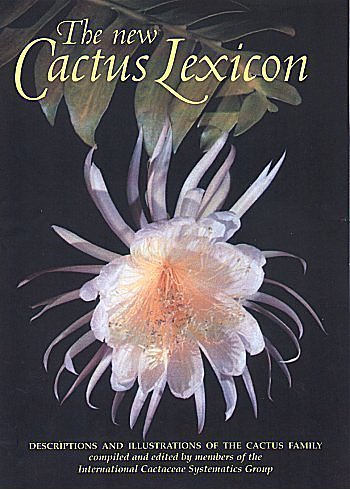
The New Cactus Lexicon: A Review

The New Cactus LexiconThe New Cactus Lexicon
David Hunt, Nigel Taylor, Graham Charles
dh books, 2006
ISBN 0 9538134 4 4


After a lengthy gestation period, the New Cactus Lexicon was published this summer. For ease of handling it’s divided into two volumes – the text volume is a concise alphabetical catalogue of cactus genera, species and subspecies accepted or proposed in the current standard literature on cacti, while the atlas volume contains more than 2500 illustrations covering nearly all of the species and subspecies recognized in the text, sometimes with two or more images.

Atlas volume
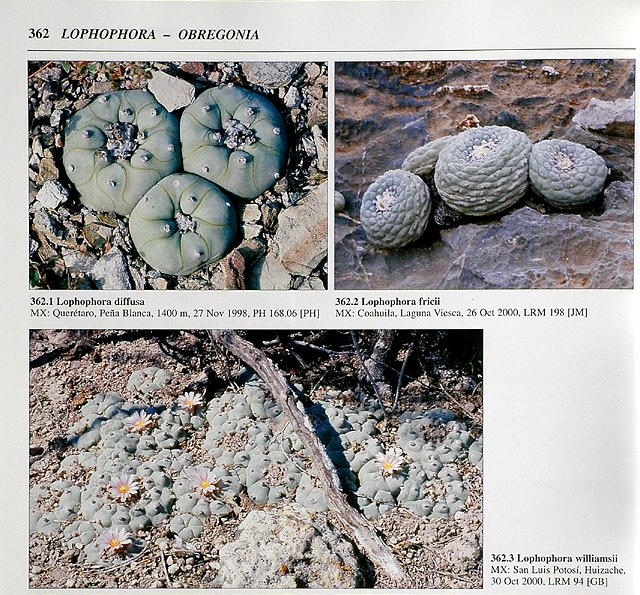
With its 526 pages of illustrations this volume is a stunning visual masterpiece, and the most comprehensive pictorial record of cacti ever published (the slightly blurred quality of the examples is entirely due to my reproduction).

Illustrations of Lophophora speciesThe aim of the atlas volume is to illustrate all of the recognized species, with an emphasis on using photographs of plants in habitat at a specified locality or in cultivation from a known source, whenever possible.

The entries in the atlas are not grouped alphabetically but rather ‘like with like’, making it easier for the user to compare related species or identify unnamed plants.

Text volume
The text volume comprises 373 pages and is a no-frills dictionary of the currently recognized genera, species and subspecies of cacti. It does not include any chapters of general information about the family, its history, morphology, ethnobotany, cultivation and so on – so don’t expect an encyclopedic work like Anderson’s The Cactus Family or Benson’s Cacti of the United States and Canada.

David Hunt is a known lumper and some of the main genera changes (Parodia now includes the former Notocactus, Echinopsis including Lobivia and Trichocereus etc.) have already been the cause of much debate (maybe that’s the reason for Hunt quoting Bill Bryson for having said “Taxonomy is sometimes described as a science and sometimes as an art, but really it’s a battleground” ;-).

Illustrations of Acharagma speciesStill, there has been room for some splitting , e.g. the division of Opuntia has added 12 genera, Lophophora fricii is now recognized as a valid species, Acharagma is not submerged in Escobaria, etc.

Whether you agree with Hunt’s classification or not, the New Cactus Lexicon is an excellent reference and certainly will become the reference book for years to come. As already mentioned the atlas volume is in a league of its own with excellent illustrations of the majority of the recognized cacti species and subspecies.

You can find more information on the New Cactus Lexicon in this post.

The book can be acquired directly from dh books or from specialized bookstores like Rainbow Gardens Bookshop or Keith’s Plant Books.

Thursday, August 24, 2006

Flowering Lophophora williamsii – III

My Lophophora williamsii (SB 854; Starr Co, Tx) graft has gone on a flowering spree and is currently flashing its 7th and 8th flower this season.

Flowering Lophophora williamsii

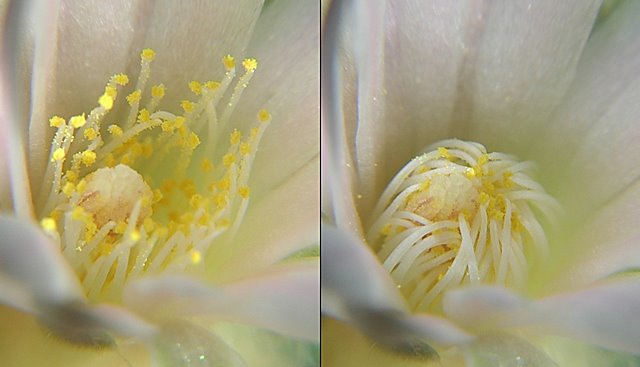
Like other species of Lophophora, L. williamsii has sensitive stamens, closing around the style when touched.

L. williamsii stamens closing around the style

In this flower the anthers are actually brushing the stigmas when the stamens react to a touch, i.e. the thigmotropic reaction will assist the flower to self-pollinate. I have to test if this is sufficient to pollinate the flower (in a previous post I also wondered if it was necessary to manually self-pollinate the Lophophora williamsii (SB 854; Starr Co, Tx) flowers or if they could cope without any help ;-)

For comparison you can check a photo of thigmotropic behavior in Lophopohora jourdaniana. In this case the stamens fold in below the stigmas, apparently not touching them.

The fruits (or berries, pods, whatever;-) from the plants first two flowers this season have just appeared.

Lophophora williamsii fruits

I’m looking forward to see how many of the flowers will actually result in a fruit.

< previous |

All Time Most Popular Posts