Sunday, March 21, 2010

Acharagma roseana – flowers and fruits

To be honest, Acharagma roseana plants are not particularly ingratiating – the flowers are not breathtaking nor is the spination stunning. To me, the attraction of A. roseana lies in its close relationship with Lophophora and Obregonia, making it an obvious candidate for hybridization experiments.

Acharagma roseana flower with pale yellowish tepals with brownish pink midveins

Gene sequence studies by Butterworth et al. (2002) suggest that Acharagma belongs in a well-supported taxonomic clade with Lophophora and Obregonia. They sum up their results as follows:

LOPHOPHORA CLADE. Although there is strong support for this clade (87% bootstrap, 5 decay steps), few morphological features unite this clade. All members have napiform or carrotlike tap-root systems, although these features are also found in other members of the tribe.

The two species of Acharagma have been a source of taxonomic confusion. […] The rpl16 intron data suggest the removal of these two species from Escobaria, placing them in a well-supported (bootstrap 87%, decay 5) clade containing Obregonia and Lophophora, the latter shown to be polyphyletic based on this topology.

(the closing remark on Lophophora being polyphyletic is an interesting statement in its own right, but that’s a whole other story)

Acharagma roseana flower with pink tepals with darker red-tinged midstripe

In The New Cactus Lexicon, Hunt describes this species as Acharagma roseanum - I’m not sufficiently well-versed in the Latin language to say which form of the name is correct, but according to this site on botanical Latin the specific epithet must match the genus name in gender. As Acharagma is from the Greek a, without, charagma, groove (the gender of which, according to Hunt, is neuter) this would warrant the “-um” ending. I’m a firm believer in applied laziness so I’ll stick to the (apparently erroneous) “-a” ending for a wee bit longer and avoid having to re-label my plants ;-) Hunt accepts two subspecies: ssp. roseanum and ssp. galeanense, the latter having more spines and slightly larger, cylindrical bodies, compared to the egg-shaped body of the typical form.

Comparison of the two different color forms of Acharagma roseana flowers

The Acharagma roseana plants featured in this post were started from seed in 2005 and flowered freely last summer. As mentioned I would like to use these plants for hybridization experiments with Lophophora but I still need to come up with a good protocol for avoiding self-pollination. The locality information for these specific plants is: LX 578; Ramon Arizpe, Coahuila - “Ramon” should probably read “Ramos” but I'll stick to the information from the vendor’s seed list.

Acharagma roseana with fruits

Like most other parts of Acharagma roseana the fruits are not showy either. They are an inconspicuous yellowish green color, but have a surprising, not unpleasant, tart taste reminiscent of gooseberries.

The plants grow in my unheated greenhouse and I hope they survive the month long cold snap that is just now loosening its grip of Denmark.

Monday, March 15, 2010

Echinocereus engelmannii v. armatus - flower and fruit

My Echinocereus engelmannii v. armatus (Joshua Tree National Park, California) flowered for the first time in the late spring of ‘09.

Echinocereus engelmannii v. armatus flower, close-up

The flower was beautiful with bright yellow anthers, a mesmerizing green stigma, and petals ranging from intensive pink to almost crimson at the center of the flower.

Flowering Echinocereus engelmannii v. armatus

The plant easily lives up to its varietal name - even the flower stalk is heavily armed with spines, protecting the ovary and the coming fruit.

Echinocereus engelmannii v. armatus flower armed with spines

I hand-pollinated the flower and two months later the plant bore fruit. This is the only mature Echinocereus engelmannii v. armatus in my collection and no other Echinocereus plants flowered at the time so my E. engelmannii v. armatus seems to be self-fertile. Time will tell if the seeds are viable.

Echinocereus engelmannii v. armatus with fruit

Echinocereus engelmannii v. armatus with fruit, top view

Sunday, February 28, 2010

Huichols harassed by police during peyote pilgrimage, Wirikuta

February 22, 2010 a large group of Huichols, or Wixárika as they call themselves, were harassed by police while they were gathered at the sacred place they call Wirikuta, conducting an ancient ritual that, to them, ensures the well being of not only their own community but of the entire universe.

According to a bulletin released by the Asociación Jaliscense en Apoyo de Grupos Indígenas (AJAGI), the police treated the Wixárika gathering with disrespect - they broke up the ceremony with rifles, handled sacred objects and offerings, crossed a ceremonial line that shouldn’t be crossed, accused a mara'kame (shaman) for cocaine use, and showed various other types of abusive behavior.

The police counted the number of peyote buttons collected by the pilgrims and accused them for being in violation of the law. In 2004 a maximum “personal” quota of 100 peyote buttons was introduced, but the Wixárika pilgrims are collecting peyote for the entire community, not just individual use. The police also threatened that the Federal Agency for the Protection of the Environment would sanction and detain the pilgrims, arguing that the peyote had been cut with the root. Harvesting the root might not be the best of harvesting techniques but it has been the practice of the Wixárika for several thousand years.
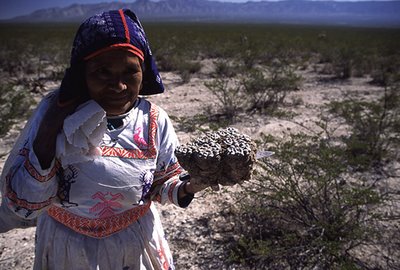
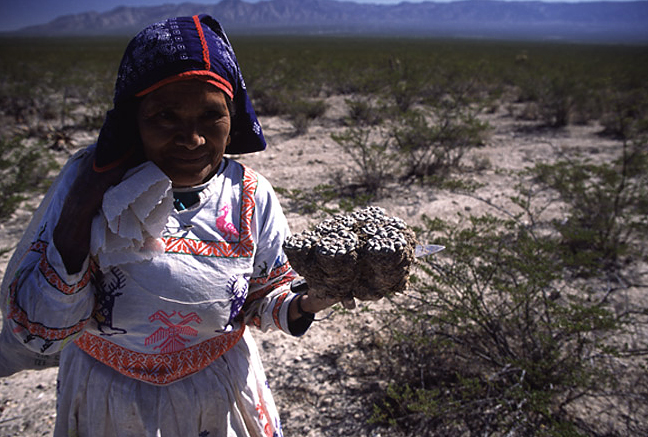
Huichol woman holding large peyote, Wirikuta

The AJAGI bulletin more than indicates that the real conflict is not as much based on plant conservation issues as on the clash between the traditions and ceremonies of a millennia-old culture and the tireless insisting on “development” by modern society. Today the Huichols’ sacred pilgrimage route is threatened by mines, agro-industry, and manufacturing facilities along with the highways, roads, and electric infrastructure needed to supply these industries.

The Huichols are known to fight for their right to the peyote pilgrimage route. In February 2008 a group of 800 Huichols set up an encampment at a highway construction site and remained there for six months. Since then they have filed suit against the government, saying the highway project violates environmental laws as well as their spiritual rights and right to the land.

One can only hope that this intricate situation is going to be solved with respect for all involved parties.

References
AJAGI bulletin, February 25, 2010
Police harass Huicholes during pilgrimage, The Esperanza Project
The image above is courtesy of Nicola “Okin” Frioli

For reference, please find the full content of the AJAGI bulletin included below.


February 25, 2010

To National and International Civil Society
To the Press
To the National Indigenous Congress

At five pm on February 22, 2010, while a sizable Wixárika contingent from Tuapurie - Santa Catarina Cuexcomatitlán, was in a location named Tanque Valentín, in the ejido (rural land concession) of Las Margaritas, municipality of Catorce in the state of San Luis Potosí, carrying out ceremonies that are part of their millenarian tradition in the sacred region of Wirikuta, four squad cars of state police arrived with an arrogant attitude and began to insult and treat the wixaritari as delinquents, interrupting their ceremony. The sacred circle was broken and Our Grandfather Fire was disrespected by breaking up the large Wixárika gathering with rifles.

The harassment continued until 8 pm and took place in a location where the three ceremonial centers of the community of Tuapurie, Las Latas, Pochotita and Tuapurie had gathered in a rare fashion (the latter had left for another sacred point in the desert of Wirikuta just a few hours prior). Each ceremonial center had brought a bus full of Wixárika pilgrims bringing together a large concentration of jicareros (votive bowl carriers).

The police manhandled the sacred offerings, the deer antlers, and crossed the ceremonial line that they should not have. They accused one mara'kame (shaman) of ingesting cocaine.

They proceeded to count the number of peyote buttons that the pilgrims had gathered, citing an accord signed by governmental agencies that regulates the pilgrimage to Wirikuta, in violation of the communities' traditions and forms of ceremonial operation, in that the pilgrims are representatives of the entire community and not just of one person or family.

At that moment, the police threatened to return and did so on Tuesday the 23rd at 2 am, arriving with video and photo cameras once again interrupting the ceremony, the chant of the mara'akame and the words of the sacred Ancestors.

On Tuesday, while the emissaries of the ceremonial centers left to place offerings at the sacred site of Leunar (in the Cerro Quemado), the police returned at 9 am and threatened that the PROFEPA (Federal Agency for the Protection of the Environment) would sanction and detain the pilgrims, arguing that the peyote had been cut with the root; a practice that has occurred for the past 3 thousand years.

This aggression in itself is an attack against the Wixárika people, and particularly for those from Tuapurie since the assault was against all three ceremonial centers of this community, that are in charge of the wellbeing not just of their territory but of the entire universe.

The harassment occurred just a few hours after personnel from the Commission for the Development of Indigenous People (CDI for its Spanish acronym) of the state of San Luis Potosí left the site of the ceremony.

It makes no sense that the PROFEPA, as a branch of the SEMARNAT (Secretary of the Environment and Natural Resources), harasses Tuapurie under environmental pretexts and norms which do not fall under the jurisdiction of the state police. This, while the extraction of peyote at the hands of drug traffickers is heightened and important regions of biodiversity are destroyed by multinational agro­industrial operations.

We cannot lose site of the fact that, since February of 2008, the community of Tuapurie has been resisting the imposition of the Bolaños­Huejuquilla paved road which has been stalled by strong mobilizations that have led the community to have diverse jurisdictional proceedings pertaining to environmental, penal and agrarian rights.

Among these is the injunction that stalled this mega project at a crucial moment after the Secretary of Urban Development (SEDEUR for its Spanish acronym) argued that it had 400 signatures from the community members in favor of the road construction. In the court injunction, the SEDEUR presented simple copies of said signatures on February 8, 2008 pointing out that the PROFEPA held the originals. The community proceeded to ask said agency to physically present the originals, the request was denied.

In reality these signatures did not exist since the assembly and supposed act of assembly were falsified. In the case that these signatures are presented, the signatures should be ruled false and if genuine it should be ruled that they were gathered by a government agency in an illegitimate manner. This situation unmasks the delinquent actions of both the federal and state level governments; furthermore this serious fraud was directly mediated by the CDI, the federal entity that proclaims to serve indigenous people.

The tension of the situation has only increased at the announcement by the state of Jalisco that the road would be completed before 2012 and by the decision by the general communal assembly of Tuapurie that the road will not be allowed to cross communal land, thus manifesting the same stance that they held when the tensions began in February 2008.

The Context of Wirikuta

Legal accords exist, based on biological, ecological, socio­economic and anthropological studies and the number of goats, cattle and horses owned by the regions ejidatarios (members of rural land concessions) counted in the sacred land of Wirikuta. These studies that have cost sizable amounts of public money, have led to the decree that rules the area an Ecological and Cultural Reserve which does not recognize the ancient relations between the desert and its inhabitants with the Wixárika people and their right to pilgrimage.

This is in direct violation of the International Labor Organization's Convention 169 on indigenous and tribal peoples regarding psychotropic plants for ceremonial use, a supreme law in our country under the 2nd Article of the Mexican Constitution, and under the 9th Article of the State Constitution of San Luis Potosí.

All the laws of management under the Ecological and Cultural Reserve are based on the imposition of laws that pretend to regulate the ancestral Wixárika pilgrimage, a process that has continued alongside the imposition of neo­liberal political economic ordinances.

In June of 2004, the municipal headquarters of Estación Catorce, San Luis Potosí in the presence of the CDI, the state of San Luis Potosí's Secretary of Ecological and Environmental Management, the State Agency for Attention to Indigenous Peoples, the Commission for Indigenous Matters of the state's congress, and the State Attorney for Indigenous Matters of Jalisco established a maximum quota for personal extraction of 100 peyote buttons. It was also ruled that "security, municipal and state authorities must be notified of annual definitive extraction" and that an annual calendar of visits be elaborated. It is worth mentioning that that same year the assembly of Tuapurie rejected the aforementioned accords.

This is all done under the auspices of preventing the excessive extraction of peyote and to "protect the species" leading to the situation in which Tuapurie finds itself today.

On the other hand, there exists an unprecedented pressure for the installation of large tomato farms belonging to the wealthy landowners of Cedral, San Luis Potosí (close to the state's governor) who bought 400 hectares of land from the Ejido Estación Catorce, parceled by the Program for the Certification of Ejido Rights (PROCEDE) to 15 ejidatarios for the installation of tomato agro­industry, Clearing a region that measures 5 kilometers by 3 kilometers and that is located in an area of high endemic biodiversity with large quantities of peyote.

This company dug deep wells, drying them by square kilometers, they have also detonated explosives into the air to disperse clouds in the region and prevent rain to protect the tomatoes, affecting thousands of peyote buttons.

Is this the environmental protection that the PROFEPA refers to? Is it the state police's duty to protect the National Commission for the Protection of Natural Areas (CONANP for its Spanish acronym)?

The State Plan for Urban Development of San Luis Potosi (2000-2020) intends to build highways, roads, and electric infrastructure to supply manufacturing facilities, mines and agro­industry in every municipality located along the sacred pilgrimage route.
The situation is delicate and the Wixárika people need for the general civil society and human rights organizations to be vigilant of the developments relevant to this traditional pilgrimage, as well as to the harassment that has systematically occurred against Tuapurie since February of 2008.

CONSTITUCIÓN NO. 102, COL. CENTRO * TONALÁ, JALISCO * MÉXICO
TEL.: 0133 38 25 68 86 Y 0133 38 26 61 03

Sunday, February 21, 2010

Flowering Mammillaria meiacantha

I've had a few Mammillaria meiacantha plants (SB 249; Bernalillo County, New Mexico) growing in my cold house for the last couple of years. The plants thrive and last spring they embarked on a flowering spree.

Mammillaria meiacantha flower

One of the traits Steve Brack mentions for these plants in his seed catalogue are their huge red fruits, so I hope I succeeded in pollinating the flowers and will see some fruits soon.

Flowering Mammillaria meiacantha

I bought these plants for my unheated greenhouse because of their extreme cold tolerance. Steve Brack classifies Mammillaria meiacantha as being safe easily to -10F (-23C). So these plants, if any, ought to be able to survive the cold snap that has engulfed Denmark in snow and almost constant (severe) frost for more than two months now.

Mammillaria meiacantha is also known as Mammillaria heyderi v. meiacantha.

Saturday, February 20, 2010

Prickly Pear Cactus Candy

I have to get me a pound of prickly pear cactus candy the next time I’m in the US – if the candy is just half as great as the retro cardboard box, I’ll be in for a treat ;-)

Prickly Pear Cactus Candy

I haven’t been able to find an ingredients list, but one source says the cactus candy is made from the juice of the prickly pear and is an unusual but pleasant taste.

If you are the DIY kind of guy or gal the Opuntia Blog has a recipe for transforming Opuntia cladodes into candy – I would image that a candy based on the prickly pear fruit juice would be more delicious, though, but I have tasted neither.

Monday, February 15, 2010

Flowering Mammillaria grahamii

In the late spring of '09 I bought a handful of Mammillaria grahamii (SB 507; Dona Ana County, New Mexico) from Kakteen-Haage. A few months after receiving the plants they flowered vigorously.

Mammillaria grahamii flower

The all-pink petals and filaments are beautifully contrasted by the bright yellow anthers and the dusty chartreuse stigma. I cross-pollinated several of the flowers and hope for seeds next year.

Flowering Mammillaria grahamii

I bought the plants for my cold house as Mammillaria grahamii is said to be relatively cold hardy. If they survive the current cold snap I guess they can survive anything (in relation to Danish winters, that is ;-) The current freezing conditions have lasted since before Christmas with outdoor temperatures as low as -15 C (5 F) so I hope the plants are not frozen solid.

Hooked Mammillaria grahamii spine

Seeing the Mammillaria grahamii spines up close it is easy to understand why it is also called fish-hook cactus ;-)

Tuesday, February 09, 2010

Gymnocalycium calochlorum with fruit

I have only one Gymnocalycium calochlorum (Mina Clavero, Córdoba, Argentina) plant in my collection and it flowers freely every summer (I’m not sure if this should be put in the past tense as I’m uncertain if the plant survives this winter’s hard frost; the photos in this post are all from the summer of ‘09).

Gymnocalycium calochlorum with ripe, split fruit

The last time the G. calochlorum plant flowered I self-pollinated it and as the pictures show my efforts (as well as the plant ;-) bore fruit. My experience with Gymnocalycium is very limited and I don’t know if these plants in general are self-fertile – anyway, this one bore fruit and the coming spring will show if the seeds are actually any good.

Gymnocalycium calochlorum with ripe fruit and newly pollinated flower
G. calochlorum with ripe fruit and newly pollinated flower

I’m pretty certain that the seeds are the result of selfing – of course I can’t say for absolutely sure but I hand pollinated the flowers and none of the (very few) other gymnos in my collection were flowering at the time. Theoretically the seeds could be the result of some freak hybridization but that doesn’t seem very plausible, as most of the other cacti in my collection are of North American origin and not closely related to Gymnocalycium at all.

Gymnocalycium calochlorum fruit with exposed seeds

I pollinated two flowers that both set fruit. The last fruit is still growing on the plant.

Saturday, February 06, 2010

The stone flowers of the Taj Mahal

I spent two weeks working in Delhi, India during January. I had one weekend off and had planned to spend it in Delhi at my own leisure, but when the guys I worked with offered to take me to Agra and show me the Taj Mahal I off course promptly accepted.

The Taj Mahal
The Taj Mahal

The Taj Mahal is one of the most famous buildings in the world. The magnificent white marble mausoleum is the tomb of Mughal empress Mumtaz Mahal, the favorite wife of Mughal emperor Shah Jahan. Mumtaz Mahal died in 1631 while giving birth to their 14th child and Shah Jahan commissioned the Taj Mahal as a monument and tomb for his beloved wife (and later of Jahan himself). So it’s understandable that the Taj is told in most tourist guides as a true monument to love, or “a teardrop on the face of time” as the British historian Michael Wood poetically phrases it.

South facade of the Taj Mahal

The Taj Mahal rises up on a marble platform that makes it seem to almost float in mid-air when observed from the entrance gateway of the complex. The precise proportions and strict symmetry of the structure are incredible to watch and permeate everything from the minarets and facades on the large scale to the floral motifs inlaid with stone on the small scale.

Floral motifs inlaid with stone above the south portal

The four facades of the tomb are identical and each has a grand portal, known as an iwan or pishtaq. Each portal is bordered by a rectangular frame decorated with inscriptions of verses from the Qur’an inlaid with black marble. The triangular spaces on either side of the point of the arch are decorated with carved arabesque and floral designs inlaid with semiprecious stones.

Decorated marble plinths inside the south portal

In Islamic culture flowers are often seen as symbols of Paradise; the kingdom of God. And stone flowers are everywhere at the Taj Mahal - flowers depicted with realism, yet with a soft lyricism that almost makes you forget they are carved in marble or inlaid with stone. And again the perfect symmetry is everywhere.

One can only admire the artisans who crafted these exquisite marble carvings; marble is a very hard stone to cut and they worked with large slabs of marble – in the above photo there goes 3 “plants” to one slab of marble. In case the craftsmen made just the smallest mistake they would have to ditch the whole slab and start from scratch.

Flower cut in marble, south portal

Floral designs inlaid with stone, south portal

As you enter the burial chamber of Mumtaz Mahal the floral motifs become even more pronounced and eminently detailed. Flowers – both cut and inlaid with stone – are absolutely everywhere. Photography is not allowed within the tomb, but I managed to “sneak in” a couple of (no flash) pictures while the guards were otherwise occupied (I hope taking pictures inside the tomb is not considered rude or bad taste – to my defense I’ll say that the Indian visitors also let loose and took lots of pictures while the guards were gone ;-)

Detailed floral pattern inlaid with stone, burial chamber

It has been said that the only discordant note in the Taj is, ironically enough, the tomb of Shah Jahan placed next to that of Mumtaz. The building was designed so that Mumtaz’s tomb would be its single centerpiece directly below the central dome in the octagonal burial chamber – Shah Jahan’s tomb breaks the symmetry that otherwise permeates the whole construction.

Inscriptions from the Qur’an inlaid with black marble

The main tomb building of the Taj Mahal

Four minarets sit at the corners of the square, raised marble platform that houses the main tomb building. Each slender, round tower is made of white marble, outlined in inlaid black stone, and includes a winding internal staircase leading up to its gallery (which is no longer used to call the faithful to prayer, though)

Minaret at the Taj Mahal

If you have the chance, seeing the Taj Mahal is a must – its ethereal, sad beauty will silence even the most cynical of world travelers.

As a foreigner visiting the Taj Mahal be prepared for a massive difference in entrance fees, though – I paid 750 INR while my Indian friend had to pay only 20 INR. I understand why this is done but I don’t like the signal it’s sending. Maybe I’m just grumpy but after many visits to India I’m growing weary of the ubiquitous (and often professional) beggars and hustlers that seem to think that westerners are walking ATMs that will dispense cash on demand, and it makes me sad to see that even the official India, in this case represented by the Archaeological Survey of India, condones this view.

Tickets to the Taj Mahal

I just watched Michael Wood’s The Story of India and new discoveries apparently suggest that the design of the Taj Mahal might go back to Sufi saints – that the key to the Taj may be a mystic map of a Sufi’s dream, a map where different parts of the Taj Mahal complex represents different elements of the judgment day.

Monkeys at Agra Fort

It has absolutely nothing to do with the Taj Mahal, but I couldn’t resist posting this photo of a couple of monkeys living at the nearby Agra Fort. The monkeys seem to be seriously contemplating if they really need to adhere to the directives on the sign – or if they instead should be frolicking on the lawn, tearing off leaves and eating flowers.

Tuesday, January 05, 2010

Cactus art: Double Cactus / Doppelkaktus

I recently got in contact with the German artist Klaus Weber who works with cacti (among other things) in an artistic context.

Double Cactus by Klaus Weber

Klaus would like to exhibit a Double Cactus in New York, i.e. a piece consisting of two San Pedro (Trichocereus pachanoi) plants grafted together to form one, mirrored plant similar to the ones pictured in this post. Unfortunately Klaus has encountered problems with bringing the plant(s) into the US from Germany and consequently he is looking for a US resident who can help him recreate the grafted cactus piece “in situ”. If you (or anybody you know) are a skilled grafter with the inclination to collaborate with Klaus on creating a Double Cactus in the states, please get in touch with me.

Another Double Cactus

I'm especially infatuated with the last picture – the cacti that sort of grow into each other, reflected in the mirror they sit on, go perfectly with the pillar that transcends smoothly from the “actual” world into the reality behind the looking glass.

The pictures are used with the kind permission of Klaus Weber.

Saturday, January 02, 2010

The Lophophora blog turns 5

Five years ago today, this blog started out with a humble test post.


The blog was started in frustration over the limited amount of meaningful information about Lophophora online. It was originally conceived as a Lophophora/peyote only blog, but early on (beginning with the first post, one could argue ;-) the blog segued into a more general cactus blog, covering especially smaller Mexican species. Lately a few pieces of non-cactus related flotsam and jetsam have also drifted onto the blog, but the main focus will not swerve from cacti in general and the Lophophora genus specifically.

I hope the blog has met its objectives and provided the reader with (at least a few bits of ;-) relevant information on the Lophophora genus.

Seeing the initial test post again reminds me that I have loads of pictures from my visit to the Joshua Tree National Park that I would like to share – maybe in a future post ;-)

All Time Most Popular Posts