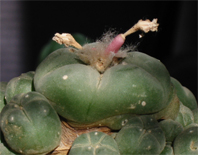
Monday, August 15, 2005

Munching on Lophophora williamsii

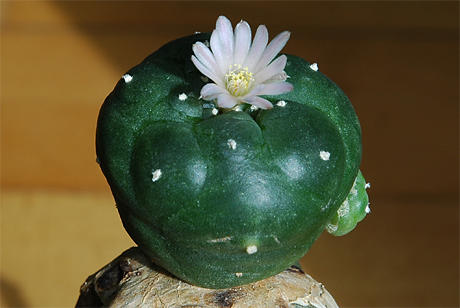
Until lately my coldhouse grown Lophophora williamsii (SB 854; Starr Co, Tx; sowed May 1, 2004) were dazzling in their immaculate appearance – until some critter decided to munch on them.
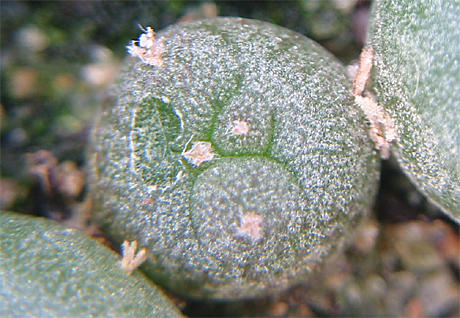
Munched on Lophophora

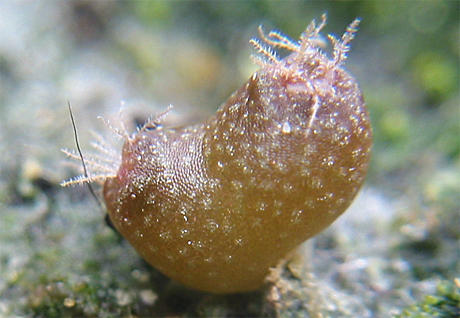
The main shoot of my Cylindropuntia tunicata was maimed too. A search of the cacti revealed a great green bush-cricket (Tettigonia viridissima) hiding among the plants. I took the mug shot below before releasing the suspected culprit outdoors.
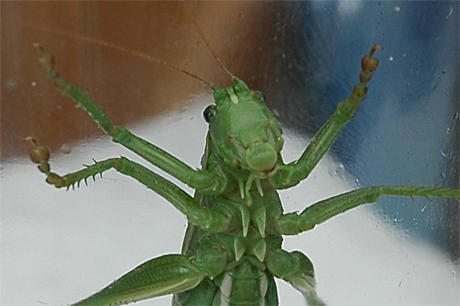
Captured great green bush-cricket

The harm is not too great and I expect the plants to fully recuperate from the damage.

Monday, August 08, 2005

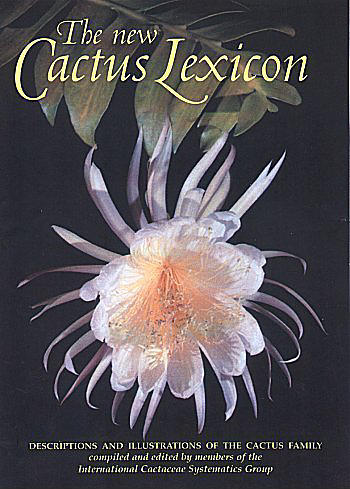
The New Cactus Lexicon

I finally got around and ordered my ‘early subscriber’ copy of the The New Cactus Lexicon. The lexicon is prepared on behalf of the International Cactaceae Systematics Group (ICSG) by David Hunt et al. and will publish by March 2006 at the latest. The invitation to subscribe early expires at August 31, 2005. A full prospectus and order form is available online.

The New Cactus Lexicon“Planned as a successor to Backeberg's Cactus Lexicon, The New Cactus Lexicon will be the most scientifically authoritative conspectus of the Cactaceae published for nearly a century. It will be comprehensively illustrated in colour and is confidently expected to become the benchmark reference for all those with amateur or professional interests in the diversity, identification and conservation of cacti.”

I trust the lexicon will have in-depth coverage of Acharagma, Lophophora, Obregonia, Strombocactus etc. ;-)

Update - July 31, 2006
The lexicon arrived a couple of days ago – I’ll get back with more information when I’ve had a chance to study the books.

Update - September 17, 2006
The New Cactus Lexicon: A Review

Monday, July 25, 2005

The power of grafting - II

In less than one and a half years my grafted Lophophora williamsii (SB 854; Starr Co, Tx) has grown from a minute seedling to a mature plant, flowering for the first time. The Lophophora scion is 4.85 cm (~1.9’’) wide and has grown 3 offshoots; the flower is a typical pinkish white with a somewhat darker midstripe, and is 1.8 cm (~0.7’’) wide. None of my other plants are currently blooming so I attempted to self-pollinate the flower.

Flowering Lophophora williamsii graft

The Echinopsis (Trichocereus) pachanoi stock is striving to get a life of its own – since the previous post I’ve removed two offshoots. Even though it slows the growth of the Lophophora scion down a bit, I let the shoots grow for as long as they don’t intimidate the scion. The removed shoots are rooted and will be used for future grafts.

< previous | next >

Sunday, July 24, 2005

Sowing in the rough - III

I’m not sure if it’s the seed, the coldhouse environment or sheer coincidence, but in addition to the deviating growth forms described in an earlier post one of the Lophophora williamsii (SB 854; Starr Co, Texas) seedlings turned out achlorophyllous.

Achlorophyllous Lophophora williamsii

The seedling lacks chlorophyll and will not survive on its own roots for long so I grafted it on Pereskiopsis spathulata – hopefully it will survive and prosper.

< previous |

Monday, July 18, 2005

Seedling grafting on Pereskiopsis - II

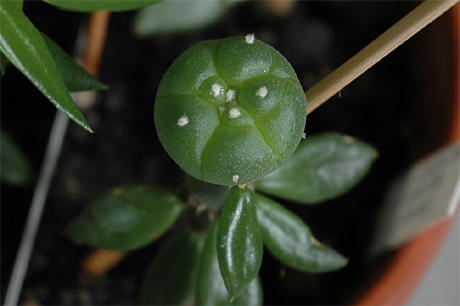
Well, my first experience with grafting on Pereskiopsis spathulata was a limited success – limited by a combination of stupidity and clumsiness. I ignored the advice of experts and watered the Pereskiopsis plants heavily before grafting. As a result the small seedling scions were soon sailing away on a sea of cactus sap. When trying to correct this I managed to knock off half of the scions. Despite this treatment two of the grafts took (one each of L. williamsii, RS 428A, Cuatro Ciénegas, Coahuila and L. diffusa RS 1193, Peña Miller, Queretaro). Especially the Lophophora williamsii graft is doing great – in 11 weeks it’s grown to a width of 1.9 cm (0.75’’).

Lophophora williamsii seedling grafted on Pereskiopsis spathulata

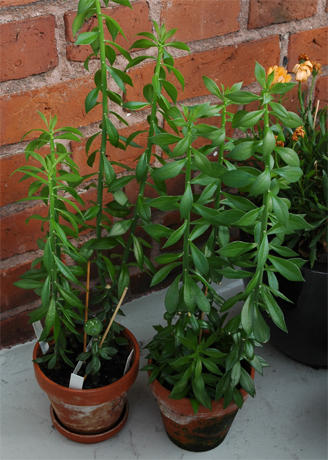
The Pereskiopsis spathulata plants are easy to grow. I planted the ‘waste products’ from the graft, and along with the plants where the graft didn’t take, they now make up a shrubbery that would make even the Knights who say ‘Ni’ happy.

Pereskiopsis spathulata 'shrubbery'
Pereskiopsis spathulata ‘shrubbery’

The hardest part of growing Pereskiopsis is to remember to give them a generous treatment with plenty of water ;-)

< previous |

Monday, July 11, 2005

Sowing in the rough - II

Some of the Lophophora williamsii (RS 268; Huizache, San Luis Potosí) seedlings are developing interesting growth forms. One is clearly dichotomous (a simple type of branching in plants where the apical meristem splits at various intervals) and another shows signs of an extension of the apical meristem into a ridge - I'll watch it closely to see if it develops a crest.

Dichotomous Lophophora williamsii seedling

Dichotomous Lophophora williamsii seedling

Lophophora williamsii seedling with a crest meristem?<br />

Lophophora williamsii seedling with a crest meristem?

< previous | next >

Winter-hardy Opuntias

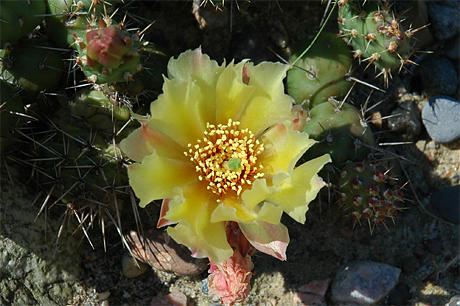
This post is slightly off topic, but many of the Opuntias in my winter-hardy cacti bed are flowering right now and I would like to share a couple of photos of the beautiful flowers.

Opuntia polyacantha
Opuntia polyacantha

Opuntia 'Claude Arno'

Opuntia 'Claude Arno'

Opuntia fragilis (Butte Co, Nebraska)

Opuntia fragilis (Butte Co, Nebraska)

The plants are growing in the northwestern parts of Denmark, only a couple of hundred meters (yards) from the North Sea. I bought the plants two years ago at Benny’s Cactus.

Tuesday, June 07, 2005

Exploding Lophophora Inevitable

The main head of my grafted Lophophora williamsii v. caespitosa is now 4.5 cm (~1.77’’) wide – the total width of the scion is 7.3 cm (~2.87’’). The plant was grafted one year ago as a 2 cm (~0.78’’) wide cutting taken from the plant shown in my profile photo. Unfortunately the mother plant caught rot in the wound and withered during winter. The scion is grafted on a Trichocereus bridgesii (Echinopsis lageniformis) stock.

Grafted Lophophora williamsii v. caespitosa

Maybe the Andy Warhol/Velvet Underground inspired title is a bit corny – but it seemed fitting for a plant exploding with growth ;-)

Follow this link to see the state of the Lophophora williamsii v. caespitosa graft one year later.

Friday, May 27, 2005

Flowering Nestor

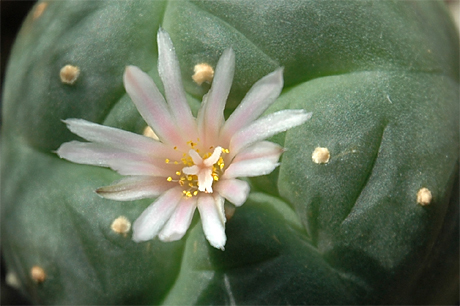
Today the oldest cactus in my collection (a Lophophora williamsii named Nestor;-) flowered for the first time this year. I bought it in 1992 as a small plant in a flower shop, i.e. I don’t know the exact age of the plant nor do I have any locality information (except that it probably originates from a commercial Dutch grower ;-).


Lophophora williamsii in flower


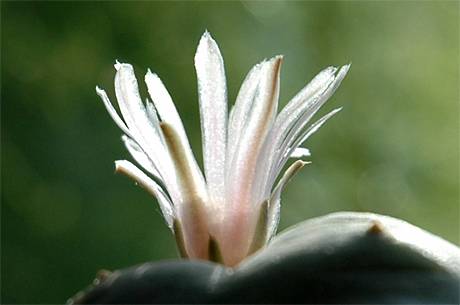
The flower backlit by the sun

The photo of the backlit flower doesn’t do full justice to the sight – the sunlit flower has an almost mother-of-pearl sheen to it.

Saturday, May 14, 2005

Sowing in the rough

If I don’t chicken out, the plants growing from the seeds sown today are going to spend the rest of their lives in an unheated greenhouse in Denmark. 30 seeds of each of the below species were sown.


  • Acharagma aguirreana (RSM 396; Sierra Paila, Coahuila)
  • Acharagma roseana (LX 578; Ramon Arizpe, Coahuila)
  • Lophophora williamsii v.decipiens
  • Lophophora williamsii (RS 268; Huizache, San Luis Potosí)

I also sowed some leftovers from last year. 10 seeds each of:

  • Lophophora diffusa (JR; Higuerillas, Queretaro)
  • Lophophora williamsii (SB 854; Starr Co, Texas)

A cold house batch of the two latter species was also sowed last spring. Most plants survived the winter and are now resuming growth.

| next >

All Time Most Popular Posts