I’ve been pretty busy lately and completely forgot to post on the 3rd anniversary (June 7) of my Lophophora williamsii v. caespitosa graft. The main head is 5.5 cm (~2.2'') wide and the total width of the scion has increased to approximately 13 cm (~5.1'').

Lophophora williamsii v. caespitosa graft
The Lophophora williamsii v. caespitosa scion is grafted on a Trichocereus bridgesii stock and was repotted early this spring (hence the supporting props).

Lophophora williamsii v. caespitosa graft - top view
I’m fascinated by the explosive growth induced by the Trichocereus stock (for comparison you can check the posts on the same plant one and two years ago) but the appearance of the plant tends to become increasingly freakish.
The plant doesn’t bloom with the same vigor as it grows – until now it’s only flowered once.
Monday, June 25, 2007
Lophophora williamsii v. caespitosa graft
Monday, June 11, 2007
Flowering Lophophora jourdaniana, take two.
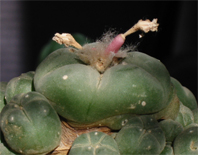
One of my Lophophora williamsii v. jourdaniana plants is flowering again – this time with the full cooperation of the sun, resulting in a much more well-developed flower compared to the previous one.
Flowering Lophophora jourdaniana
My two Lophophora williamsii v. jourdaniana plants are almost in full compliance with Habermann’s description (rose-violet perianth, pistil, and filaments; persistent spines on young areoles) but the open flower clearly contradicts Habermann’s claim of cleistogamic flowers (i.e. flowers that do not open and are self pollinated). Apparently Habermann misunderstood or used this term incorrectly as the photo accompanying the type description also shows a plant with an open flower ;-)
Lophophora jourdaniana – thigmotropic stamens
Like many other species of cacti (including the other Lophophora species/varieties) L. jourdaniana has thigmotropic stamens, i.e. stamens that when touched fold in around the style (as is evident for the front stamens in the rightmost picture).
The following stop motion video provides a better illustration of the thigmotropic mechanism - I'll try to make a higher quality movie the next time the plant flowers.
References
Vlastimil Habermann (1975), “Lophophora jourdaniana Habermann species nova”, Kaktusy 11 (1), 3
All Time Most Popular Posts
-
Lophophora williamsii (peyote) populations have diminished in large areas of South Texas where peyoteros harvest the cactus for ceremonial ...
-
Below is a list of retailers/nurseries selling cactus seed and plants. I've only listed vendors I've done business with. If you ar...
-
Most cacti are easily grown from seed - and with a little patience and care they can be grown into beautiful plants. Lophophora williamsi...
-
Yet another slightly off topic and probably not entirely politically correct post, but I couldn’t help noticing the similarity of my monstr...
-
There seems to be an increased focus on the alarming Texas peyote situation. A couple of weeks ago the Houston Press published a mournful, i...
-
On various occasions I've been asked what growing media I'm using for my cactus plants. I don't have a set soil mix recipe as su...
-
I spent two weeks working in Delhi, India during January. I had one weekend off and had planned to spend it in Delhi at my own leisure, but ...
-
In last month’s post on the troubled Texan peyoteros I referred to Anderson’s article on the peyote situation in Texas. Given the importanc...
-
As is evident from several posts on this blog I enjoy visiting botanical gardens whenever I have the chance. Spending part of my summer vac...
-
This post is very much off the usual topic – now you are warned ;-) Ramsons basking in the spring sun Spring has finally arrived in Den...