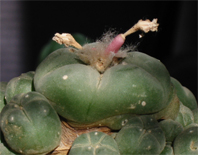
Since 2004 I’ve experimented with growing Lophophora, Epithelantha, and Acharagma in an unheated greenhouse in Denmark. The winter this year has been damp but not very cold - the coldest temperature registered in the coldhouse was -5C (23F) – so even the L. diffusa plants are doing great. 
Lophophora williamsii (SB 854; Starr Co, Texas)
The L. williamsii plants (sown May 2004) are thriving in the coldhouse. The epidermis is glaucous bluish-green, much truer to the type than plants grown in my windowsill. All my cold grown Lophs are wrapped in horticultural fleece during winter – not so much because of the temperature, but to avoid attacks from various critters. This kind of damage is not a problem with the spine covered species.
Lophophora diffusa (Higuerillas, Queretaro, Mexico)
In 2005 I sowed L. diffusa and L. decipiens to grow in the coldhouse. Especially the L. diffusa plants had a hard time last winter and only 2 survived. Both are now doing fine and are developing the typical yellowish-green epidermis. 
Lophophora decipiens
L. decipiens is not a “good” species; it’s probably just a cultivar form of Lophophora fricii (I couldn’t obtain any collection data for these seeds either when I bought them). Anyway, the plants are doing well and are getting ready to go 8-ribbed at an age of two.
I’m growing both “regular” Epithelantha micromeres and Epithelantha micromeris v. gregii. The gregii variety seems to be a faster grower than the regular micromeres; it also has a very beautiful coverage of spines, as illustrated below.
Epithelantha micromeris v. greggii (Cuesta la Muralla, Coahuila, Mexico)
Epithelantha micromeris v. greggii – closeup
All of the Epithelantha plants made it through this winter without damage.
Saturday, March 31, 2007
Lophophora and Epithelantha - experiments in cold hardiness II
Posted by
lophophora
at
10:08 PM
9
comments
Labels: Epithelantha, Experiments in cold hardiness, Lophophora decipiens, Lophophora diffusa, Lophophora williamsii
Monday, March 05, 2007
Seed starting Lophophora, Ariocarpus, and Epithelantha
The last couple of days I’ve been busy starting the next generation of plants from seed. One of the more interesting lophs this year is a variety of Lophophora williamsii originating from El Oso, Coahuila, Mexico. According to The genus Lophophora – Kaktusy Special 2, 2005 this variety forms massive clusters with individual heads measuring up to 15 cm (5.9'') in diameter! Unfortunately it seems the El Oso site is severely threatened by agricultural activities.
Lophophora williamsii - El Oso, Coahuila (picture taken from The genus Lophophora – Kaktusy Special 2, 2005)
I’ve sown the following Lophophora seeds this year:
- Lophophora diffusa v. koehresii (RS 1182; El Sabino, San Luis Potosí)
- Lophophora diffusa ssp. kubesai (JJH 0010892; Puente Mezquitio, Querétaro)
- Lophophora fricii (RS 404B; Viesca, Coahuila)
- Lophophora williamsii (MMR 89; El Oso, Coahuila)
- Lophophora williamsii (RS 428A; Cuatro Ciénegas, Coahuila)
I have great expectations for the Lophophora diffusa ssp. kubesai. According to the retailer’s seed catalog this variety is prone to offsetting (in contrast to the typical single stemmed L. diffusa specimens), eventually forming multi-headed clumps as pictured below.

Lophophora diffusa ssp. kubesai
In addition to the Lophophora seeds I also started a handful of Ariocarpus from seed:
- Ariocarpus fissuratus (JDL 26; Hot Springs, Big Bend, Texas)
- Ariocarpus fissuratus (VVZ 204; Terlingua, Texas)
- Ariocarpus fissuratus (VVZ 205; North of Alpine Texas)
- Ariocarpus kotschoubeyanus v. macdowellii (RS 134; Hipolito, Coahuila)
I’ve specifically selected extreme northerly types of A. fissuratus as most of the Ariocarpus seedlings will be moved to a coldhouse later in spring (along with half of the L. williamsii and L. fricii seedlings) to experiment with the cold hardiness of these species. The move is also a necessity because my windowsills are getting crammed ;-)
Finally, the following Epithelantha seeds (also for the coldhouse) were sown:
- Epithelantha micromeris (JM 101; Sitting Bull Canyon, New Mexico)
- Epithelantha micromeris v. gregii (MMR 179; El Oso, Coahuila)
The seeds were bought from Jan Martin Jecminek and Jaromír Dohnalík – details for both are listed in the seed and plant retailers section. All seeds are sown in a mix of limestone gravel, regular soil, and loamy sand (mixed in a 2:2:1 ratio). The pots are placed in closed bags where they will stay until the seedlings are well established - check out the post on growing cactus from seeds for more information on seed starting.
Posted by
lophophora
at
9:01 PM
1 comments
Labels: Ariocarpus, Epithelantha, Lophophora diffusa, Lophophora fricii, Lophophora koehresii, Lophophora williamsii, Seed starting